The Oita Insurance-Fraud Substitute-Body Murders
Two men were killed in a linked series of crimes in Kitakyushu and Oita in January 2002. Ozaki Masayoshi and Hara Masashi arranged a life-insurance fraud in which another man's body was made to look like Hara's. The investigation also connected the pair to an earlier robbery-murder and arson. Both received death sentences, upheld by the Supreme Court on 8 November 2010.
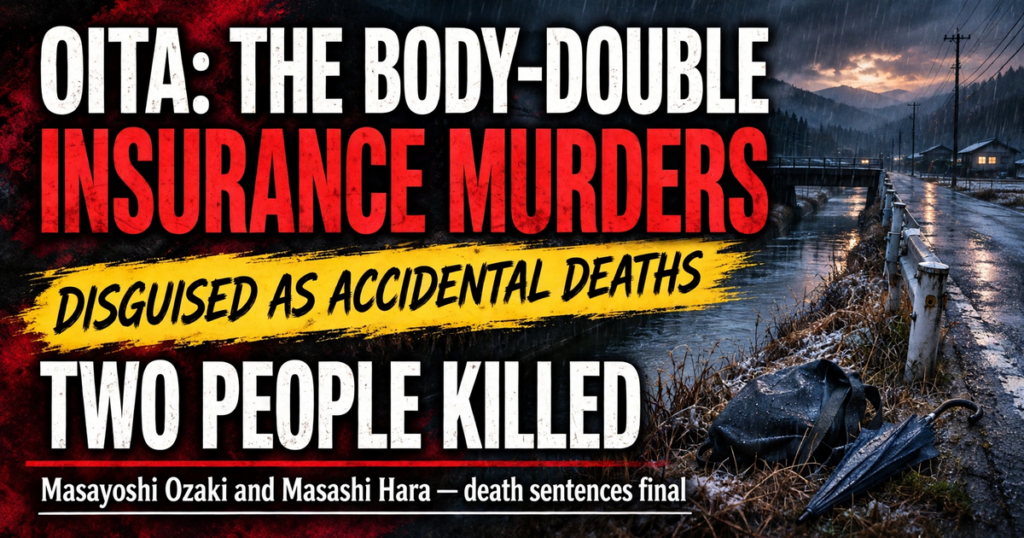
A substitute body was used to make Hara appear to have died
On the night of 31 January 2002, a man was found dead in a waterway in the former town of Ajimu, Oita Prefecture. Items including Hara Masashi's health-insurance card had been left with the body, making it appear that Hara himself had died. The body was part of a plan to collect life-insurance money on policies taken out on Hara. The plan unravelled when explanations given at the scene did not fit and investigators established that Hara was still alive. The dead man was a different person whose identity had been used to stage the false death.
The substitute-body scheme was linked to an earlier killing in Kitakyushu
The investigation did not stop with the apparent death in Oita. It led police to a separate killing in Kitakyushu, Fukuoka Prefecture, on 8 January 2002, approximately three weeks earlier. In that case, a man was killed in his home, bankbooks and seals were taken, and the house was set on fire. The two incidents involved different locations and methods, but the courts examined them as part of a linked series of crimes involving the same principal defendants. The insurance fraud was therefore not the only killing considered in the criminal proceedings.
Ozaki was treated as the organiser and Hara as the principal executor
The trial courts distinguished the roles of Ozaki Masayoshi and Hara Masashi. Ozaki was found to have led the overall plan, drawn Hara into the crimes and given detailed instructions. Hara carried out the principal physical acts in the killings. The courts did not accept that Hara was so completely controlled that he had no meaningful responsibility. They found that he had participated for his own benefit and had performed acts essential to the offences. The difference in leadership was relevant to the assessment of each man's role, but it did not remove Hara's criminal responsibility.
The first victim was killed during a robbery and the house was burned
On 8 January 2002, the defendants used a delivery-worker disguise to gain entry to a man's home in Kitakyushu. The victim was killed, and bankbooks, seals and other property were taken. The house was then set on fire in an attempt to conceal evidence. At trial, Ozaki disputed responsibility for directing the killing and arson, while Hara acknowledged involvement in the physical acts but argued that he had been dominated by Ozaki. The Supreme Court's later judgment described the case as a planned home invasion and robbery-murder followed by arson and damage to the body.
Life insurance was taken out on Hara before a substitute victim was selected
Alongside the Kitakyushu crime, the group pursued a plan to make it appear that Hara had died. Large life-insurance policies were taken out on him. To claim the proceeds while Hara remained alive, the plan required the death of another person whose body could be mistaken for his. The first person considered for this role was a homeless man, but that attempt failed when the man escaped. The group then selected another man, aged 62, who was not connected to Hara's insurance contracts and had no reason to be involved in the scheme.
The 62-year-old man was drugged and drowned in an Oita waterway
On 31 January 2002, the selected man was given sleeping medication and taken to a waterway in Ajimu, Oita Prefecture. He was killed by drowning. Hara's health-insurance card and other identifying items were left with the body to make it appear that Hara had died. The Supreme Court's account described the victim being taken outside the prefecture, drugged, transported by vehicle to a riverbank and held in the water until he stopped moving. The victim was a substitute in the insurance scheme, not the insured person. His death was the second fatality in the linked series.
The false identity collapsed and investigators connected the two crimes
The attempt to establish Hara's death failed when the explanations surrounding the body did not match the available facts and Hara was found to be alive. Investigators examined the insurance contracts, financial relationships, movements and communications of the people involved. That work revealed links to the 8 January Kitakyushu robbery-murder and arson. The two incidents had different immediate objectives: the first involved taking property and concealing a killing, while the second was designed to produce an insurance claim through a false identity. The courts nevertheless considered them part of a connected profit-driven criminal course.
The defendants disputed their respective levels of responsibility
Ozaki denied that he had instructed the killing and arson in the Kitakyushu case, and contested parts of the prosecution's account. Hara accepted involvement in the two killings but argued that he had been subjected to long-term control and fear and should receive a reduced sentence. The courts recognised that the two men had different roles, but did not accept that Hara was merely an unwilling instrument. They found that he had acted to obtain personal benefit and had carried out essential parts of the crimes. The sentencing analysis therefore assessed leadership and execution separately while recognising the gravity of both men's participation.
A separate co-defendant received an eight-year sentence
Another co-defendant involved in the substitute-body killing was dealt with separately. The Oita District Court's Nakatsu Branch imposed a prison term of eight years in 2002, and that sentence became final. The difference between that sentence and the death sentences imposed on Ozaki and Hara reflected the courts' assessment of each person's role, degree of participation and conduct. The separate co-defendant's sentence should not be confused with the later appeals by Ozaki and Hara, who were convicted in the linked proceedings involving two deaths.
Both death sentences became final after the Supreme Court dismissed the appeals
The Fukuoka District Court's Kokura Branch sentenced Ozaki and Hara to death on 16 May 2005. The Fukuoka High Court dismissed their appeals on 16 January 2007. On 8 November 2010, the Supreme Court's Second Petty Bench dismissed their final appeals, leaving both death sentences in place. The Supreme Court considered the two deaths, the profit-driven motives, the planning, the arson and the false-identity scheme, as well as the different roles of the two defendants. The article's review through 27 August 2026 reported no public announcement that either man had been executed or had died in custody. The established legal outcome is that both remain death-sentenced prisoners, not that the sentences have been carried out.
Original Japanese record: 大分替え玉保険金殺人事件|2人殺害、尾崎正芳・原正志の役割と死刑確定
Last updated: