
The Fukushima Teacher's Residence Cesspit Death
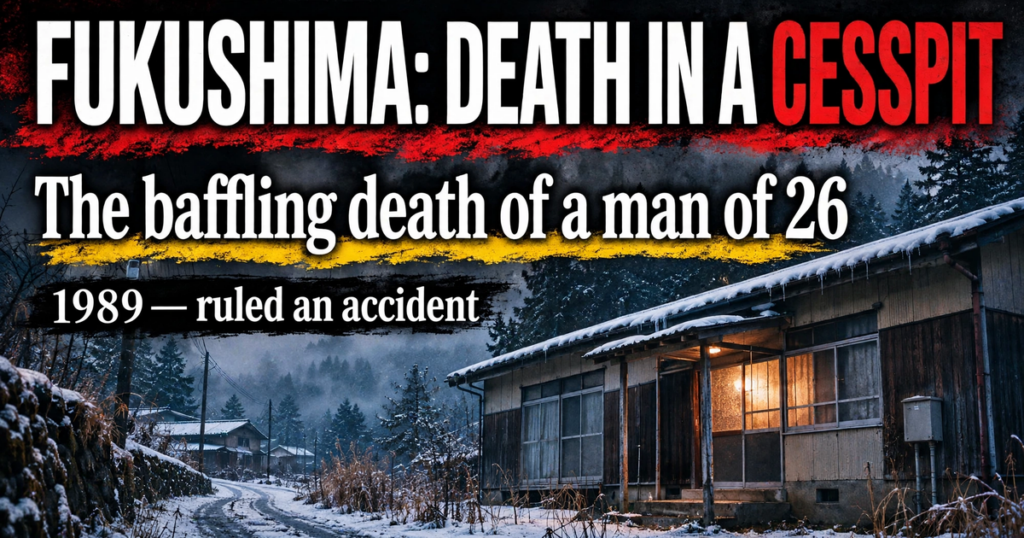
A 26-year-old man was found dead inside the cesspit of a teacher's residence in Miyakoji Village, Fukushima Prefecture, on 28 February 1989. Police reportedly attributed the death to respiratory difficulty caused by compression in the confined space and hypothermia, and found no evidence linking it to a crime. The reason and manner in which he entered the tank remain unexplained.
A 26-year-old man was found inside a toilet cesspit
On 28 February 1989, the body of a 26-year-old man was discovered inside the cesspit of a teacher's residence in the former village of Miyakoji, Tamura District, Fukushima Prefecture. The location is now part of Miyakoji Town in Tamura City. The discovery was unusual because the body was inside the tank beneath a non-flushing toilet, rather than in the toilet room itself. The man is referred to in the current account as K, rather than by a publicly confirmed full name. The unusual position of the body later generated speculation, but the basic fact is a death discovered in a confined waste tank.
The tank was narrow and the body was folded into a confined space
Later reporting based on a 1989 article in AERA described the dimensions of the toilet and tank. The opening on the toilet side was said to be about 20 centimetres across, while the outdoor opening used for removing waste was about 36 centimetres. The U-shaped tank was reported to be approximately 125 centimetres high and no more than about 50 centimetres wide at its broadest point. The body was found with the knees bent and the upper body curled. Reports also said that the upper body was unclothed. These physical details explain why the discovery attracted attention, but the dimensions alone do not prove that another person forced the man into the tank.
The deceased man worked for a company maintaining nuclear facilities
The 2026 review of contemporary reporting identifies K as a 26-year-old employee of a company involved in maintenance work at nuclear facilities. The AERA article cited in that review described him as a sales supervisor. He was also said to have held a role in the village youth association, where he was responsible for recreational activities. Those details provide a limited picture of his work and community life. They do not establish why he went to the residence or why he entered the cesspit. Because the current police record does not publish a full name, the translation does not supply a personal name that cannot be verified from the official material.
The accounts differ about who first discovered the body
There is a discrepancy in the available descriptions of the discovery. A 2026 article in Monthly Seikei Tohoku, after examining the AERA coverage from 1989, says that the female teacher who lived at the residence found the body. An online transcription referring to the Fukushima Minpo newspaper dated 2 March 1989 instead says that a colleague of the teacher checked the tank and notified police. The original newspaper issue has not been examined in the current review. It is therefore not possible to identify one first discoverer with confidence. The translation preserves the difference rather than choosing one version or presenting either as an uncontested fact.
Police reportedly attributed the death to compression and hypothermia
The police conclusion reported at the time was that K had died from breathing difficulty caused by compression in the narrow space, together with hypothermia. The date was at the end of February, when temperatures in the area were low. The explanation was that the man could not free himself once he was inside the confined tank, and that the resulting physical pressure and cold led to his death. This account concerns the physical mechanism of death. It does not answer the separate question of how he came to be inside the tank, when he entered it, or why he was there.
Residents collected approximately 4,300 signatures seeking clarification
The police assessment did not end public concern. Residents in the village organised a petition seeking further investigation and reportedly collected approximately 4,300 signatures in less than a month. A petition was submitted to Miharu Police Station, which is now part of the area served by Tamura Police Station. The number of signatures indicates that many residents were dissatisfied with the explanation or wanted a fuller account of the circumstances. It does not, by itself, establish that a crime occurred. The police position reported at the time was that there was no material connecting the death to criminal conduct.
The peeping and mayoral-election stories were reported as rumours
AERA's 1989 account recorded rumours that K might have entered the residence to spy on the female teacher. It also mentioned speculation about events surrounding a village mayoral election, including a story that K had refused a request from a candidate's supporters near the end of the campaign. These accounts were presented as rumours, not as findings by police or a court. No election-related individual was charged in connection with K's death, and no peeping motive was officially established. Repeating the rumours as fact would turn unverified theories into allegations against people who were never judicially found responsible.
The incident was not prosecuted as an unsolved murder
The distinction between an unexplained death and an unsolved homicide is central to this record. The material reviewed for the current article says police found no evidence linking the death to a crime and handled it as a death incident. There is no confirmed arrest on suspicion of murder, no indictment for homicide and no criminal trial that determined another person's responsibility. At the same time, it would be inaccurate to say that every aspect of the incident was explained. The reason K entered the tank and the precise route by which he got inside remain unresolved. The police assessment of criminality and the unanswered question about his actions are separate matters.
Later theories cannot replace the limited contemporary record
The unusual tank dimensions and the folded position of the body have been repeatedly discussed in television programmes, personal websites, videos and social media. Some later accounts have presented a forced-entry theory as though it were established. Others have treated the peeping story as a proven motive. Neither conclusion follows from the verified record. The current article notes that only a small number of contemporary magazine reports have been located, and that much of the detail circulating online was added later. The responsible account is therefore narrow: a 26-year-old man died inside a confined cesspit; police reportedly attributed the death to compression-related breathing difficulty and hypothermia; and the reason he entered the tank was never established.
Original Japanese record: 福島女性教員宅便槽内死亡事案|事故判断と4300人署名、侵入経緯は不明
Last updated:
Related articles

Case record
The Matsukawa Railway Incident: Twenty Convictions Overturned and Three Deaths Still Unresolved

Case record
The Disappearance of Mai Ishii: A Seven-Year-Old Missing from Her Home in 1991
Case record
The Daisetsuzan SOS Mountain Incident: A Giant Signal, a Recorded Cry for Help and a Corrected Bone Identification

Case record