
The Tokyo Station Coin-Locker Body Case
The body of an unidentified elderly woman was found in a yellow suitcase stored at JR Tokyo Station on 31 May 2015. The Metropolitan Police Department continues to investigate the case as a murder.
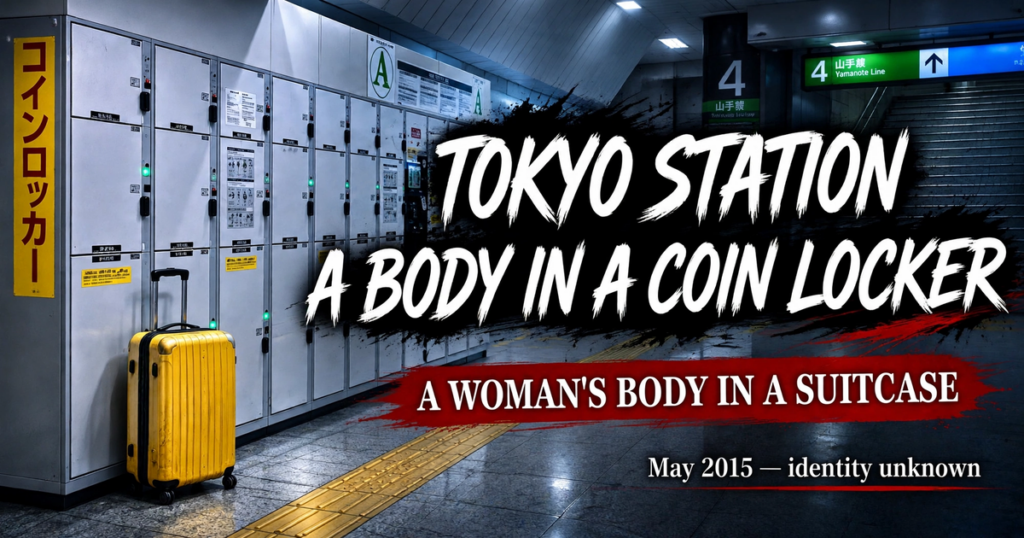
A yellow suitcase was first found unattended in April 2015
On 26 April 2015, a large yellow wheeled suitcase was found left in a coin locker at JR Tokyo Station without being locked. The station moved it to a storage area under its lost-property procedures. No owner came forward during the period it was held. The bag was not opened immediately as a criminal exhibit; it remained in the station’s custody until the relevant storage period expired. This initial discovery date is important because it precedes the discovery of the body by more than a month. Investigators have sought information about anyone who may have transported or left the suitcase at the station around that time.
The body was discovered when the stored bag was opened
At around 9 a.m. on 31 May 2015, station staff opened the stored suitcase at the JR Tokyo Station Marunouchi South Gate area and found the body of an elderly woman. Early reports said she was clothed and had no obvious external injuries. She was reportedly wrapped in a thin white cloth resembling a small blanket. The body was believed to have been dead for approximately one month. The Marunouchi Police Station conducted an examination and a judicial autopsy to investigate the cause of death and the woman’s identity. The initial description of the body did not end the investigation.
The woman remains unidentified as person number 1178
The Metropolitan Police Department’s unidentified-person materials continue to list the woman as number 1178. Current information estimates her age at between 70 and 90 and her height at approximately 135 to 145 centimetres. Earlier posters gave a narrower estimate of 70 to 80 years and around 140 centimetres. The current range should be used when describing the latest official identification appeal. She was described as slim, with hair mixed with grey, and a small raised area of approximately five millimetres near the centre of her forehead. These details are intended to help someone recognise a relative, acquaintance or person who disappeared around the relevant period.
The suitcase and personal effects may help identify her
The yellow suitcase was approximately 73 centimetres high, 53 centimetres wide and 27 centimetres deep, with wheels and an older design that could be pushed from behind. Police materials also list a cardigan, a towel and keys among the woman’s clothing or possessions. The suitcase was conspicuous in colour and size, making observations of someone transporting it potentially useful. However, the person who left the suitcase has not been publicly identified, and the fact that an item was found with the body does not establish who purchased or carried it. The police appeal seeks information both about the woman and about the movement of the suitcase.
The investigation’s classification has developed over time
The case initially came to attention as a body-disposal incident because the body was found inside a suitcase left at a station. The Metropolitan Police Department has since publicly stated that it continues to investigate the matter as a murder. The 2026 statement from the Criminal Investigation Division, issued on the anniversary of the discovery, is important because it confirms the current investigative classification. It should not be mistaken for a court judgment identifying a perpetrator. No suspect has been publicly arrested or prosecuted, and no trial has determined the precise circumstances of the woman’s death.
Tokyo Station creates both investigative opportunities and difficulties
The station is a major transport hub with large numbers of passengers and people passing through. A suitcase may have been brought from elsewhere, and the person carrying it may not have been a regular station user. The volume of foot traffic can make a single witness difficult to identify, while the distinctive yellow bag may remain memorable to someone who saw it. Police have sought information about a person pushing or carrying the bag around 26 April, as well as information about women who disappeared or lost contact with relatives during the relevant period. The public record does not establish the suitcase’s full route before it reached the locker.
No identity, arrest or criminal judgment has been announced
As of the source article’s November 2026 update, the woman’s identity remained unknown. The Metropolitan Police Department’s number 1178 listing remained active, and the investigation was described as continuing as a murder case. No public announcement confirmed that a person had been arrested, charged or convicted in connection with the body. The case is therefore not a completed murder prosecution. The identification of the woman remains a central objective alongside determining who placed the suitcase in the locker and how she died.
The case is not resolved by the discovery of the body alone
The discovery established that a woman’s body had been concealed in a suitcase and left at Tokyo Station. It did not establish her name, the exact location of death, the identity of the person who transported her, or the circumstances that led to her death. Those questions require separate evidence. A person who recognises the physical description, clothing, keys or suitcase may provide an important lead, but a resemblance alone is not an identification. The current legal and investigative position remains an unresolved case in which police seek both the woman’s identity and the circumstances of her death.
Dental records and facial reconstruction were part of the identification effort
Kyorin University’s forensic medicine department published a request for information about a distinctive treatment mark on the woman’s lower right first molar. The Metropolitan Police Department released several artist’s impressions in June 2015 and, in October that year, used a three-dimensional skull model to produce a facial reconstruction. These materials are estimates rather than photographs. Their purpose was to help relatives, acquaintances or dental professionals recognise a possible match. The woman’s name remains unknown, so her last residence, medical history and personal relationships cannot yet be traced through the usual identification process.
Original Japanese record: 東京駅コインロッカー遺体事件|身元不明女性を警視庁が現在も殺人事件として捜査
Last updated:
Related articles

Case record
The Roppongi Nightclub Attack: Ryosuke Fujimoto's Death and the Search for Shinichi Mitate

Case record
The Higashinippori Street Stabbing
Case record
The Disappearance of Mayumi Arashi: What Is Known, and What the “Do Not Believe Yoko” Note Does Not Prove

Case record