
The Chiba University Medical Students Sexual-Assault Case: Four Defendants, Different Charges, and Different Sentences
After a drinking gathering in Chiba City on 20–21 September 2016, three medical students and a university-hospital resident were prosecuted for sexual offences against a woman in her twenties. Two received immediate prison terms, while the other two received suspended sentences; their charges, university sanctions, and professional consequences were not identical.
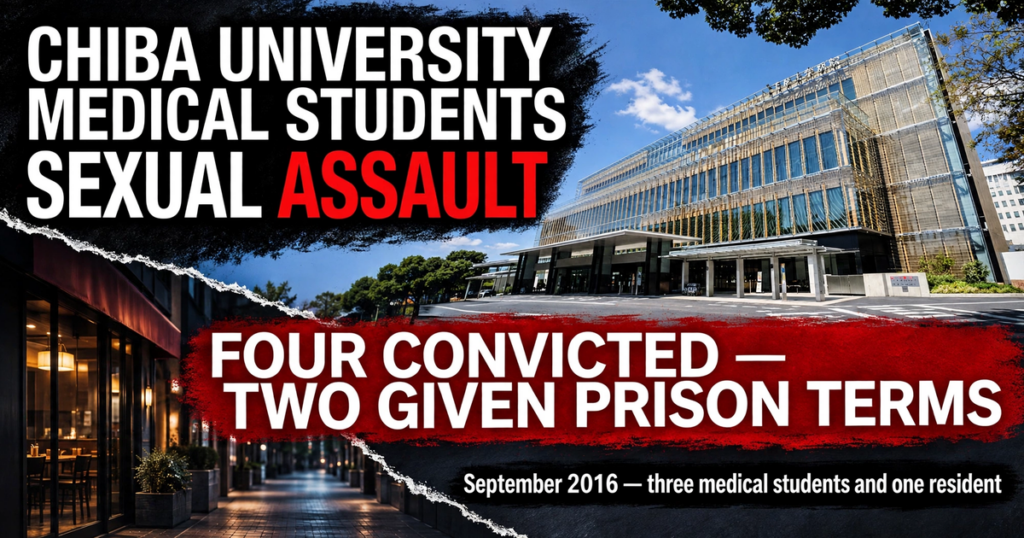
A drinking gathering led to criminal proceedings against four medical personnel
The incident took place from the night of 20 September into the early hours of 21 September 2016. A drinking gathering involving people connected with clinical training was held at a restaurant in Chiba City. A woman in her twenties became heavily intoxicated and was later found by the courts to have been in a condition in which she could not resist. Three Chiba University medical students and one resident doctor at the university hospital were prosecuted for sexual offences. The case was widely referred to in news reports as the Chiba University group-rape case, but the four defendants did not face identical charges.
The four defendants were prosecuted for different conduct
The medical students were Yoshimoto Masaya, Yamada Kensuke, and Masuda Mineto. The fourth defendant was Yuji Fujisaka, a resident doctor who had been involved in organizing the gathering and had a supervisory role in clinical training. The prosecution distinguished the conduct that occurred at the restaurant from a separate incident after the group left. Yoshimoto and Yamada were tried in connection with the acts inside the restaurant as a group offence. Masuda was prosecuted for a separate act at his home, while Fujisaka was prosecuted for a different offence involving indecent conduct. The popular label for the case should not obscure these distinctions.
Yoshimoto and Yamada disputed the extent of their joint responsibility
At the first hearing on 31 January 2017, Yoshimoto initially claimed that the woman had consented and sought acquittal. Yamada largely acknowledged his own conduct but disputed whether he shared responsibility for Yoshimoto's actions and whether there had been a prior agreement. Yoshimoto later withdrew the claim of consent and acknowledged his own conduct, while continuing to contest the extent of joint criminal responsibility for the other acts. The court examined each defendant's actions and understanding separately. The proceedings were not a single undifferentiated judgment that treated all four men as having committed the same offence.
The court found that Yoshimoto and Yamada acted jointly at the restaurant
The Chiba District Court found that Yoshimoto and Yamada had successively sexually assaulted the woman while she was in a condition of intoxication that made resistance difficult. The issue was not only what each man had done directly, but also whether their conduct was sufficiently connected to establish joint responsibility under the group-offence provisions then in force. The court found that the actions were linked and that the two defendants could not limit responsibility to only their individual acts. This legal assessment was based on the law applicable in September 2016, not the later terminology introduced by the 2017 amendment.
Yamada received three years in prison on 17 April 2017
On 17 April 2017, the Chiba District Court sentenced Yamada to three years' imprisonment. The court criticized the conduct and the disregard for the victim's dignity. In determining the sentence, it also considered that the offence had not been the result of a carefully prepared plan in advance, but had developed in the circumstances of the gathering. The prosecution had sought five years. The court nevertheless imposed an immediate prison term, finding the conduct too serious for a suspended sentence. Yamada challenged the judgment, but the Tokyo High Court later rejected his appeal and maintained the sentence.
Yoshimoto received four years in prison on 29 May 2017
On 29 May 2017, the Chiba District Court sentenced Yoshimoto to four years' imprisonment. The prosecution had sought six years. The court regarded his responsibility as the heaviest among the four defendants, including because of his role in initiating or encouraging the conduct involving the other student. Yoshimoto's sentence was one year longer than Yamada's. He appealed, but the Tokyo High Court upheld the first-instance judgment and dismissed the appeal. The two immediate prison sentences therefore remained in place; neither was changed to a suspended sentence on appeal.
Masuda received a suspended sentence for a separate act at his home
Masuda was prosecuted for a separate incident after the gathering, when he took the intoxicated woman to his home and sexually assaulted her. The charge was quasi-rape under the law then in force, rather than the group offence used against Yoshimoto and Yamada for the restaurant conduct. On 30 March 2017, the Chiba District Court sentenced Masuda to three years' imprisonment, suspended for five years. He admitted the charge, and the judgment was reported as final. The location and conduct were different from the restaurant incident, which is why his legal responsibility was assessed separately.
Fujisaka was convicted of quasi-indecent assault and received a suspended sentence
Fujisaka, who was 30 and worked as a resident doctor, was prosecuted for quasi-indecent assault. The charge concerned indecent conduct toward the woman while she was in a condition in which she could not resist. He admitted the charge at the first hearing. On 30 March 2017, the Chiba District Court sentenced him to two years' imprisonment, suspended for three years. His conviction was therefore not for the same sexual-intercourse offence charged against the other defendants. The difference in the charges reflected the conduct attributed to each individual, rather than a single common charge applied to all four.
University, hospital, and medical-profession sanctions followed separate rules
Chiba University expelled all three medical students through disciplinary decisions issued at different times: Masuda on 24 April 2017, Yamada on 10 May, and Yoshimoto on 19 June. Under the university's rules, expulsion was the most serious student disciplinary measure. Fujisaka was dismissed by Chiba University Hospital on 14 March 2017. After the criminal judgment, he also received a three-year administrative suspension from medical practice, effective 5 October 2017. These measures had different legal bases and purposes. A criminal sentence, university expulsion, employment dismissal, and professional administrative suspension are not the same type of sanction.
The 2017 amendment should not be used to rewrite the offences at the time
The conduct occurred in September 2016, when the Penal Code used the terms rape, quasi-rape, and group rape-related offences. Amendments that took effect in July 2017 changed the terminology and structure of sexual offences, including replacing the former rape offence with the offence then called forcible sexual intercourse and abolishing the separate group-rape category. The charges and judgments in this case applied the law in force at the time of the conduct. Replacing the historical offence names with current legal terms would misstate the actual charges and legal reasoning. The four defendants' different sentences must be understood against that historical legal framework.
The case cannot accurately be summarized as four defendants convicted of one offence
The final criminal outcomes were different. Yoshimoto and Yamada received immediate prison terms for the group conduct at the restaurant; Masuda received a suspended sentence for a separate quasi-rape offence at his home; and Fujisaka received a suspended sentence for quasi-indecent assault. The university expelled its three medical students, the hospital dismissed Fujisaka, and the medical profession imposed an additional administrative sanction on him. The two immediate prison sentences were upheld on appeal. The case is best understood by separating the individual charges and sanctions, rather than treating the four defendants as having received one common conviction and sentence.
Original Japanese record: 千葉大学医学部生ら性的暴行事件|4人で異なる罪名・判決、実刑2人と執行猶予2人
Last updated:
Related articles
Case record
The Satosho Guesthouse Sexual Assault Case: Ten Female Victims and a 26-Year Prison Sentence Upheld
Case record
The Former Yokohama Principal Case: Child Sexual Exploitation and the Figure of 12,660
Case record
The Murder of Le Thi Nhat Linh: A Nine-Year-Old Student, a Community Volunteer and a Life Sentence
Case record