
The Sapporo Reclusive Man Case: A 48-Year-Old Man's Mummified Remains Found During House Demolition
In November 2012, demolition workers found the mummified remains of a 48-year-old man in a house in Sapporo's Teine Ward. He had lived with his elderly mother and two sisters but had reportedly withdrawn to his room and lost contact with the rest of the household. His mother died at 98, and his sisters moved out before the house was demolished. Police later referred the older sister to prosecutors on suspicion of abandoning the remains. The man's cause of death and the subsequent prosecutorial disposition were not established in the public materials reviewed.
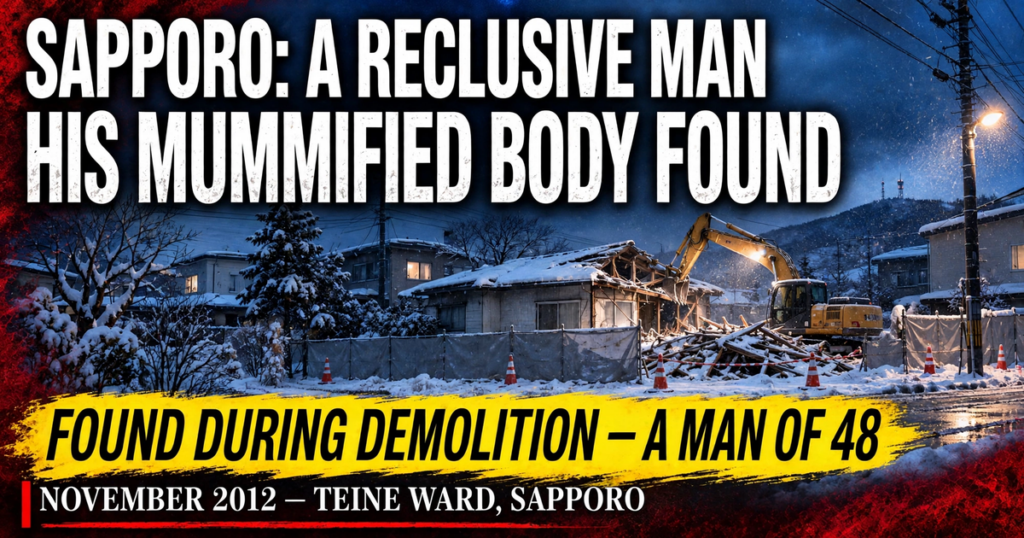
Demolition workers found the remains of a man who had been dead for years
In November 2012, workers demolishing a house in Teine Ward, Sapporo, found the mummified remains of a 48-year-old man in a room inside the property. The remains were believed to have been there for several years. The discovery did not result from a family member reporting a death. It occurred only after the house had become vacant and work began to remove it. The unusual circumstances prompted an investigation into how long the man had been dead, what his relatives knew and what had happened after they became aware of his death.
The man had lived with his mother and two sisters
The man was not living alone. He shared the house with his elderly mother, an older sister and a younger sister. However, reports said that he had withdrawn to his own room and had little or no ordinary contact with the rest of the family. The younger sister, who was 46 when the remains were found, reportedly told police that her brother had stayed in his room for about two years and that she did not know whether he was alive or dead. Sharing an address did not mean that the family was monitoring his health or daily condition.
The mother's death and the sisters' move led to the house being opened
The mother died in 2012 at the age of 98. The two sisters moved out of the property on 1 November. After the house was vacated, demolition work was arranged, and workers entered rooms that had remained closed. The remains were discovered about a week after the sisters moved. The sequence is important: the man's death came to public attention when the physical home was being cleared, not through a report made by the household. The change in occupancy exposed a situation that had remained hidden while other family members continued to live there.
The condition of the remains did not establish the cause of death
Early reports described the remains as mummified and suggested that death had occurred several years earlier. They also said that there were no obvious external injuries, but the publicly available reporting did not establish a cause of death. The passage of time and the condition of the remains made it difficult to determine exactly when or why the man had died. Police did not publicly treat the sisters as suspects in causing his death. The investigation instead focused on their actions after they may have realised that he had died.
The older sister's later discovery must be distinguished from the younger sister's statement
Reports published after the discovery described two different sisters and two different stages. The younger sister, then 46, was the person quoted as saying that she did not know whether her brother was alive or dead. The older sister, then 49, was later reported to have entered the room after the move to clear belongings and noticed part of the remains. She reportedly placed some remains in a plastic bag but did not notify the authorities. The two accounts should not be merged: the person who gave the early statement was not the same person later referred to prosecutors.
The older sister was referred to prosecutors without being arrested
On 2 April 2013, Sapporo Teine Police Station sent the older sister's case to the Sapporo District Public Prosecutors Office on suspicion of abandoning a corpse. This procedure, known in Japan as document referral, sends the investigation file to prosecutors while the person remains at liberty. It is not the same as an arrest, indictment or conviction. Reports attributed to the sister an explanation that she feared criticism from others and thought the remains could be disposed of with rubbish. That explanation was reported as her account; it does not establish the man's cause of death or the final prosecutorial decision.
The public record does not confirm what happened after the referral
The Japanese archive identifies the 2 April 2013 referral as the last clearly traceable criminal-procedure step in the materials it reviewed. Major public sources do not establish whether the Sapporo prosecutors later indicted the sister, declined prosecution or took the case to trial. It would therefore be inaccurate to describe her as convicted or to state that the case ended in a confirmed acquittal. The man's death also remains unexplained in the public reporting reviewed. The known facts concern the discovery, the family circumstances and the referral on suspicion of post-death abandonment.
The case shows how isolation can exist inside a shared household
The case is sometimes described as a hikikomori-related incident, but the man's withdrawal should not be presented as the proven cause of his death. Nor should the family's living arrangement be treated as proof that someone was supervising him. The available reports describe a long breakdown in contact inside the home, a death that went unreported and an eventual discovery caused by demolition. The legal investigation focused on the handling of the remains after death, not on an allegation that the sisters killed him. That distinction is essential to an accurate record of an event in which the most important unanswered questions remain unresolved.
Original Japanese record: 札幌ひきこもり男性ミイラ化遺体事件|母の死と転居後、解体中の家で見つかった48歳男性
Last updated:
Related articles

Case record
The Susukino Hotel Murder and Dismemberment Case: Three Defendants at Different Stages of Trial
Case record
The Nagoya Manga-Cafe Employee Death and Corpse-Abandonment Case
Case record
The Murder of a First-Grade Girl in Kobe's Nagata Ward: A Death Sentence Replaced by Life Imprisonment
Case record