
The Takadanobaba Livestreamer Stabbing: A Debt Dispute, an Attack Broadcast Online and a Sixteen-Year Sentence
On March 11, 2025, 22-year-old livestreamer Airi Sato was attacked on a street in Takadanobaba, Shinjuku, while broadcasting a walking trip along the Yamanote Line. Kenichi Takano, who had watched her streams since late 2021, was arrested after the attack. The two had a civil dispute over approximately 2.55 million yen in loans, of which only about 30,000 yen had been repaid. Prosecutors said Takano used the public livestream to locate and wait for Sato. The Tokyo District Court found at least 55 stab and cut wounds and imposed a sixteen-year prison sentence on July 15, 2026. The archive's latest update reports the first-instance judgment but does not establish a later appellate outcome.
A livestreaming walk exposed the victim's location
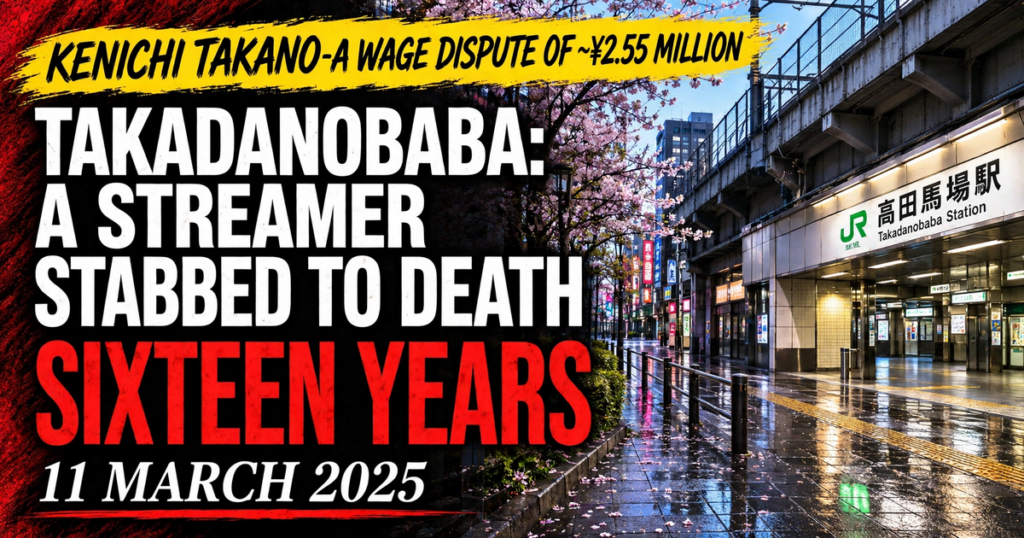
On the morning of March 11, 2025, 22-year-old Airi Sato was walking through Tokyo as part of a livestreaming project that followed the Yamanote Line. The plan had been announced in advance, and viewers could infer her location from the live images. At about 9:50 a.m., she was attacked on a street in Takadanobaba, Shinjuku Ward. The case drew attention because the public stream, intended to connect the performer with viewers, also gave a person who was watching a way to locate her in real time.
Takano had followed Sato's broadcasts since late 2021
Kenichi Takano began watching Sato's livestreams around December 2021. He spent more than 1.63 million yen on gifts or “tips” through the streaming service. Later, Sato asked him to lend money for living expenses and other needs. The sums lent over a relatively short period reached approximately 2.55 million yen. Takano used his savings and also borrowed money from consumer-finance companies to provide the loans. The money spent as streaming gifts and the money lent on the understanding that it would be repaid were different transactions.
Only about 30,000 yen was repaid, and civil proceedings failed to recover the balance
Of the approximately 2.55 million yen Takano said he had lent, about 30,000 yen was repaid. In 2023, he filed a civil lawsuit seeking repayment. He also pursued enforcement measures, including an attempt to seize money in Sato's bank account. The account reportedly contained only about 160 yen. The civil process did not produce meaningful recovery. These financial facts were examined at the criminal trial as part of the background to the offence, but a debt dispute did not give Takano any legal right to use violence.
Messages and preparations showed that the anger developed over time
Prosecution evidence included a message Takano sent to an acquaintance in early 2024 saying, in substance, that if the money was not returned he had moved toward wanting only revenge. He had bought a knife online around the time he filed the civil action in 2023. On March 10, 2025, the day before the attack, he learned about Sato's planned livestream and travelled to Tokyo carrying two blades. These facts were presented to show that the attack was not simply an accidental street encounter followed by a sudden argument.
He used the livestream to find Sato and waited in Takadanobaba
On March 11, Takano used information from the broadcast to locate Sato. Prosecutors argued that he waited for her in Takadanobaba and approached her while she was walking. The attack occurred at about 9:50 a.m. and was captured in part by the livestreaming equipment. The public nature of the broadcast was therefore directly relevant to how the defendant found the victim. It is important, however, to distinguish the prosecution's description of the planning from the specific facts accepted by the court in its judgment.
The court found at least 55 stab and cut wounds
The Tokyo District Court found that Sato had sustained at least 55 stab and cut wounds. One wound to her neck penetrated as far as the carotid artery. The court considered the number of attacks, the body parts targeted and the force used, and concluded that Takano had a strong intent to kill. Takano had argued that he did not initially intend to kill her, but the court assessed intent from the objective manner of the attack as well as his statements.
Takano picked up the livestreaming phone after the attack
After Sato's voice stopped, Takano picked up the smartphone being used for the broadcast and filmed her face while she lay on the ground. He also kicked her head and made a remark to the effect of asking whether she was dead. The district court treated this conduct as an additional violation of the victim's dignity and considered it in sentencing. The judgment therefore examined not only the physical attack but also Takano's conduct after Sato could no longer resist.
He was first arrested on suspicion of attempted murder and later indicted for murder
Sato was taken to hospital, where her death was confirmed. Takano was detained near the scene and initially arrested on suspicion of attempted murder. After her death was confirmed, police investigated the case as murder. Following a psychiatric examination detention to assess criminal responsibility, prosecutors indicted Takano on May 29, 2025, for murder and related offences. During the trial he admitted the charged conduct and apologised to Sato and her family, while the strength of his intent and the appropriate sentence remained disputed.
The trial considered the debt dispute and the defence's ASD argument
The lay-judge trial opened at the Tokyo District Court on July 1, 2026. Prosecutors sought a twenty-year sentence, emphasising the waiting, the use of the livestream to locate Sato and the repeated attacks. The defence argued that the unpaid loan and Takano's unsuccessful legal efforts should be considered in mitigation and asked for nine years. It also referred to traits associated with autism spectrum disorder, arguing that they had affected his ability to control anger. The court considered the argument but did not treat those traits as a major mitigating circumstance.
The district court imposed sixteen years on 15 July 2026
On July 15, 2026, the Tokyo District Court sentenced Takano to sixteen years in prison. The sentence was four years below the prosecution's request and substantially above the nine years sought by the defence. The court acknowledged that the loan dispute and failed collection efforts had contributed to the formation of the motive, and it referred to Sato's conduct in relation to the money. It nevertheless found that those circumstances did not justify the killing. The repeated attack, strong intent and post-attack conduct were serious aggravating factors.
The debt dispute and the murder must not be treated as equivalent wrongs
The judgment attracted discussion because it addressed the victim's handling of the money as part of the defendant's motive. The civil debt issue and the criminal killing nevertheless remained legally distinct. A person who believes money is owed may pursue civil litigation and lawful enforcement, but cannot use violence to collect it. The court's consideration of the financial background did not make the attack lawful or transfer responsibility for the killing to the victim. The sentence was based on the defendant's criminal conduct and the aggravating and mitigating circumstances considered by the court.
The latest published record identifies a first-instance sentence, not a confirmed final outcome
The Japanese archive's entry was last updated on August 28, 2026, and records the Tokyo District Court's sixteen-year sentence of July 15. The article does not state that an appeal was filed or that the sentence became final. The legally careful description is therefore that Takano received a sixteen-year first-instance sentence. Unless a later appellate record is confirmed, the case should not be described as a final conviction or as having completed all appeals.
Original Japanese record: 東京・高田馬場ライバー女性刺殺事件|約255万円の貸金問題と強固な殺意、懲役16年判決
Last updated:
Related articles

Case record
The Komae Robbery Resulting in Death: Kinuyo Oshio's Killing and the Separate Trials of Local Operatives and Overseas Organisers
Case record
The Edogawa 18-Year-Old Woman Murder
Case record
The Luffy Wide-Area Robbery Cases: Four Separate Leadership Trials and Their Different Legal Stages

Case record