
The Fukuoka “Murder Teacher” Case: A Civil Damages Judgment and a Disciplinary Reversal
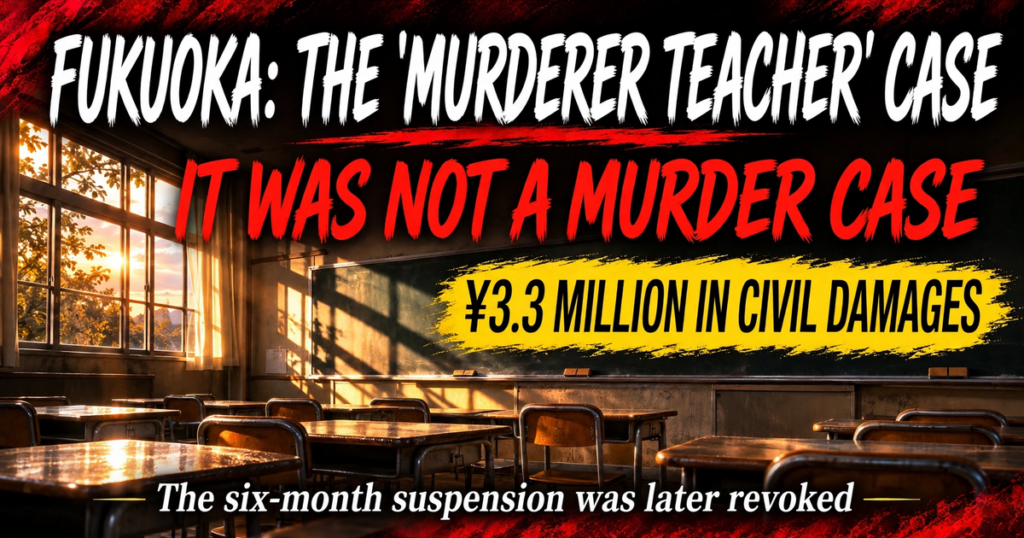
In 2003, a fourth-grade boy and his male homeroom teacher at a municipal elementary school in Fukuoka became the subject of intense national coverage. The child's family alleged repeated corporal punishment, discriminatory remarks and words that seemed to urge the child to die. A weekly magazine called the teacher a “murder teacher,” but no child had been killed and the teacher was never arrested or charged with murder. A civil court later found some acts unlawful and ordered Fukuoka City to pay 3.3 million yen. In a separate administrative proceeding, the Fukuoka City Personnel Commission cancelled the teacher's six-month suspension in 2013. The two outcomes must be kept distinct.
The dispute became public through a fourth-grade pupil and his family
In May and June 2003, allegations emerged concerning a fourth-grade boy at a municipal elementary school in Fukuoka City and his male homeroom teacher. The child and his family said that, after a home visit, the teacher repeatedly used physical punishment and made discriminatory remarks about the child's family background. They also alleged that the teacher used words that could be understood as urging the boy to die. The claims attracted national attention and were reported in highly charged terms. The later proceedings did not accept every allegation as true; individual acts and statements were examined separately.
The phrase “murder teacher” was a media label, not a criminal charge
In autumn 2003, a weekly magazine used the expression “murder teacher” in reporting about the dispute. The phrase created a powerful public image of a teacher who had supposedly driven a child to death. But the boy did not die, and the teacher was not arrested or indicted for murder. The expression was not a legal offence, a court finding or the name of an administrative penalty. An accurate account must begin by separating the media label from the actual proceedings: a school-discipline dispute, a civil damages lawsuit and an administrative review of the suspension.
Fukuoka City imposed a six-month suspension on 22 August 2003
After an investigation by the school and education authorities, the Fukuoka City Board of Education imposed a six-month disciplinary suspension on the teacher on August 22, 2003. The teacher challenged the measure and filed an administrative appeal with the Fukuoka City Personnel Commission in October. That appeal asked whether the disciplinary action could be maintained under the rules governing public employees. It was separate from the civil lawsuit that the child and parents later brought to obtain damages for the alleged physical and psychological harm.
The child and parents filed a civil action in October 2003
In October 2003, the child and his parents sued the teacher and Fukuoka City, alleging repeated physical and verbal abuse and claiming that the boy had developed post-traumatic stress disorder. They sought compensation for physical and emotional harm. The civil court had to determine which alleged acts had been proved, whether those acts were unlawful, what injuries were causally connected to them and who was legally responsible for compensation. It was not a criminal trial, and it did not determine whether the teacher had committed murder or any other homicide offence.
The Fukuoka District Court awarded 2.2 million yen in 2006
On July 28, 2006, the Fukuoka District Court partially accepted the claim and ordered Fukuoka City to pay 2.2 million yen. It found some of the teacher's conduct to constitute unlawful corporal punishment or bullying, but it did not accept every allegation made by the child and his family. The claim against the teacher personally was dismissed. For conduct by a public-school teacher in the performance of official duties, the State Redress Act generally places compensation responsibility on the local public entity rather than the individual official. The dismissal of the personal claim should not be misread as a finding that no unlawful conduct occurred.
The teacher's position in the appeal changed after the personal claim was withdrawn
The child and family appealed the first-instance judgment. In 2007, they withdrew their appeal against the teacher personally, and the teacher participated in the High Court proceedings as an assisting participant on the city's side. This procedural position mattered. The Fukuoka High Court explained that the teacher could not, in that role, contradict facts that Fukuoka City had admitted in the litigation. The appellate court's factual findings therefore reflected not only the evidence but also the procedural relationship between the city and the teacher.
The Fukuoka High Court found some acts unlawful and awarded 3.3 million yen
On November 25, 2008, the Fukuoka High Court found that the teacher had repeatedly used corporal punishment against the boy over about one month and had made remarks, including statements insulting Americans, that were not acceptable in an educational setting. It treated those acts as unlawful and recognised the child's physical and emotional suffering. The court awarded three million yen in consolation damages and 300,000 yen in legal fees, for a total of 3.3 million yen payable by Fukuoka City. The judgment did not establish that every allegation in the original reporting was true.
The High Court did not find that the unlawful acts caused PTSD
The boy had received a PTSD diagnosis and had experienced a period of hospitalisation. The High Court examined medical records, interviews and observations and did not find that PTSD had been caused by the unlawful acts it had recognised. It also did not accept that the alleged conduct had made hospitalisation necessary. However, the court did recognise psychological symptoms and the need for outpatient treatment from late June to early September 2003 as causally connected to the bullying it found. The distinction is important: rejecting the PTSD claim did not mean that the court denied all psychological harm.
The Personnel Commission cancelled the suspension on 17 January 2013
The teacher's administrative appeal continued after the civil judgment. On January 17, 2013, the Fukuoka City Personnel Commission cancelled the six-month suspension imposed by the Board of Education in 2003. The commission examined whether the facts relied on for the disciplinary measure justified that specific penalty and concluded that it could not be maintained. This was a separate administrative determination, made almost nine years after the teacher first sought review. It did not reopen or cancel the 2008 civil judgment.
The civil damages award and the disciplinary cancellation did not cancel each other
The 2008 High Court judgment left a civil obligation for Fukuoka City to pay 3.3 million yen because some corporal punishment and statements had been found unlawful. The 2013 Personnel Commission decision cancelled the six-month suspension as an administrative penalty. Neither decision automatically erased the other because the procedures had different purposes, parties and standards of review. It is therefore inaccurate to say that the 2013 cancellation proved that no unlawful acts occurred, just as the civil damages award does not mean the disciplinary suspension was legally justified.
The case was not a murder, and its outcome was not a single verdict of guilt or innocence
The Fukuoka “Murder Teacher” case cannot be reduced to a criminal conviction or acquittal. There was no murder, no deceased child and no murder prosecution. The civil courts recognised some unlawful acts and ordered the city to compensate the child, while rejecting other parts of the claim, including the PTSD causal claim. The Personnel Commission later cancelled the teacher's suspension in a separate administrative process. The most accurate description is a contested school-abuse dispute with a partial civil finding of liability and a later disciplinary reversal, not a homicide case.
Original Japanese record: 福岡「殺人教師」事件|民事判決の330万円賠償と、停職6カ月の懲戒取消
Last updated:
Related articles
Case record
The Iizuka Case: A Death Sentence, an Execution and Continuing Retrial Petitions
Case record
The Koto Memorial Hospital Case: A Twelve-Year Sentence Overturned by Retrial, and a Death Not Proven to Be Homicide

Case record
The Shibushi Case: A Failed Vote-Buying Allegation, Twelve Acquittals and an Unlawful Investigation
Case record