
The Hirosaki University Professor's Wife Murder: A Fifteen-Year Sentence Overturned by a Retrial Acquittal
On August 6, 1949, the 30-year-old wife of Hirosaki University medical professor Fujio Matsunaga was stabbed to death while sleeping at her home in Hirosaki, Aomori Prefecture. Takashi Nasu, a 25-year-old neighbour, was arrested and tried. The district court acquitted him of murder in 1951, but the Sendai High Court reversed the decision and sentenced him to fifteen years in 1952. The conviction relied heavily on a bloodstain on a white naval-style shirt. In 1971, Fukumatsu Takiya confessed to the killing. A retrial began in 1976, and the Sendai High Court acquitted Nasu on February 15, 1977, explicitly identifying Takiya as the actual killer. The acquittal became final on March 2.
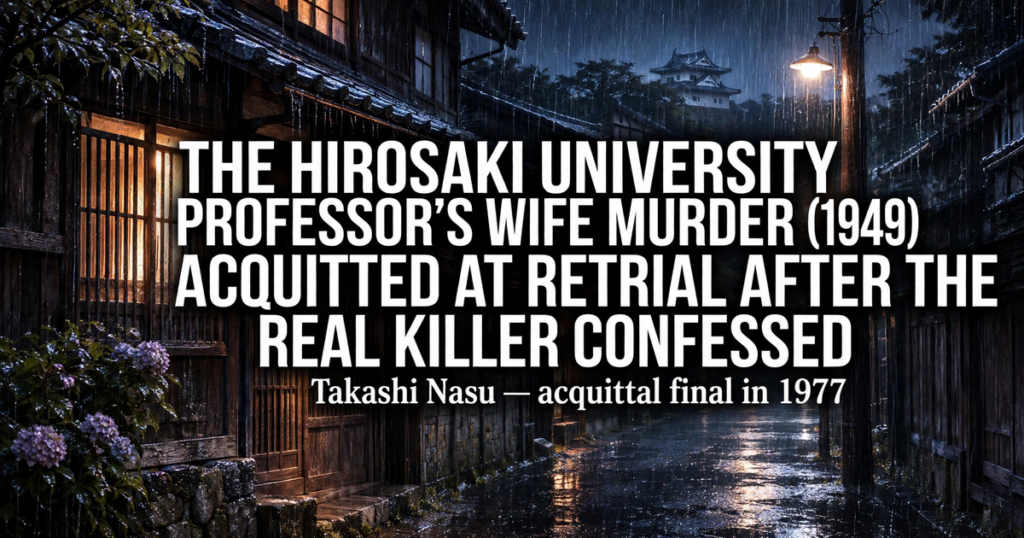
A professor's wife was killed while sleeping at home
At about 11:00 p.m. on August 6, 1949, the 30-year-old wife of Fujio Matsunaga, a professor at Hirosaki University Medical School, was sleeping in a detached room of her home in Hirosaki, Aomori Prefecture. An intruder stabbed her in the neck with a sharp weapon, cutting major blood vessels and killing her. Her mother was present and saw a young man fleeing immediately after the attack. Later retrial materials recorded the witness's description of a man who appeared to be in his early twenties, wearing a white short-sleeved shirt and shorts.
The investigation did not recover a decisive object or fingerprint
Investigators did not find a clear item left by the killer or a fingerprint that could be attributed to the intruder. Bloodstains were found on a road believed to be part of the escape route. Police checked local residents and people with prior records, and Nasu Takashi, who lived nearby, became a suspect. He was 25 at the time. The case did not begin with a weapon, eyewitness identification of Nasu or a single forensic item that conclusively established his guilt. Instead, the prosecution later relied on the interpretation of a bloodstain found on his clothing.
Nasu was arrested sixteen days after the killing
On August 22, 1949, Nasu was arrested on suspicion of murder. Police searched his home and seized a handgun and other items. He was also prosecuted for a separate violation of the prohibition on possessing firearms and related weapons. The evidence most important to the murder case was a stain on a white naval-style open-collar shirt belonging to Nasu. Both Nasu and the victim had blood type B under the ABO system, so investigators used additional blood-typing methods that were available at the time.
The white shirt's stain became the central forensic evidence
The stain on the shirt was identified as human blood of type B and was also reported to have the same Q-system blood type as the victim, while Nasu was classified as q-type. The prosecution argued that the stain was the victim's blood and had been deposited on the shirt as back-splatter during the killing. There was no direct eyewitness identification of Nasu as the attacker and no murder weapon recovered. The blood evidence therefore played a central role in connecting him to the crime. Its value depended on whether the stain had been present at the time of the offence.
The shirt was not seized until sixteen days after the murder
The white shirt was not taken into evidence on the day of the killing. It was seized from Nasu's home on August 22, sixteen days after the murder. Civil judgment materials later recorded that Nasu had continued to use it as work clothing up to that date. Even if a stain had a blood type consistent with the victim, that alone could not establish when the blood had been deposited. The handling, preservation and examination history of the shirt later became major issues in the retrial. The question was not only what the stain contained, but whether it was the same stain in the same condition throughout the forensic process.
The first trial acquitted Nasu of murder
On January 12, 1951, the Hirosaki Branch of the Aomori District Court acquitted Nasu of murder. It imposed a fine for the separate firearms-related offence, but did not find that he had killed the professor's wife. The prosecution appealed, and the case went to the Sendai High Court. The first-instance acquittal was therefore not the final outcome at that stage. The appeal changed the legal position dramatically, even though the underlying evidence, particularly the shirt stain, would later be challenged again.
The Sendai High Court imposed fifteen years, and the Supreme Court made the conviction final
On May 31, 1952, the Sendai High Court overturned the murder acquittal and sentenced Nasu to fifteen years in prison. It gave weight to the bloodstain evidence and also referred to aspects of Nasu's character and past statements. The Supreme Court dismissed his appeal on February 19, 1953; the conviction became final on March 3. Nasu was released on parole in January 1963 after serving part of the sentence. His release did not erase the conviction, and he continued seeking a legal way to clear his name.
Takiya's confession led to a new examination of the evidence
Around May 1971, Nasu's side learned that Fukumatsu Takiya had said he was the actual killer. Takiya had spoken about the Hirosaki murder to a fellow prisoner and later gave more detailed accounts to lawyers and journalists. His statements included details about the route into the house, the positions of the people in the room, the stabbing and the escape. Nasu filed a retrial request on July 13, 1971. The Sendai High Court rejected the first request on December 13, 1974, finding that Takiya's account was not sufficiently decisive. Nasu's side challenged that decision.
The High Court ordered a retrial in July 1976
On July 13, 1976, a different panel of the Sendai High Court overturned the rejection and ordered a retrial. It examined Takiya's account alongside the objective circumstances and the history of the white shirt evidence. The court found serious doubts in the evidence that had supported the original conviction. It examined the colour and condition of the stain when the shirt was first seized, the later forensic examinations and the movement of the garment between experts and laboratories. The court considered whether the stain might not have been present when the shirt was seized and whether its later description could be trusted.
The retrial acquitted Nasu and identified Takiya as the actual killer
On February 15, 1977, the Sendai High Court acquitted Nasu of murder in the retrial. It concluded that there was no evidence sufficient to establish that Nasu had committed the offence and expressly identified Takiya as the actual killer. The court found that Takiya's account matched the scene and escape route in multiple details. The prosecution did not appeal, and the acquittal became final on March 2, 1977. This was not merely a ruling that the prosecution had failed to prove guilt; the retrial judgment went further and named another man as the killer.
Takiya could not be prosecuted because the limitation period had expired
By the time Takiya identified himself as the killer in 1971, the limitation period for the 1949 murder had already expired under the law then in force. The retrial court's finding did not permit prosecutors to bring a new murder prosecution against him. The case therefore ended with Nasu's acquittal and the judicial identification of Takiya, but without a criminal trial or sentence for Takiya. The Hirosaki case became a major example of a wrongful conviction built around forensic evidence whose collection and preservation history later came under serious scrutiny.
Original Japanese record: 弘前大学教授夫人殺害事件|白シャツ血痕で懲役15年、真犯人告白から1977年再審無罪
Last updated:
Related articles
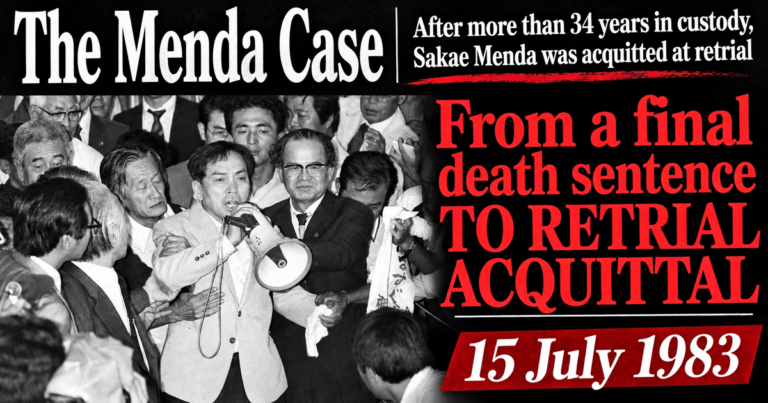
Case record
The Menda Case: Japan's First Postwar Retrial Acquittal of a Death-Row Prisoner
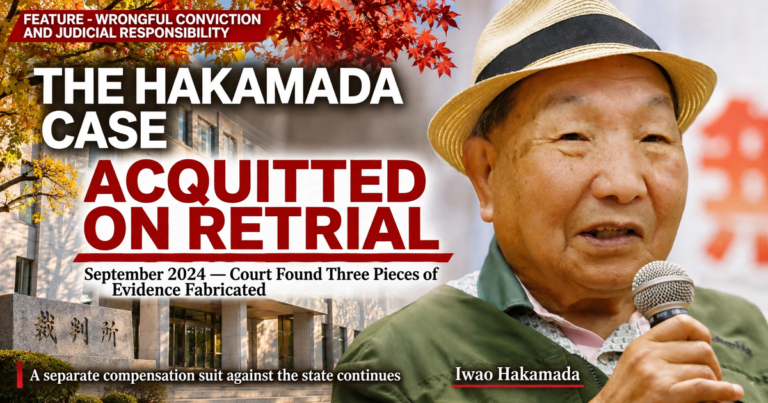
Case record
The Iwao Hakamada Case: From Death Row to a Final Acquittal

Case record
The Matsukawa Railway Incident: Twenty Convictions Overturned and Three Deaths Still Unresolved
Case record