
The Kobe Graduate Student Beating Murder: Seven Convictions and a Civil Judgment Against Police Inaction
In the early hours of March 4, 2002, Kobe Merchant Marine University graduate student Kuniaki Uranaka, aged 27, called police after a dispute over a parked vehicle escalated into violence involving members of a criminal group. Police officers arrived, but Uranaka was not found. He had been confined inside a vehicle and was taken away while officers ended their on-scene response. The beating continued elsewhere, and his body was found in a river in Kobe's Nishi Ward the following afternoon. Seven people were convicted in the criminal proceedings. Separately, a civil court found that the police had unlawfully failed to use their powers and that the failure was causally connected to Uranaka's death; approximately 97.36 million yen in damages became final in January 2006.
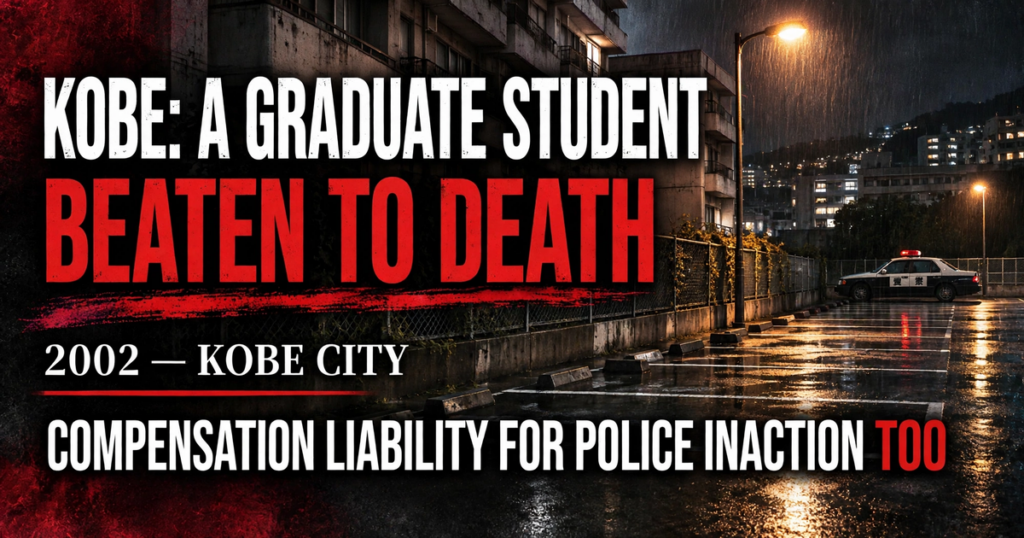
A parking dispute escalated into a group assault
At about 3:10 a.m. on March 4, 2002, Uranaka Kuniaki, a 27-year-old graduate student at Kobe Merchant Marine University, was near a prefectural housing complex in Arise, Ikawadani-cho, Nishi Ward, Kobe. A friend had driven him close to home. They became involved in a dispute with Takayuki Sato and other members of a criminal group over the way a vehicle had been parked. Uranaka and his companion were assaulted. The companion suffered serious injuries, and the confrontation quickly became more than an ordinary argument about a parking space.
Uranaka and a neighbour called the police
A nearby resident called the police, and Uranaka himself also dialled 110 from his mobile phone. During the call, he said that he was being confronted by people connected with organised crime and had been suddenly attacked. His companion also told officers that Uranaka might have been taken away. The call was made at around 3:20 a.m. and lasted approximately three minutes. These details later became important in the civil proceedings because they showed what the police had been told while the incident was still unfolding.
Eighteen officers attended, but Uranaka was not found
Police officers from Kobe Nishi Police Station arrived approximately 17 minutes after the first call. A total of 18 officers were eventually involved at the scene. They protected Uranaka's companion and obtained information about vehicles associated with the group. However, Uranaka was not located. In fact, he was being held inside one of the group's vehicles. The officers questioned people and checked vehicle information, but they ended their response without adequately confirming whether Uranaka had been abducted or was still in danger.
The later civil judgment identified several failures in the police response
The subsequent civil judgment examined the officers' failure to search the vehicle thoroughly, the premature end of questioning and the decision not to initiate a wider emergency deployment. The companion had raised the possibility that Uranaka had been taken, and Uranaka's own emergency call had described an ongoing assault involving people associated with a criminal group. The court considered whether those circumstances gave the police sufficient reason to take further steps to locate him and prevent additional harm.
The attackers continued beating Uranaka after taking him away
The group drove Uranaka to another location in Nishi Ward and continued to assault him over an extended period. The criminal proceedings considered the conduct of Sato and the other participants, including murder and assault causing death. The violence was not treated as a brief roadside fight. It continued after the group had removed Uranaka from the original scene. His body was left in or near a river and was found on the afternoon of March 5, 2002, in Nishi Ward.
Seven people were convicted, but their sentences reflected different roles
Seven people, including Sato, were prosecuted for offences including murder and assault causing death. On August 5, 2004, the Kobe District Court found all seven guilty. It found that Sato had acted with conditional intent to kill and sentenced him to 20 years in prison, below the life sentence requested by prosecutors. Other defendants received sentences reflecting their respective roles. Kyoko Tani, who was in a common-law relationship with Sato, was convicted of assault causing death and initially received three years' imprisonment suspended for four years.
The Osaka High Court maintained Sato's twenty-year sentence
Sato and the prosecution both appealed. In June 2005, the Osaka High Court maintained Sato's twenty-year prison sentence and rejected the appeals concerning his conviction and punishment. The appellate court did not accept the argument that the course of violence was merely a lesser assault. In a separate part of the proceedings, Tani's suspended sentence was set aside and changed to three years' immediate imprisonment. The different outcomes show why the seven defendants should not be described as having received identical convictions or sentences.
Uranaka's mother brought a separate civil action against Hyogo Prefecture
In 2003, Uranaka's mother filed a damages action against the perpetrators and Hyogo Prefecture. The civil case was distinct from the criminal prosecutions. It asked whether the police had unlawfully failed to exercise their powers and whether that failure was connected to Uranaka's death. The prefecture argued that officers had responded appropriately and could not have predicted that the dispute would develop into an abduction and killing. The mother's case relied in part on the recording of Uranaka's 110 call and on information provided by his companion.
The Kobe District Court found unlawful inaction and a causal connection
On December 22, 2004, the Kobe District Court largely accepted the mother's claim and ordered Hyogo Prefecture and the relevant defendants to pay approximately 97.36 million yen. The court found that the failure to search for Uranaka and other failures to use police powers were seriously unreasonable and unlawful. It also found that the circumstances gave the police reason to foresee the danger that Uranaka had been taken and might be killed. The court concluded that there was a substantial possibility that appropriate searches and an emergency deployment could have saved him.
The compensation judgment became final in January 2006
Hyogo Prefecture appealed, but the Osaka High Court dismissed the appeal in July 2005. The prefecture then appealed to the Supreme Court. On January 19, 2006, the Supreme Court dismissed that appeal, making the state-compensation judgment final. The criminal convictions and the civil finding against the police were separate legal outcomes: the former addressed the responsibility of the assailants, while the latter addressed the public authority's failure to act after the emergency calls. The case became an important judgment on police duties and the legal consequences of failing to respond to a possible abduction.
Original Japanese record: 神戸大学院生リンチ殺人事件|浦中邦彰さん殺害、警察の不作為にも約9700万円の賠償責任
Last updated:
Related articles
Case record
The Tokushima–Awaji Father-and-Son Murders: Eleven Years of Flight, No Trial
Case record
The Murder of a First-Grade Girl in Kobe's Nagata Ward: A Death Sentence Replaced by Life Imprisonment
Case record
The Kobe Nagata Ward Shooting: The Killing of a Security Escort and Hishikawa's Arrest After Nearly Nine Years
Case record