
The Utsunomiya Jewelry Store Arson-Robbery Murders: Six Employees Bound and Killed for High-Value Stock
On the night of June 11, 2000, six female employees, including the manager, were bound and blindfolded inside a jewelry store in central Utsunomiya, Tochigi Prefecture. The offender, Kazuo Shinozawa, had posed as a customer interested in buying expensive jewelry for cash. He took jewelry worth more than 140 million yen and set fire to the store with gasoline. All six employees died. The courts rejected Shinozawa's claim that the fire had ignited accidentally and found that the robbery and killings had been planned together. His death sentence became final in 2007 and was carried out in 2010.
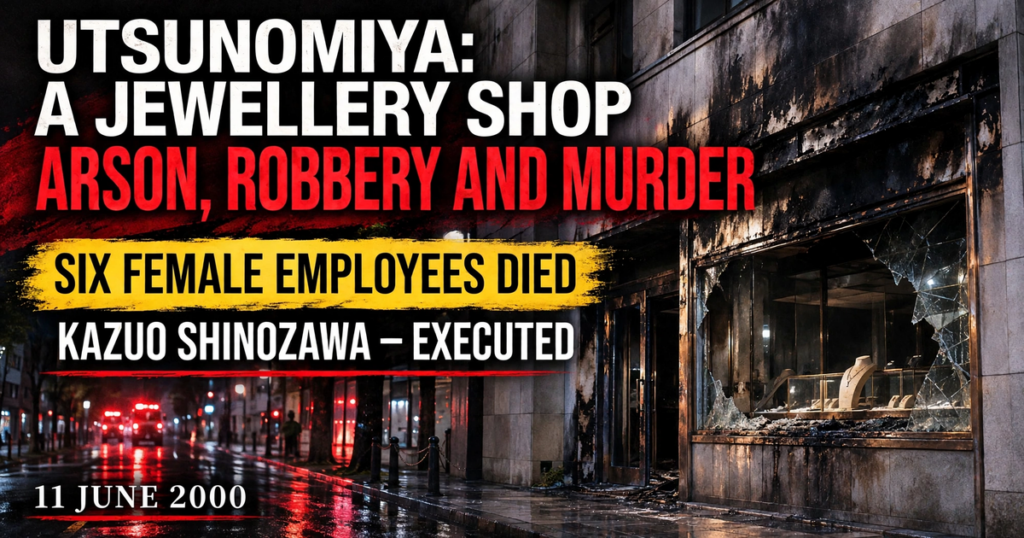
A jewelry-store transaction was used to prepare the robbery
Kazuo Shinozawa targeted a high-end jewelry store in central Utsunomiya, Tochigi Prefecture. The Supreme Court found that he selected a shop staffed by women and planned to take valuable jewelry after killing the employees who could identify him. Before the offence, he had visited the store as a customer. Later reporting described an earlier attempt to draw the manager outside through a high-value transaction, which was abandoned when a male employee was expected to accompany her. The archive distinguishes that reported background from the facts established in the final judgment.
The offender posed as a customer who would pay cash for expensive goods
On June 11, 2000, Shinozawa returned to the store and presented himself as a customer who wished to buy expensive jewelry with cash. The store assembled the goods for the proposed transaction, and the discussion continued after closing time. The concentration of valuable items in one place was used as part of the robbery plan. The Supreme Court treated the apparent business transaction as a deception that allowed Shinozawa to keep the employees occupied and to make the store's inventory available for him to take.
Six female employees were restrained in the back of the store
After the store closed, Shinozawa subdued six employees, including the manager. He bound their hands and feet, blindfolded them and pushed them into a rest room at the rear of the premises. The employees were placed in a position where escape was difficult. Shinozawa then spread gasoline that he had brought with him near the entrance and other parts of the store and ignited it with a lighter. The building was destroyed by fire and all six women died. The six deaths were the result of a planned robbery and arson, not an accidental fire during an ordinary theft.
The stolen jewelry was worth more than 140 million yen
The Supreme Court found that the jewelry taken was worth more than 140 million yen. Reports at the time described approximately 293 items, including rings, although the judicially stated value is the safer measure to use in the English record. Shinozawa left the scene with the jewelry and was himself burned during the fire. Police traced the transaction and the person who had left the store. On June 12, the day after the incident, officers located him and questioned him. Jewelry believed to have been stolen was found among his possessions.
Shinozawa was arrested and denied that he had intended to kill the employees
Shinozawa was arrested in the early hours of June 13, 2000, on suspicion of robbery-murder and arson. He did not deny taking the jewelry, but at trial he disputed the allegation that he intended to kill the six women. He argued that he had used a lighter only as a threat and that gasoline vapour had ignited unexpectedly. The prosecution argued that the selection of a women-only store, advance preparation of gasoline and restraints, and confinement of all six employees in a room from which escape was difficult showed an original plan to kill witnesses.
The courts treated the fire as an intentional part of the robbery plan
The courts rejected the account of an accidental ignition. The Supreme Court's findings connected the robbery motive, the restraints and blindfolds, the movement of all six employees to the rear room and the use of gasoline. The order of those acts supported the conclusion that Shinozawa had planned to kill the employees while taking the jewelry. The legal issue was not merely whether he had started a fire; it was whether he had done so with the intention of killing the women to prevent them from identifying him. The courts found that he had.
The district and high courts imposed and upheld death
The Utsunomiya District Court sentenced Shinozawa to death on March 19, 2002. The Tokyo High Court dismissed his appeal on April 23, 2003. The defence continued to dispute intent and the severity of the punishment. The courts considered the scale of the property taken, the six deaths, the deliberate choice of the store and the preparation before the fire. The case was treated as a planned robbery-murder involving six victims, rather than a robbery followed by an unforeseen accident.
The Supreme Court confirmed the death sentence in 2007
On February 20, 2007, the Supreme Court's Third Petty Bench dismissed Shinozawa's final appeal. It accepted the finding that he had carefully prepared the robbery and intended to kill the employees. The Court considered that he had bound all six women, blindfolded them, confined them in the back room and then spread gasoline and set the store alight. The death sentence became final on the date of the Supreme Court's decision.
Shinozawa was executed on 28 July 2010
Shinozawa was executed at Tokyo Detention House on July 28, 2010, approximately three years after the death sentence became final. Justice Minister Keiko Chiba attended the execution carried out under the execution order she had issued. Government explanations later stated that the records had been reviewed and that no reason to suspend the execution or stop it because of retrial proceedings had been found. The case's final legal chronology is therefore the June 2000 robbery and arson, death sentences in 2002 and 2007, and execution in July 2010.
Original Japanese record: 宇都宮宝石店放火強盗殺人事件|女性従業員6人を拘束・放火、篠沢一男の死刑執行
Last updated:
Related articles
Case record
The Utsunomiya Confinement Murders: Two Deaths, Three Survivors and a Final Death Sentence

Case record
The Makiba Couple Murder-Arson: A Former Employee, Two Deaths and a Final Death Sentence
Case record
The Osaka Sisters Murder: A Planned Robbery, Two Deaths and a Death Sentence Final by Appeal Withdrawal
Case record