
The Kanagawa Two Robbery Murders: An Acquittal Reversed and a Death Sentence Later Upheld
On December 28, 1988 and January 1, 1989, two men were killed in separate robbery incidents in Kanagawa Prefecture. Eiji Ishibashi stabbed a 44-year-old taxi driver in Hiratsuka while trying to take the fare money, then robbed a former co-worker of 28,000 yen at a workers' dormitory and set the building on fire while the victim was still alive. The first trial acquitted Ishibashi of the taxi murder and imposed life imprisonment for the dormitory case. The Tokyo High Court reversed that finding and imposed death. The Supreme Court upheld the sentence in 2004; Ishibashi died in custody in 2009.
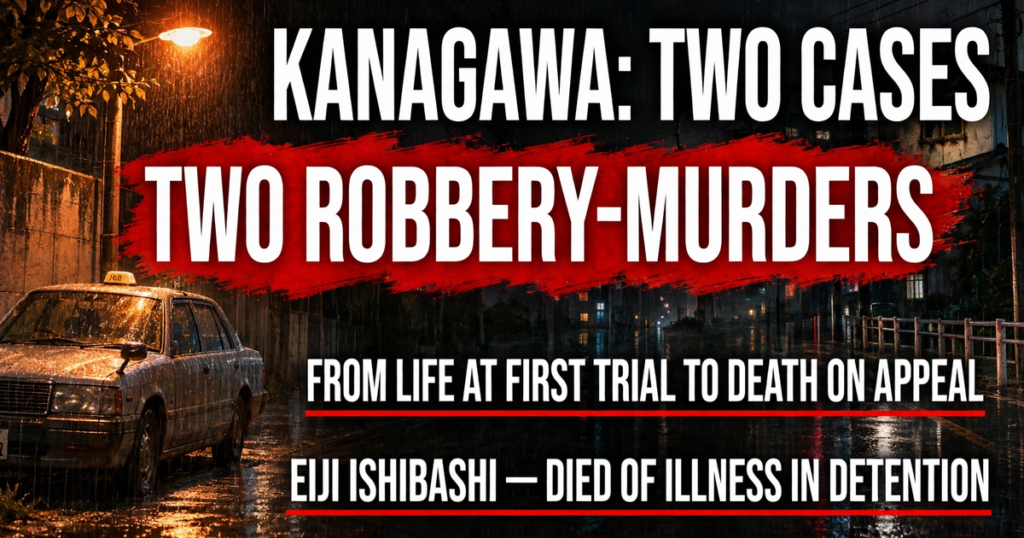
Two killings occurred within five days
The offences occurred on the night of December 28, 1988 and in the early hours of January 1, 1989. Eiji Ishibashi had been dismissed from a construction company and was short of money after spending his wages and borrowed funds on drinking and entertainment. The first victim was a taxi driver whom Ishibashi did not know. The second was a construction worker he had known from a former workplace. Both killings were committed for money, but the circumstances and the evidence differed. The case became particularly important because the first-instance court and the Tokyo High Court reached opposite conclusions about the taxi driver's death.
The taxi driver was stabbed in Hiratsuka
Shortly after 11:00 p.m. on December 28, Ishibashi took a taxi in Hiratsuka, Kanagawa Prefecture. He intended to take the driver's sales money and attacked the 44-year-old man from behind the rear seat with a fruit knife. He stabbed the driver several times in the left side of the neck, shoulder and head. The driver died from blood loss. Ishibashi became distressed when he saw the blood and left without taking the money. The later courts nevertheless found that the original purpose had been robbery and that the failure to take the cash did not erase the robbery-murder offence.
The second victim was a former co-worker at a dormitory
At approximately 12:30 a.m. on January 1, Ishibashi visited a workers' dormitory connected with a construction company where he had previously worked. He said he had come to borrow money. A 39-year-old former co-worker was there and gave him alcohol. After the man became intoxicated and fell asleep, Ishibashi decided to kill him and take his money. He struck the man's face with an iron tool and cut his face and neck with a utility knife. He then took 28,000 yen. The victim was still alive after the assault and theft.
The dormitory was set on fire while the victim was alive
Ishibashi moved the injured man near a heater, spread kerosene inside the dormitory and set fire to the building. The plan was to make the incident appear to be an accidental fire and conceal the robbery. The prefabricated dormitory was completely destroyed, and the victim died in the fire. The Supreme Court regarded the fact that Ishibashi knew the man was still alive when he set the fire as particularly serious. The offence was not merely a theft followed by an attempt to destroy evidence; the arson caused the death of the injured victim.
The taxi incident became a dispute about the reliability of a confession
During the investigation, Ishibashi made statements admitting the taxi attack. At trial he withdrew that account and denied being the offender. The defence argued that the confession had been forced and challenged both its voluntariness and its reliability. In the dormitory case, Ishibashi admitted taking the money and some aspects of the fire but disputed details of the assault. The taxi incident depended heavily on how the confession was evaluated and whether it matched the other evidence. This evidentiary dispute was the reason the first-instance and appellate courts reached different results.
The first-instance court acquitted him of the taxi murder
On March 8, 1996, the Yokohama District Court's Odawara Branch found that doubts remained about Ishibashi's confession to the taxi-driver killing and acquitted him of that offence. The court did, however, find him guilty of the robbery-murder and arson at the workers' dormitory and sentenced him to life imprisonment. The first judgment therefore contained one acquittal and one conviction within the same case. The life sentence was based on the single homicide the court found proved, not on a conclusion that both victims had been killed by Ishibashi.
The Tokyo High Court reversed the taxi acquittal and imposed death
The prosecution appealed the acquittal. On April 28, 1999, the Tokyo High Court overturned the first-instance judgment, found Ishibashi responsible for both incidents and sentenced him to death. It examined the circumstances of the interrogation, the contents of the confession, consistency with other evidence and Ishibashi's conduct after the offences. The high court concluded that the confession had not been forced and that its contents were consistent with the surrounding evidence. With both deaths found to be robbery-murders, the factual basis for sentencing was substantially different from that before the district court.
The Supreme Court upheld the death sentence in April 2004
Ishibashi appealed to the Supreme Court, challenging the finding that he had killed the taxi driver, the voluntariness of his confession and the severity of the death sentence. On April 27, 2004, the Supreme Court's Third Petty Bench dismissed his appeal. It found no evidence that the confession had been coerced and accepted the Tokyo High Court's assessment of the evidence. The Court emphasized that both killings had been committed for money, that the victims had done nothing to provoke the attacks and that the dormitory victim had been set on fire while still alive. The death sentence became final.
Ishibashi died in detention before execution
After the sentence became final, Ishibashi was held at the Tokyo Detention House. He began to feel unwell around early September 2009 and received treatment, including antibiotics. He died of pneumonia on October 27, 2009, aged 72. The death sentence was not carried out. The legal outcome remains a final death sentence imposed after the Tokyo High Court reversed the taxi-case acquittal and the Supreme Court upheld that reversal. Ishibashi's death in custody must not be described as an execution.
The reversal changed the number of deaths attributed to the defendant
The central feature of the case is the reversal between the two court stages. The district court found one robbery-murder and one acquittal, imposing life imprisonment. The Tokyo High Court found both robbery-murders proved and imposed death, and the Supreme Court maintained that result. The two incidents were separated by only five days, but one involved a stranger in a taxi and the other a former co-worker in a dormitory. The case shows why the treatment of confession evidence and the findings about each separate offence must be described precisely.
Original Japanese record: 神奈川2件強盗殺人事件|一審無期から逆転死刑、石橋栄治は確定後に拘置中病死
Last updated:
Related articles

Case record
The Isesaki Junior-High-School Girls Murders: Robbery, Arson and a Death Sentence
Case record
The Osaka Private Video Booth Fire: Sixteen Deaths, a Final Death Sentence and a Second Retrial Denial

Case record
The Four-Prefecture Four-Murder Case: Twelve Years for the First Killing and Death for Three Later Murders
Case record