
The Iruma Yakuza Office Shooting: Five Deaths, a Death Sentence and Death in Custody
At midday on December 14, 2003, five senior members of the same organized-crime group were shot dead at a gang office in a residential area of Iruma, Saitama Prefecture. The gunman was Kaiichi Yamamoto, a senior member of a Sumiyoshi-kai-affiliated group. He surrendered to police immediately after the shootings. Yamamoto said he had heard that others were planning to kill him, but the courts rejected the idea that this justified a pre-emptive shooting. His death sentence became final in 2008; he died of liver cancer in detention in 2010 and was not executed.
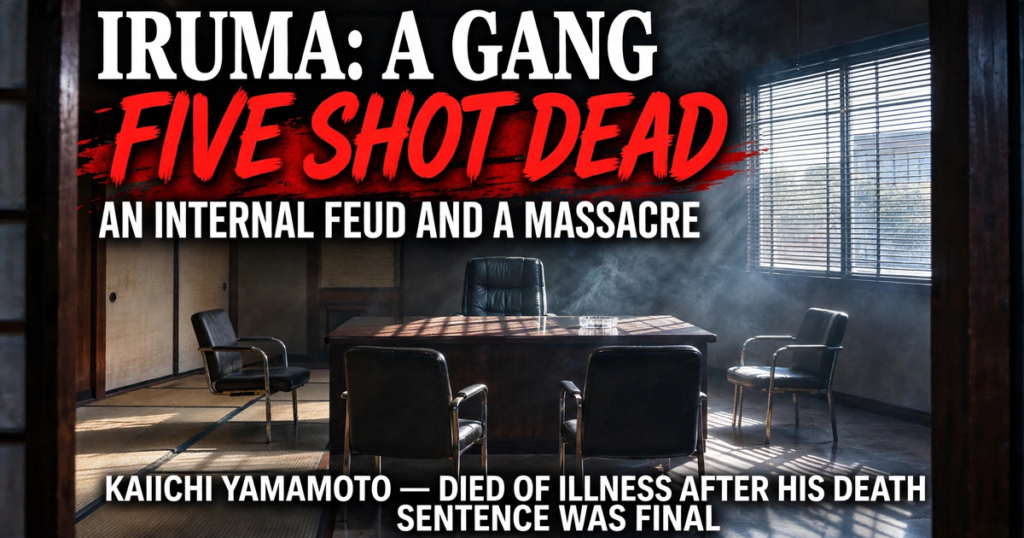
Five senior members were killed at a gang office
At midday on December 14, 2003, five men who belonged to the same organized-crime group were shot dead at a gang office in a residential district of Iruma, Saitama Prefecture. The gunman was Yamamoto Kaiichi, a senior member of a Sumiyoshi-kai-affiliated organization. He surrendered to police immediately after the shooting. The victims were all senior members or executives of the same organization. The incident was therefore an internal conflict within an organized-crime group, but the fact that the victims were gang members did not change the legal assessment of their deaths or reduce the seriousness of the five murders.
Yamamoto believed that a plan to kill him was being discussed
Yamamoto had joined the organized-crime world soon after graduating from junior high school and had spent many years in the organization. By 2003, relations with other leaders in the same upper organization had deteriorated. He was dissatisfied with his position and the way the group was run. He also heard information that a plan to kill him was being discussed and believed that danger was approaching. The defence later relied on this fear and argued that Yamamoto had acted before the other side could kill him. The courts examined the claim but did not accept it as a justification for the shootings.
The court rejected a private pre-emptive attack as a lawful response
The Supreme Court reasoned that, even if a plan to attack Yamamoto had existed, he could have sought protection from police or used other lawful means to avoid danger. The existence of hostility or a possible threat did not authorize him to take a firearm to a meeting and shoot several people. The case was not treated as an immediate act of self-defence against an attack already underway. The courts distinguished a perceived future threat from a situation in which lethal force might be necessary to repel an imminent unlawful attack.
He went to a meeting prepared to shoot several people
On the day of the incident, Yamamoto went to the gang office when senior members were gathered. He brought a firearm and entered the premises with the intention of shooting people who were present. The Supreme Court regarded the sequence as planned, rather than a single shot fired during a sudden argument. Yamamoto fired repeatedly at the executives, killing all five. The fact that the office was located in a residential neighbourhood also mattered. The shootings took place in daylight and created danger and fear beyond the immediate victims.
Yamamoto surrendered and admitted the shootings
After the attack, Yamamoto did not continue fleeing. He went to the police and admitted that he had shot the five men. His surrender and consistent acceptance of the basic facts were considered favourable circumstances in the sentencing process. They did not, however, erase the planning and the result of the crime. The court compared those favourable circumstances with the preparation of the firearm, the decision to target a group meeting, the repeated shooting of five people and the danger created in a residential area.
The courts considered his prior record and long involvement in organized crime
The Supreme Court also considered Yamamoto's history of violent offences. His record included a previous conviction for attempted murder that had resulted in a four-year prison term, along with other offences involving violence. The Court did not treat membership in an organized-crime group as a crime in itself. Rather, it considered his history when assessing the way he responded to conflict: instead of seeking lawful protection, he chose to use a firearm to kill people he believed might threaten him. The number of victims, the planning and the prior record were weighed together.
The district, high and Supreme Courts all maintained the death penalty
The Saitama District Court sentenced Yamamoto to death on September 8, 2005. The Tokyo High Court dismissed his appeal on September 28, 2006, maintaining the sentence. On April 24, 2008, the Supreme Court's First Petty Bench dismissed his final appeal. The Supreme Court described the five shootings as planned and brutal and considered the scale of the loss of life, the effect on the community and Yamamoto's criminal history. It acknowledged his surrender and admissions but concluded that they did not justify reducing the sentence. The death sentence became final in April 2008.
Yamamoto died in detention before the sentence was carried out
After the death sentence became final, Yamamoto was held at the Tokyo Detention House. He died there on January 2, 2010, aged 62, from liver cancer. The death sentence was never carried out. His death in custody must be distinguished from an execution: the legal sentence had become final in 2008, but the state did not execute it before he died. The case's final procedural record is therefore five murders, a final death sentence, and death in detention before execution.
The courts rejected the idea that gang conflict justified the killings
The case illustrates the boundary between a background conflict and a legal justification for violence. The courts did not deny that Yamamoto believed he was at risk from other members of the organization. They nevertheless found that he had chosen a planned armed attack in a residential area and killed five people. The surrender and admissions were considered, but the scale and method of the offence remained decisive. The final death sentence was imposed and upheld through all three ordinary court stages; Yamamoto later died of illness in detention rather than being executed.
Original Japanese record: 入間市暴力団組員5人射殺事件|山本開一が幹部5人を射殺、死刑確定後に病死
Last updated:
Related articles
Case record
The Kodaira Murders: Ten Murder Charges, Seven Convictions and a Postwar Pattern of Predation
Case record
The Utsunomiya Jewelry Store Arson-Robbery Murders: Six Employees Bound and Killed for High-Value Stock
Case record
The Konohana Pachinko Parlor Arson Murders
Case record