
The Aconite Insurance Murder: Two Toxins in Preserved Blood and a Case Built on Circumstantial Evidence
On May 20, 1986, 33-year-old Risako died during a trip to Ishigaki Island in Okinawa. Her death was initially difficult to explain. Blood preserved after the autopsy was later found to contain aconite alkaloids and tetrodotoxin, a combination that became central to the investigation of her husband, Chikara Kamiya. The prosecution relied on toxicology, insurance arrangements, the acquisition of aconite plants and the couple's travel movements. Kamiya received life imprisonment, which became final on February 20, 2002. He died in prison in November 2012.
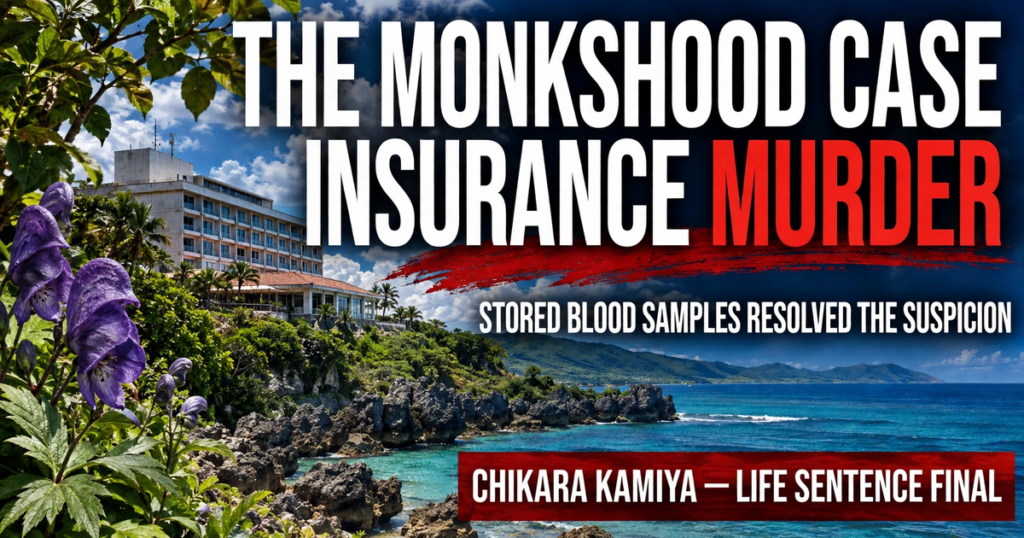
Risako became critically ill after separating from her husband
On May 20, 1986, 33-year-old Risako became seriously ill during a trip to Okinawa. She had travelled with Kamiya and other acquaintances. During the trip, Kamiya changed his plans and separated from his wife and the others; Risako continued with a companion to Ishigaki Island. A forensic-medicine paper described her as developing sudden severe nausea and vomiting at a hotel, losing consciousness in an ambulance and dying in hospital after ventricular fibrillation. At first, a heart attack was suspected. The visible autopsy findings did not establish a clear cause of death, and the interval between separating from Kamiya and the onset of symptoms later became important.
Blood retained after the autopsy changed the investigation
Blood samples collected after the autopsy were stored at minus 20 degrees Celsius. Later analytical methods and additional testing detected aconitine, mesaconitine and hypaconitine, alkaloids associated with aconite poisoning. The same preserved blood also contained tetrodotoxin, the toxin commonly associated with pufferfish. The findings led investigators to regard aconite poisoning as the cause of death. The body had already been cremated, so a new examination of the remains was no longer possible. The retained blood sample nevertheless allowed scientists to test for substances that had not been identified when the original examination took place.
The two toxins became central to the timing question
Aconite toxins affect sodium channels in nerves and cardiac muscle and can cause severe arrhythmias. The difficulty for the prosecution was that Risako became ill after a period apart from Kamiya, rather than immediately after the suspected opportunity to administer a poison. The defence could argue that the timing did not fit a simple explanation involving aconite alone. In response to the discovery of both toxins, forensic researchers examined their combined effects in animal experiments. A 1992 paper reported that, under certain dose ratios, tetrodotoxin could delay death compared with aconitine alone and reduce the fatal effect.
The science did not establish a precise delayed-action poison
The 1992 research did not prove that a person could set a precise timer by combining the two substances. The paper itself noted that the pharmacokinetics of aconitine and tetrodotoxin, including reliable blood-concentration measurement, were not fully understood at the time. What the experiments directly showed was an antagonistic interaction under particular conditions: tetrodotoxin could reduce aconitine's toxic effect and delay death in the tested animals. The English account therefore avoids the popular but inaccurate claim that a scientifically perfected time-release poison had been demonstrated. The important evidence was the detection of both toxins in Risako's blood and the experimentally observed interaction.
Insurance and the acquisition of aconite formed part of the prosecution case
Reports at the time of Kamiya's arrest stated that life insurance policies totalling 185 million yen had been taken out on Risako, with Kamiya as beneficiary. Investigators also examined his earlier purchases of aconite plants. Reporting in 1991 referred to suspicion that he had bought approximately seventy plants from a high-altitude plant shop in Fukushima Prefecture. The insurance and plant purchases were relevant to motive and preparation, but neither fact alone proved murder. The prosecution combined them with the toxicology findings, the couple's movements during the trip, the timing of their separation and other circumstances.
There was no eyewitness to the administration of the poison
No witness directly saw Kamiya hand Risako a poisoned capsule or watched her swallow it. The precise time, place and method of administration could not be fixed to a single moment. The defence challenged the clarity of the charged conduct, while the Tokyo District Court considered whether the prosecution had specified the act as far as the available evidence allowed. The court assessed the evidence as a whole: the preserved blood, the scientific research, the insurance contracts, the purchase of aconite, Kamiya's conduct during the trip and other circumstances. It concluded that the combined circumstantial evidence established an insurance-motivated murder beyond reasonable doubt.
The courts imposed and upheld life imprisonment
The Tokyo District Court sentenced Kamiya to life imprisonment on September 22, 1994. He appealed, but the Tokyo High Court dismissed the appeal on April 28, 1998. The Supreme Court dismissed his final appeal on February 20, 2002, making the life sentence final. Some older summaries have incorrectly given 2000 as the year of finality. The archive's review of the court chronology and published materials confirms 2002. The case is an example of a conviction based on multiple strands of circumstantial evidence rather than a direct eyewitness account of the poisoning.
Kamiya died while serving the final sentence
Kamiya continued serving his life sentence after the Supreme Court's decision. He died in November 2012 at Osaka Medical Prison at the age of 73, according to the reports cited by the archive. His death ended the execution of the sentence in the ordinary sense, but it did not reverse the conviction or produce an acquittal. No retrial or judgment overturning the conviction is recorded in the Japanese article. The legal result remains a final life sentence, not a death sentence and not an unresolved investigation.
The case must be understood through both science and legal proof
The Aconite Insurance Murder is often remembered for the unusual combination of two toxins. The judicial question, however, was broader than the laboratory result. Toxicology identified substances in the preserved blood; experiments examined how they interacted; and the court considered insurance, the acquisition of plants, the travel itinerary and the defendant's conduct. The forensic paper did not identify the person who administered the poison or establish an insurance motive. Those were questions for the criminal court, which evaluated the scientific findings alongside the other evidence. Keeping these separate avoids turning a scientific observation into a conclusion that the research itself did not make.
Original Japanese record: トリカブト保険金殺人事件|保存血液の二毒検出と、時間差をめぐる間接証拠
Last updated:
Related articles
Case record
The Matayoshi Takeo Wanted Case: The 1990 Killing of Two Okinawa Police Officers and an Unresolved Search
Case record
The Uruma City Murder: Rina Shimabukuro's Killing, a Disputed Intent to Kill and a Life Sentence
Case record
The Sendai Elderly Couple Robbery Murders: A Five-Year Suspension in the Supreme Court and a 19-Year Path to Finality
Case record