
The Koganei Stalking Attack: A Victim's 110 Call, Police Dispatch Failures and the Limits of the Law
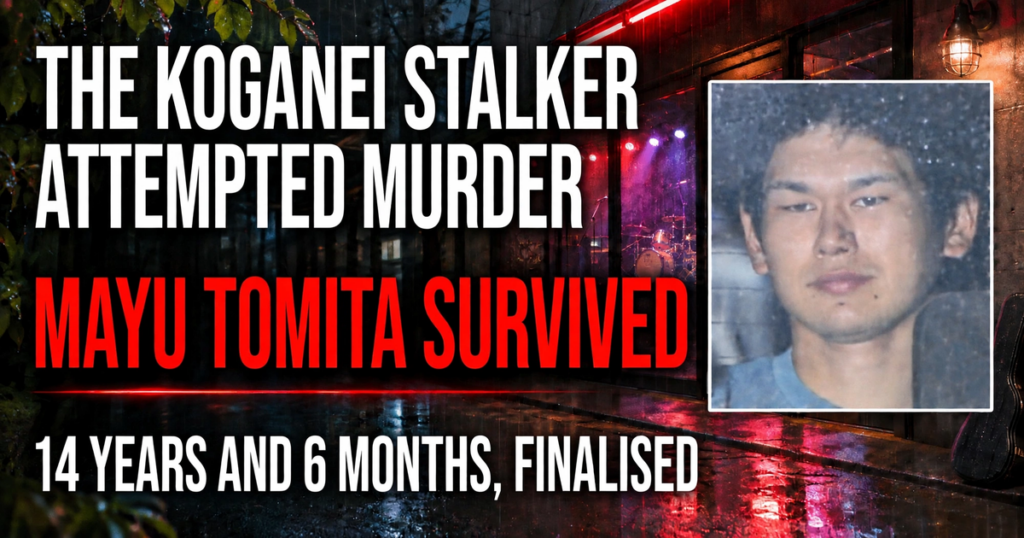
On May 21, 2016, musician and university student Mayu Tomita, 20, was repeatedly stabbed near a live-music venue in Koganei, Tokyo, by Tomohiro Iwasaki. She survived after suffering life-threatening injuries. Tomita had previously reported persistent social-media harassment to police and called 110 shortly before the attack. The initial dispatch was directed toward her registered home address rather than her actual location. Iwasaki received 14 years and six months in prison in 2017. The case helped prompt a revision of the Stalker Regulation Act to cover persistent social-media contact.
Repeated social-media contact preceded the attack
Mayu Tomita was a 20-year-old university student who was also active as a musician. Tomohiro Iwasaki repeatedly posted messages to her social-media accounts and began appearing at live-music events where she performed. Tomita became increasingly frightened by the contact. On May 9, 2016, she consulted the Musashino Police Station and explained that she feared Iwasaki might harm or kill her. The consultation took place less than two weeks before the attack. The police therefore had information about the unwanted contact before the incident occurred. The archive's post-incident review found that the consultation was not sufficiently connected to the specialist anti-stalking unit and was not treated as a high-urgency case.
The law at the time did not clearly cover every form of repeated social-media contact
The Stalker Regulation Act then in force covered specified forms of repeated contact, including certain emails and telephone communications. Persistent messages or comments on social-media platforms did not fit as clearly within the statutory categories. That did not mean every social-media message was automatically lawful, but it did create uncertainty about which provisions could be applied to the conduct Tomita reported. The Tokyo Metropolitan Assembly later discussed the limits of the existing law and the need to protect victims when online contact moved into physical stalking.
Tomita called 110 shortly before the attack
On May 21, 2016, Tomita was travelling to a live-music venue in Koganei. When Iwasaki approached her, she called the emergency number 110. The Japanese archive records the call at about 5:05 p.m. The call remained connected, and her voice indicated that she needed help. Tomita had previously been registered in a police emergency-contact system, but the information displayed to the call-taker included her home address. The actual location of the mobile phone was not immediately checked.
The first dispatch was directed toward her home rather than the scene
Because the registered home address appeared in the system, the initial dispatch sent officers toward the address associated with Tomita rather than the place where she was being attacked. A separate call from a witness reporting that a woman was being stabbed brought police toward the live-music venue. The failure to check the caller's actual location became a major issue in the post-incident review. The police system had been designed to help officers identify people who might be at risk, but in this case the stored address contributed to confusion about where immediate assistance was needed.
Iwasaki attacked Tomita near the venue
Iwasaki repeatedly stabbed Tomita near the live-music venue. She suffered numerous injuries and was in critical condition, but survived after emergency medical treatment. The attack was charged as attempted murder rather than completed murder. The fact that she survived did not make the violence minor: the court later considered the strength of the intent to kill and the persistence of the attack. Tomita was left with serious physical and psychological consequences.
The criminal trial focused mainly on the sentence
Iwasaki was arrested at the scene and charged with attempted murder and related offences. At trial, he admitted the central conduct, and the main dispute concerned the appropriate sentence. Tomita used the victim-participation system to explain the harm she had suffered and the fear she continued to experience. The court considered the danger of the attack, the repeated use of the knife and the fact that she had been left unable to defend herself. The prosecution requested 17 years in prison.
The Tachikawa Branch imposed 14 years and six months
On February 28, 2017, the Tokyo District Court's Tachikawa Branch sentenced Iwasaki to 14 years and six months in prison. The sentence was shorter than the prosecution's request of 17 years. Tomita and her representatives expressed concern about the length of the sentence and asked prosecutors to appeal. The sentence became final in 2017. The finality should not be described as a higher court affirming the sentence after a full appellate review; the Japanese archive records the sentence as final without an appellate merits judgment.
The Stalker Regulation Act was amended to cover online conduct
In December 2016, the Diet enacted amendments to the Stalker Regulation Act. The changes expanded the law to cover repeated electronic communications and persistent contact through social-media services. The amendments also strengthened the ability to issue emergency prohibition orders without first giving a warning in certain circumstances, restricted the provision of information when it was known to be used for stalking, strengthened penalties and changed the prosecution requirements for stalking offences. The revised framework addressed gaps that had become visible in cases involving online harassment followed by physical contact.
Police procedures for emergency calls were also reviewed
The police examined why the 110 call had not immediately directed officers to Tomita's actual location. The system was changed so that location information from a registered person's mobile phone could be displayed automatically when that person called for help. Police also emphasised the need to share stalking consultations across specialist units and to assess the pattern of conduct as a whole, rather than treating each message or encounter as an isolated event. These administrative improvements were separate from the criminal court's decision about Iwasaki.
A later civil settlement did not alter the criminal judgment
Tomita and her representatives later pursued a civil claim concerning the police response before the attack. That claim was settled in 2025 with Tokyo and other defendants, according to the current Japanese archive and Kyodo's case summary. A civil settlement is not the same as a criminal conviction and should not be described as a court finding that a particular officer committed a crime. Iwasaki's 14-year-and-six-month sentence had already become final in 2017. The case therefore has two distinct legal histories: the criminal case against the attacker and the later civil dispute about the response to Tomita's earlier reports and emergency call.
Original Japanese record: 小金井ストーカー殺人未遂事件|冨田真由さんの110番はなぜ現場につながらなかったのか
Last updated:
Related articles
Case record
The Mitaka Stalking Murder: A Twenty-Two-Year Sentence, a Retrial on Remand and Digital Abuse
Case record
The Shinjuku Tower-Mansion Stabbing

Case record
The Hino City Two-Child Arson Murders: Yukie Kitamura, Intent and the Life Sentence
Case record