
The Murder of Le Thi Nhat Linh: A Nine-Year-Old Student, a Community Volunteer and a Life Sentence
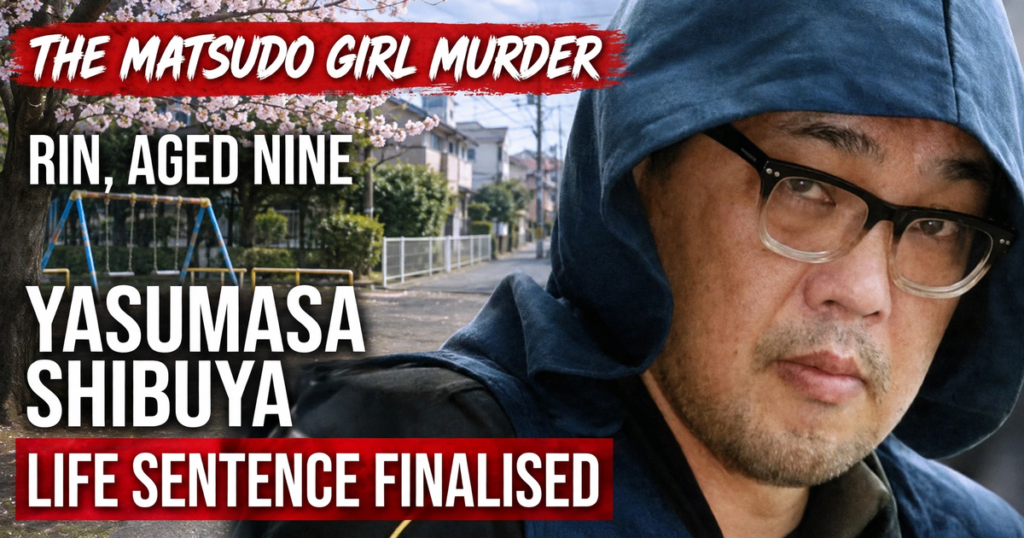
Nine-year-old Vietnamese student Le Thi Nhat Linh disappeared on her way to school in Matsudo, Chiba Prefecture, on March 24, 2017. Her body was found two days later in Abiko. The investigation linked DNA, vehicle movements, surveillance footage and evidence recovered from several locations to Yasumasa Shibuya, who had been involved in school-community safety activities. He denied the charges, and prosecutors sought the death penalty. The courts imposed life imprisonment; the Supreme Court dismissed his appeal on May 11, 2022, making the sentence final.
A nine-year-old student disappeared on her way to school
On the morning of March 24, 2017, Le Thi Nhat Linh, a nine-year-old Vietnamese girl in the third grade of elementary school, left home in Matsudo, Chiba Prefecture, for school. She did not arrive. Her family reported her missing, and police began searching the route and nearby areas. Two days later, on March 26, her body was found beside a drainage channel in Abiko, a neighbouring city. Her schoolbag and other belongings were found separately. The discovery changed a missing-child search into a murder investigation.
The investigation connected several locations rather than relying on one clue
Investigators examined the route between Linh's home and school, surveillance-camera footage, vehicle movements and physical evidence recovered from the locations associated with the case. The body had been moved, and the separate discovery of belongings meant that the police had to reconstruct more than one location and the movements between them. DNA testing and other forensic examinations were used alongside the camera and vehicle evidence. The case was not solved by a single eyewitness identification; it was built from several strands that were assessed together.
The suspect had taken part in school-community safety activities
Police arrested Yasumasa Shibuya on April 14, 2017, initially on suspicion of abandoning a body. Shibuya had previously served as president of the school's parents' association and had participated in activities intended to watch over children travelling to and from school. His role in the community made the arrest particularly shocking to local families. That role was part of the public context of the investigation, but it was not itself evidence of guilt. The prosecution had to establish the charged conduct through the forensic and circumstantial evidence.
The indictment covered the sequence from abduction to abandonment
After the arrest, the investigation developed into charges concerning the abduction of a child for a sexual purpose, indecent assault resulting in death, murder and abandonment of a body. Shibuya denied being the perpetrator and contested the prosecution's case. The prosecution relied on DNA evidence, vehicle movements, physical traces and the reconstruction of the locations. The trial therefore concerned both the identity of the offender and the legal assessment of the acts committed against Linh. The case should not be reduced to the fact that the suspect had once been a school volunteer.
The prosecution sought the death penalty, but the first court imposed life imprisonment
The Chiba District Court delivered its judgment on July 6, 2018, and sentenced Shibuya to life imprisonment. The prosecution had sought the death penalty, while the defence argued that he was not guilty. In explaining the sentence, the court considered the victim's age, the seriousness of the crimes and the circumstances of the killing. It also considered the extent to which the murder had been planned in advance. The court did not accept the prosecution's request for capital punishment, but it imposed the most severe custodial sentence short of death.
Both sides appealed, and the Tokyo High Court maintained the sentence
The defence appealed the conviction, while the prosecution appealed the decision not to impose the death penalty. On March 23, 2021, the Tokyo High Court dismissed both appeals and maintained the life sentence. The defence raised questions about the handling of evidence, including cigarette butts collected during the investigation, and continued to challenge the identification of Shibuya as the offender. The High Court upheld the first court's assessment of the evidence and did not increase the sentence to death.
The Supreme Court made the life sentence final in May 2022
The prosecution did not appeal the High Court's refusal to impose the death penalty. Shibuya alone filed a final appeal. On May 11, 2022, the Supreme Court's First Petty Bench dismissed it. The life sentence therefore became final. It is important to describe the procedural sequence accurately: the death penalty was requested by prosecutors, rejected by the trial court, and not restored on appeal; the final sentence was life imprisonment.
The case left a lasting impact on families and community safety
The case caused deep fear among parents and children in the area because Linh was attacked while travelling on an ordinary school route and the suspect had been involved in community safety activities. The conviction did not mean that every person who takes part in a school-watch programme should be treated with suspicion. It did, however, prompt renewed attention to safeguarding systems that do not depend solely on a person's public role or reputation. Linh's family continued to speak about their loss after the sentence became final. The end of the criminal proceedings did not end the family's grief.
Original Japanese record: 松戸市ベトナム人女児殺害事件|リンさん9歳、死刑求刑から無期懲役確定まで
Last updated:
Related articles

Case record
The Murder of Lindsay Ann Hawker: Police Encounter and Flight on Foot, Arrest 961 Days Later

Case record
The Murder of a First-Grade Girl in Kobe's Nagata Ward: A Death Sentence Replaced by Life Imprisonment
Case record
The Noda City Child Abuse Death: Mia Kurihara's Plea for Help and the Failure to Protect Her

Case record