
The Kudo-kai Four Civilian Attacks: The Death Sentence Overturned and the Supreme Court Appeals Still Pending
The Kudo-kai case concerns four attacks between 1998 and 2014: the killing of a former fisheries cooperative leader, the shooting of a former police superintendent, and stabbings of a nurse and a dentist. A first-instance court sentenced leader Satoru Nomura to death and senior figure Tanoue Fumio to life imprisonment. The Fukuoka High Court later acquitted Nomura of one of the four cases and reduced his sentence to life imprisonment. Both defendants and the prosecution pursued further appeals.
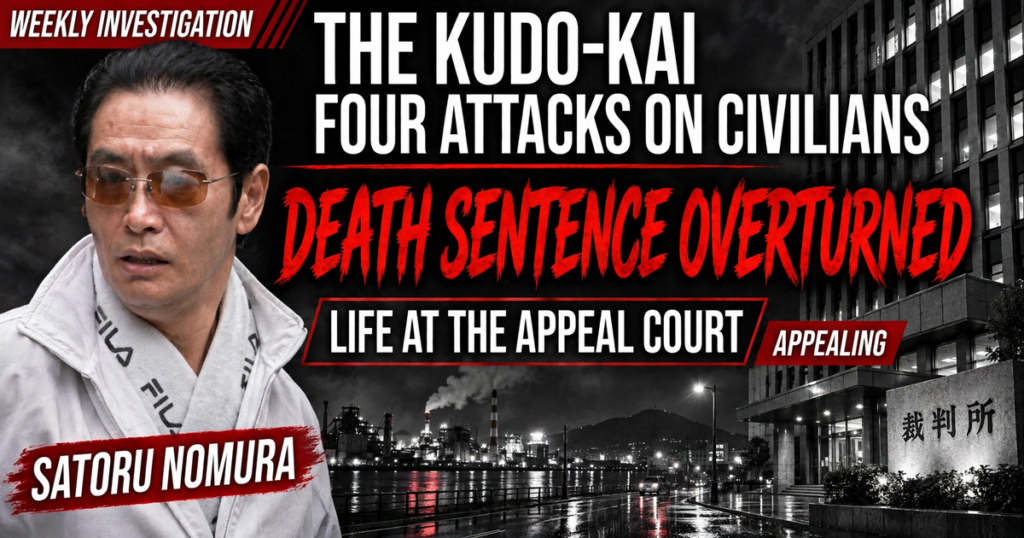
Four attacks over sixteen years became one major organised-crime trial
The term Kudo-kai Four Civilian Attacks refers to four violent incidents between 1998 and 2014 in Fukuoka Prefecture. They involved the shooting death of a former fisheries cooperative leader in 1998, the shooting of a former Fukuoka Prefectural Police superintendent in 2012, the stabbing of a female nurse in 2013 and the stabbing of a dentist in 2014. The victims were not members of a rival gang. They were civilians or a former police officer. The four incidents were prosecuted together because investigators alleged that senior figures in the Kudo-kai organised-crime group had directed or approved attacks carried out by subordinate members.
The first attack was linked to a dispute involving a fisheries cooperative
The 1998 victim was a former head of a fisheries cooperative who was said to have been in conflict with Kudo-kai interests over port-related rights. He was shot and killed. In 2012, a former police superintendent who had long worked on organised-crime investigations was shot and seriously injured. The next two incidents involved a nurse at a cosmetic surgery clinic attended by Nomura and a dentist who was related to the victim of the 1998 killing. The pattern led investigators to examine whether the attacks were isolated acts by individual members or part of decisions made within the organisation's hierarchy.
Satoru Nomura and Tanoue Fumio were prosecuted as senior figures
Satoru Nomura, the Kudo-kai's leader, and Tanoue Fumio, its senior number two, were not accused of personally firing the weapons or wielding the knives. The prosecution alleged that they had directed or approved the attacks and were therefore responsible as co-conspirators. The case required the court to assess the relationship between the men, the subordinate members who carried out the violence, the victims' connections to the organisation and the circumstances surrounding each incident. In an organised-crime group, instructions may not be recorded in written orders or direct recordings, so the prosecution relied heavily on circumstantial evidence.
The Fukuoka District Court imposed death and life sentences in 2021
On August 24, 2021, the Fukuoka District Court found Nomura responsible for all four attacks and sentenced him to death. It sentenced Tanoue to life imprisonment. The court considered the hierarchy of the group, the alleged motives and the relationships between the senior figures and the members who carried out the attacks. Nomura denied directing the crimes and argued that subordinate members had acted on their own. The first-instance court nevertheless concluded that the combined circumstances supported findings of conspiracy. Both defendants challenged the judgment.
The defence positions changed during the appeal
The appeal proceedings began in 2023. Tanoue's defence changed its position concerning the 2013 nurse stabbing and the 2014 dentist stabbing, arguing that Tanoue had directed those two attacks independently. Nomura continued to deny involvement in all four incidents. This required the High Court to evaluate the evidence separately for each defendant and each attack, rather than treating the organisational hierarchy as proof of a single blanket conspiracy. The court examined whether the first-instance inferences were logically supported by the evidence and by the circumstances of each case.
The Fukuoka High Court acquitted Nomura of the 1998 shooting
On March 12, 2024, the Fukuoka High Court overturned the first-instance judgment concerning Nomura and found him not guilty of conspiracy in the 1998 shooting of the former fisheries cooperative leader. The High Court accepted that the killing was an organised crime, but concluded that this fact alone did not prove that Nomura had participated in the agreement to commit it. It also found insufficient evidence for the first-instance inference that Nomura had been so intent on intervening in the victim family's interests that he was prepared to have the victim killed. The acquittal was limited to Nomura's responsibility for that one incident.
Nomura remained guilty of the other three attacks
The High Court maintained Nomura's criminal responsibility for the 2012 shooting of the former police superintendent, the 2013 stabbing of the nurse and the 2014 stabbing of the dentist. Because the 1998 murder was removed from the findings against him, the High Court set aside the death sentence and imposed life imprisonment. Tanoue's first-instance life sentence was maintained, and his appeal was dismissed. The result was not a blanket acquittal for either defendant: the court differentiated between the defendants and between the four attacks.
The prosecution and both defendants appealed to the Supreme Court
After the High Court judgment, Nomura and Tanoue appealed to the Supreme Court. The Fukuoka High Public Prosecutors Office also appealed the part of the decision that acquitted Nomura of the 1998 shooting. Reporting on July 16, 2026 confirmed that Nomura's appeal remained pending, and reports through August 2026 also indicated that Tanoue's appeal was continuing. The High Court outcomes must therefore not be described as final. The latest verified position for this translation is that the Supreme Court proceedings have not yet produced a final ruling.
The organisation's leadership changed while the appeals continued
On July 16, 2026, the Fukuoka Prefectural Public Safety Commission publicly announced a change in the Kudo-kai's representative from Nomura to Tanoue. Police said they had concluded that Nomura no longer exercised influence over the organisation. The leadership change is a separate development from the criminal appeals. It does not establish that the Supreme Court has decided the cases, nor does it alter the sentences imposed by the High Court. The distinction matters because public discussion of the group's leadership can otherwise be mistaken for a change in the defendants' legal status.
The central legal question was proof of conspiracy in each incident
The four attacks show why a senior figure's position in a criminal organisation cannot, by itself, establish criminal guilt for every act committed by subordinates. The prosecution relied on relationships, motive, hierarchy and events before and after the attacks. The first-instance court accepted a broad inference of responsibility, while the High Court found that the inference was insufficient for Nomura in the 1998 case but sufficient in the other three. The Supreme Court appeals will determine whether the High Court's legal and evidentiary conclusions stand. Until then, the accurate record is a High Court life sentence for Nomura, a maintained life sentence for Tanoue, and appeals still pending.
Original Japanese record: 工藤会市民襲撃4事件|野村悟の死刑を破棄した控訴審、4事件の共謀認定はどう変わったか
Last updated:
Related articles
Case record
The Iizuka Case: A Death Sentence, an Execution and Continuing Retrial Petitions
Case record
The Kitakyushu Confinement Murders: Seven Deaths Without Recovered Bodies and the Separate Sentences for Futoshi Matsunaga and Junko Ogata

Case record
The Fukuoka Serial Robbery Murders: Two Victims, a Handgun Network and a Final Death Sentence
Case record