
The Sinking of the KAZU I: Twenty Confirmed Deaths, Six Missing and the Company President's Five-Year Sentence
The passenger vessel KAZU I sank off the Shiretoko Peninsula on April 23, 2022, with 26 people aboard. The official accident report recorded 20 deaths and six passengers missing. Investigators traced the sinking to water entering through a bow-deck hatch and spreading through internal compartments, while also examining the decision to continue operating in deteriorating weather. In June 2026, company president Seiichi Katsurada received a five-year sentence, but his appeal remains pending.
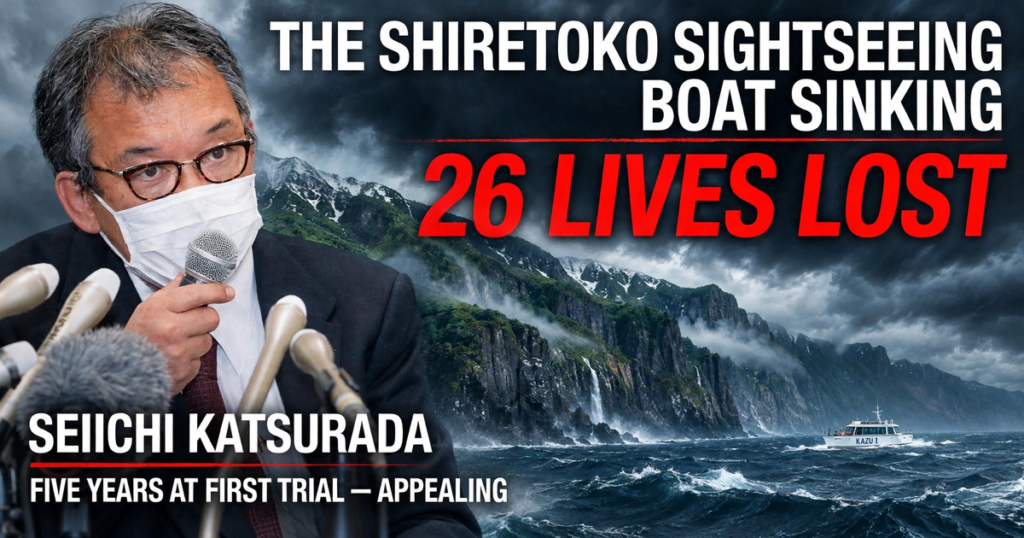
The KAZU I disappeared off the Shiretoko Peninsula
On April 23, 2022, the passenger vessel KAZU I sank off the western coast of the Shiretoko Peninsula in Hokkaido, near Cape Kashuni Falls. The vessel had departed from Utoro on a sightseeing trip toward the Shiretoko Peninsula. There were 26 people aboard: 24 passengers, the captain and one deckhand. The boat sent distress communications after water began entering the vessel, but it sank within a short period. The official accident investigation records 20 confirmed deaths—18 passengers and the two crew members—and six passengers who remained missing. The distinction between confirmed deaths and missing people is important when describing the casualty figures.
Weather conditions deteriorated during the voyage
Forecasts indicated that wind and waves would strengthen during the afternoon. The vessel continued along the western side of the peninsula and turned back from the direction of Cape Shiretoko. The weather and sea conditions were central to the subsequent investigation because the operator's standards placed limits on the conditions in which the boat could sail. Investigators examined the forecast information available before departure, the conditions that developed at sea and the decision not to return to port earlier or seek shelter. The captain died in the sinking, so investigators could not obtain his account of the decisions made on the bridge.
Water entered through a bow-deck hatch
The Japan Transport Safety Board concluded that the sinking began when seawater entered through a hatch in the bow-deck area. Waves washed over the bow, and the hatch cover was not securely closed. The movement of the vessel caused the cover to open, allowing water to enter the compartment below the upper deck. The report also examined deterioration and looseness in hatch components and the lack of adequate inspection and maintenance. A recent inspection by the small-vessel inspection organisation had not included an opening-and-closing test of the hatch, relying instead on a visual check.
Flooding spread through several internal compartments
The water did not remain in the bow. It spread from the forward compartment into the storage compartment, engine room and steering-gear room. The accident report also identified weaknesses in the watertight separation between compartments, including openings in bulkheads. As flooding advanced, the vessel lost buoyancy and stability, and the engine and steering spaces were affected. This sequence explains why describing the accident only as a boat overwhelmed by high waves would be incomplete. The official report identified a specific path by which water entered and moved through the vessel, alongside the operating decisions that allowed the voyage to continue.
The accident investigation examined the decision to continue sailing
The investigation found that deteriorating weather and sea conditions had been anticipated, yet the vessel departed with the hatch not securely closed and continued operating rather than returning early or taking shelter. The report considered the company's operating practices, the captain's decisions and the way safety standards were applied. It reconstructed the voyage using communications, weather forecasts, information about other vessels and examination of the recovered hull. The technical findings about the hatch and the operational findings about the decision to continue are related but distinct parts of the accident sequence.
The government revoked the company's operating licence
After the sinking, the Ministry of Land, Infrastructure, Transport and Tourism conducted a special inspection of Shiretoko Pleasure Boat. The inspection identified problems with the company's safety-management rules, the actual performance of the operations manager's duties and the training and supervision of the captain. On June 16, 2022, the ministry revoked the company's licence to operate an irregular passenger route under the Maritime Transportation Act. This was an administrative measure directed at the company's ability to operate safely. It was separate from the later criminal case against Katsurada personally.
The criminal trial focused on the president's duty to stop the voyage
Company president Seiichi Katsurada was prosecuted for professional negligence resulting in death. The prosecution argued that he had responsibilities as the company's president and safety-management officer and should have ordered the vessel not to depart or to stop operating when the weather deteriorated. The defence argued that the accident could not specifically have been foreseen by a person on shore and that decisions at sea belonged to the captain. The case therefore examined whether Katsurada had a duty to stop the voyage and whether the risk of deaths was foreseeable to him.
The Kushiro District Court imposed five years in June 2026
On June 17, 2026, the Kushiro District Court sentenced Katsurada to five years' imprisonment, the maximum penalty sought by the prosecution. The court concluded that he could readily have foreseen that operating in conditions beyond the company's standards could result in deaths. Katsurada's defence appealed on the day of the judgment. He was released on bail on June 19 after the Sapporo High Court rejected the prosecution's objection to bail. The first-instance sentence is therefore not final.
The appeal and the civil case remain separate proceedings
The Sapporo High Court is scheduled to begin the criminal appeal hearing on December 17, 2026. As of the latest update checked for this translation, the legal position remains a five-year first-instance sentence under appeal. A separate civil damages action brought by families against the company and Katsurada concluded at the Sapporo District Court on September 17, 2026, with judgment scheduled for February 25, 2027. The civil case does not determine the criminal appeal. The accurate current account is therefore 20 confirmed deaths and six missing in the accident report, a five-year first-instance sentence, and an appeal that has not yet been decided.
Original Japanese record: 知床遊覧船沈没事故|KAZUⅠを沈めた浸水経路と桂田精一の禁錮5年判決・控訴
Last updated:
Related articles
Case record
The Karuizawa Ski Tour Bus Crash: Fifteen Deaths and the Management Liability Trial

Case record
The Atsuma Forestry Worker Shooting Death

Case record
The Sankebetsu Brown Bear Attack: Six Days of Attacks in a Hokkaido Settlement
Case record