
The JR Uetsu Main Line Derailment: Inaho No. 14 and the Sudden Gust
On December 25, 2005, the six-car Inaho No. 14 limited express derailed near the Second Mogami River Bridge in Shonai, Yamagata Prefecture. All six cars left the rails, and the front cars overturned. Five passengers died and 33 people were injured. The investigation concluded that a highly localized gust of wind had exceeded the train's overturning limit.
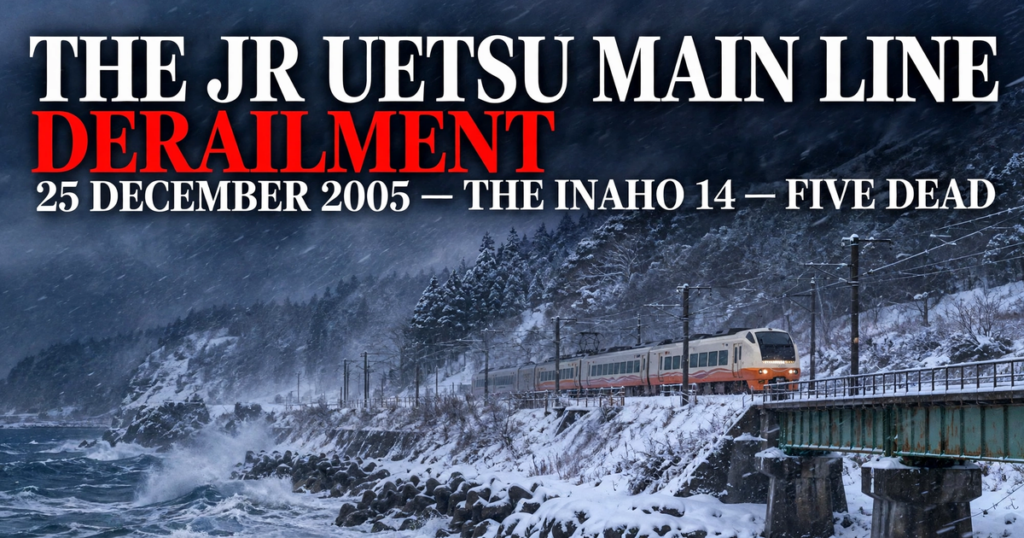
Inaho No. 14 derailed on a winter evening
At about 7:14 p.m. on December 25, 2005, the limited express Inaho No. 14 derailed between Sagoshi and Kita-Amarume stations in Shonai, Yamagata Prefecture. The train was travelling from Akita toward Niigata and consisted of six cars. It had just passed the Second Mogami River Bridge when it encountered the conditions that led to the derailment. The accident occurred during a period of strong winter weather on the Sea of Japan side of northern Japan, where low-pressure systems and passing fronts can produce severe winds.
All six cars left the rails and the front cars overturned
Every car in the six-car train derailed. The first three cars overturned and fell from the embankment. The first and third cars struck structures beside the track, causing extensive damage. The train's position and the damage to nearby buildings became important evidence in reconstructing the forces acting on the vehicles. The accident was not a case in which only the leading car left the rails; the entire train was affected, although the front cars suffered the most severe overturning and collision damage.
Five passengers died and 33 people were injured
Five passengers lost their lives. Thirty-three people were injured: 31 passengers, the driver and an onboard sales attendant. The train carried 43 passengers, two train crew members and one sales attendant. These figures distinguish the number of people aboard from the number of people who were killed or injured. The loss of life was concentrated among passengers, while the injuries included both passengers and members of the operating staff. The toll made the event one of the most serious railway accidents in Japan in the 2000s.
The weather made a localized gust difficult to measure
A low-pressure system and an associated front had strengthened the wind on the day of the accident. Investigators considered the possibility that a sudden gust had acted on the train near the derailment site. Average wind readings from a broad area do not necessarily capture a short-lived gust that strikes one small section of track. The force acting on a moving train can vary sharply over a short distance, especially where terrain, embankments and nearby structures alter the flow of air.
The investigation reconstructed the force acting on the train
The accident investigation examined the train's movement, the pattern of damage to the cars and nearby structures, and the available weather information. It considered whether the lateral force of the wind had reached a level capable of overturning the vehicles. The physical damage around the site helped investigators estimate the direction and strength of the gust. The report concluded that a localized gust from the right exceeded the train's overturning limit, causing the cars to tilt and derail. This was a specific finding about the accident mechanism, not simply a general statement that the weather was windy.
The investigation report was published in April 2008
The Aircraft and Railway Accidents Investigation Commission published its railway accident investigation report on April 2, 2008. The report described the train's passage beyond the Second Mogami River Bridge, the derailment and the role of the local gust. The Ministry of Land, Infrastructure, Transport and Tourism then issued guidance to railway and tramway operators on using weather information, including severe-wind warnings, thunderstorm advisories and tornado information. The report and the ministry's subsequent guidance served different functions: one explained the accident, while the other encouraged preventive changes across the industry.
Wind sensors and operating restrictions came under review
After the accident, railway operators and government agencies considered how to improve the observation of strong winds along railway lines. Measures included adding wind gauges, reviewing the locations at which they were installed and reconsidering the thresholds used to restrict or stop train operations. A reading at one fixed point may fail to reveal a gust that develops a short distance away. Decisions therefore need to combine local measurements with broader meteorological information and knowledge of the terrain along each route.
The challenge is detecting danger before a train reaches it
A train cannot always respond to a sudden gust in the same way that a vehicle on an ordinary road can. Once a train is moving at speed, the time available to reduce speed or stop may be limited. The accident highlighted the need to identify locations where wind can be channelled or intensified and to make operational decisions before a train enters a dangerous section. It also showed why the design of a monitoring system matters: sensors must be placed where they can detect the conditions that actually affect trains.
The accident changed the way railway operators approached strong winds
The Uetsu Line derailment became a reference point for railway wind-safety measures. The five deaths and 33 injuries led to a review that extended beyond the line where the accident occurred. Wind observation, the transmission of weather information, the rules for stopping trains and the characteristics of individual routes all became part of the response. The enduring lesson is not that every windy day creates the same risk, but that a short, highly localized gust can produce forces that are missed by a limited observation network.
Original Japanese record: JR羽越本線脱線事故|いなほ14号の5人死亡、突風の調査と鉄道の強風対策
Last updated:
Related articles

Case record
The Snow Brand Milk Poisoning Outbreak: A Power Failure, Heat-Stable Toxin and Two Different Patient Counts
Case record
The Kyoto Gion Runaway Van Crash: Seven Pedestrian Deaths, a Driver's Medical History and Changes to Driving-Licence Rules
Case record
The JR Fukuchiyama Line Derailment: 107 Dead, 562 Injured and the Questions of Speed, Safety Systems and Corporate Oversight

Case record