
The Osaka Minami Double Murder: A Death Sentence Overturned and Life Imprisonment Upheld
On June 10, 2012, Kyōzō Isohi stabbed two strangers to death in Osaka's Minami entertainment district. The Osaka District Court imposed the death penalty in 2015, but the Osaka High Court replaced it with life imprisonment in 2017. The Supreme Court rejected both appeals on December 2, 2019, making the life sentence final.
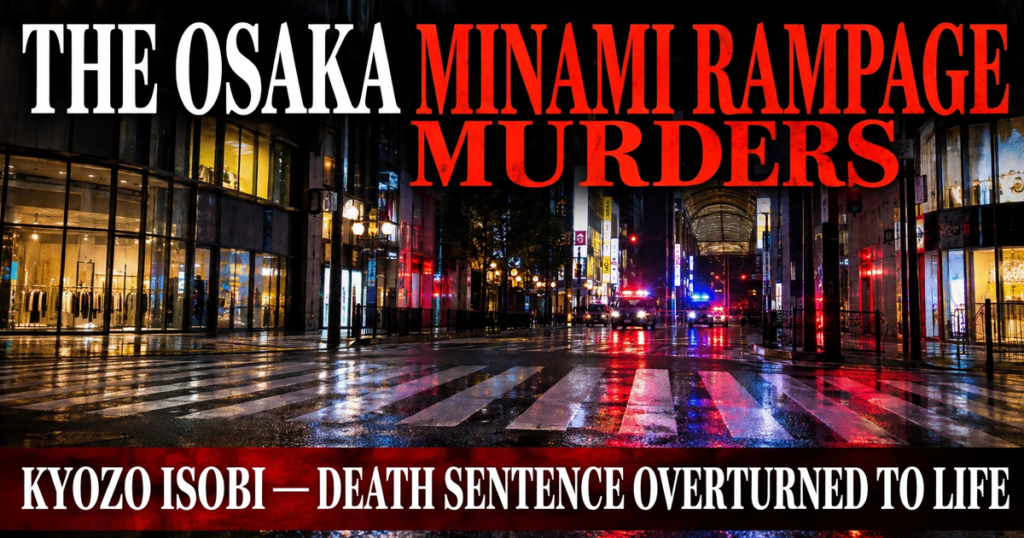
Two strangers were stabbed to death in Osaka's Minami district
At about midday on June 10, 2012, two people who did not know the attacker were stabbed in the Minami entertainment district of Osaka City. The victims were Shingo Minamino, a 42-year-old music producer, and Toshi Sasaki, a 66-year-old restaurant operator. Both died. Police officers who arrived at the scene found Kyōzō Isohi still attacking one of the victims and arrested him on the spot. Because he was caught at the scene, the identity of the attacker was not the main issue in the subsequent trial. The central questions became his mental state, the degree of planning, the seriousness of the killings and whether the death penalty was appropriate.
The victims were selected without a personal dispute
Isohi had no known personal relationship with either victim. The prosecution treated the killings as an indiscriminate double murder in a busy public area. The victims were going about ordinary activities and had no role in the defendant's personal circumstances. The fact that the attack occurred in a commercial district during the day increased the danger to members of the public. The case was not a dispute between acquaintances that escalated into violence. It involved two strangers who were killed in a public place by a man who had decided to attack people he did not know.
Isohi had recently been released from prison
Isohi had a history of stimulant-related offences and had served a prison sentence. He was released from Niigata Prison on May 24, 2012, only a little over two weeks before the killings. After release, he left a rehabilitation-support facility and travelled to Osaka. The prosecution and defence examined his recent imprisonment, his drug-use history and his mental condition. These matters formed part of the background to the sentencing debate, but they did not excuse the killings or establish that he lacked criminal responsibility.
The defendant reported hearing voices, and the courts examined their influence
During the investigation and trial, Isohi described hearing voices and experiencing hallucinations. The defence argued that his mental condition had affected his conduct and should be considered when determining responsibility and sentence. The prosecution emphasized the deliberate acts of stabbing two people and the seriousness of the result. The courts had to distinguish the question of whether he was criminally responsible from the separate question of whether the death penalty was the appropriate sentence. A finding that mental symptoms influenced the conduct did not automatically mean that the defendant was not responsible for the murders.
The Osaka District Court imposed the death penalty in June 2015
On June 26, 2015, the Osaka District Court sentenced Isohi to death. The court treated the killing of two strangers in a public district as an extremely serious offence. It found criminal responsibility and considered the manner of the attack, the number of victims and the danger created for the public. The death sentence was a first-instance judgment. Isohi appealed, and the prosecution also sought to preserve the capital sentence. The case therefore proceeded to the Osaka High Court, where the sentencing assessment was reconsidered.
The Osaka High Court replaced the death sentence with life imprisonment
On March 9, 2017, the Osaka High Court overturned the death sentence and imposed life imprisonment. The High Court placed greater weight on the low degree of advance planning and on the influence of Isohi's mental condition, including hallucinations. It concluded that the case did not meet the threshold at which the death penalty was unavoidable. The High Court did not acquit Isohi, did not deny that he had killed two people and did not find that he lacked all criminal responsibility. It changed the sentence after reassessing the factors relevant to capital punishment.
The Supreme Court criticised part of the High Court's reasoning
On December 2, 2019, the Supreme Court First Petty Bench rejected both the prosecution's and the defence's appeals, leaving the life sentence in place. The Supreme Court did not accept every part of the High Court's explanation. In particular, it cautioned against treating the low degree of planning as a single measure of the seriousness of the conduct. The assessment of a death sentence must consider the motive, the manner of the killings, the strength of the intent to kill, the number of victims and the full circumstances together. Even with that criticism, the Supreme Court concluded that the High Court's ultimate decision to replace death with life imprisonment was not so unreasonable that it had to be overturned.
The final outcome was life imprisonment, not acquittal
The legal sequence is important: the Osaka District Court imposed death in 2015; the Osaka High Court replaced it with life imprisonment in 2017; and the Supreme Court rejected both appeals on December 2, 2019. The final sentence is life imprisonment. The case was not an acquittal based on insanity, and the Supreme Court did not restore the death sentence. It confirmed the High Court's result while offering guidance on how planning and other factors should be considered in capital sentencing.
The case illustrates the difference between guilt and the choice of sentence
The courts agreed that Isohi was responsible for the murders. They disagreed over whether the death penalty was the only appropriate punishment. The first-instance court considered the two deaths and the public nature of the attack sufficient for a capital sentence. The High Court gave more weight to the limited planning and mental-health evidence. The Supreme Court reviewed whether that change was legally unsustainable and left the life sentence in place. The case therefore illustrates a sentencing dispute within a conviction, not a dispute over whether the killings occurred or whether the defendant committed them.
The victims and the public setting remain central to the record
The two victims were strangers who were killed in a busy urban district. Their deaths cannot be reduced to the debate over the defendant's mental condition or the technical question of capital sentencing. Those matters explain why the courts reached different conclusions about punishment, but they do not change the fact that two people lost their lives. The final legal record is a conviction for the double murder and a life sentence that became final in December 2019.
Original Japanese record: 大阪ミナミ通り魔殺人事件|2人を無差別に殺害した礒飛京三、死刑破棄の量刑判断
Last updated:
Related articles
Case record
The Kashiwa Serial Street Attacks

Case record
The Sendai Arcade Truck Attack: Three Dead, Four Injured and a 28-Year Sentence Replaced by Life
Case record
The Ikebukuro Street Attack: Two Women Killed, Six Injured and the Death Sentence for Hiroshi Zoda
Case record