
The Kofu Credit Union Kidnapping and Murder: A ¥45 Million Ransom Demand and a Life Sentence
Nineteen-year-old credit-union employee Yuki Uchida was lured away by a man posing as a magazine interviewer on August 10, 1993. The kidnapper demanded ¥45 million from her employer, killed her and abandoned her body near the Fuji River. Yutaka Miyagawa received a life sentence, which the Tokyo High Court upheld on April 16, 1996.
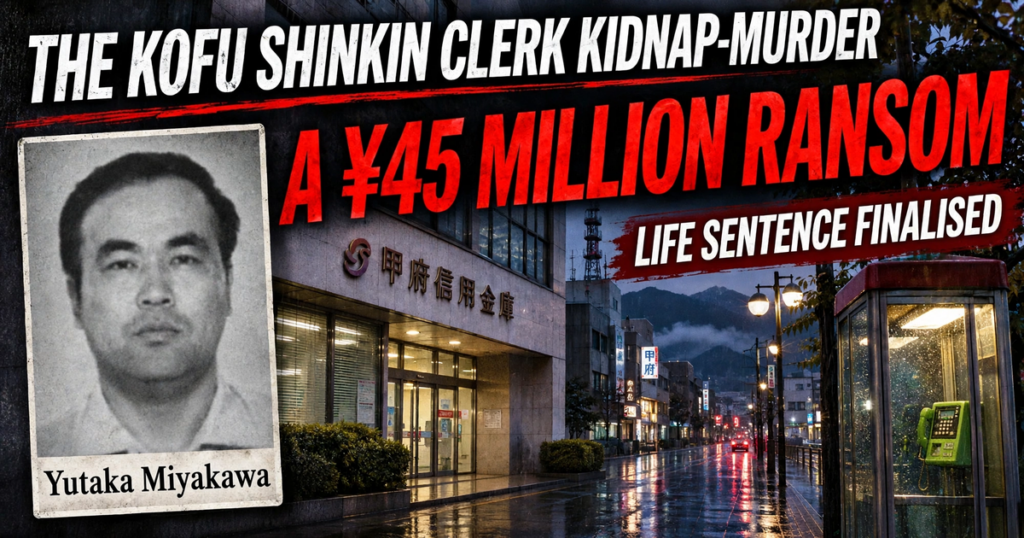
A nineteen-year-old employee disappeared after a false interview request
On August 10, 1993, Yuki Uchida, a nineteen-year-old employee at the Osato branch of Kofu Credit Union, was lured away by a man who pretended to be arranging a magazine interview. The request appeared connected to her work and gave the offender a pretext to contact her. Uchida then disappeared. The incident initially required investigators to determine whether she had left voluntarily, had been abducted or had been harmed. The fact that the approach used a work-related pretext became a defining feature of the case: the offender exploited the victim's position as a young employee rather than approaching her through a personal relationship.
The offender demanded ¥45 million from the credit union
After Uchida disappeared, a telephone call was made to the credit union demanding ¥45 million. The demand made clear that the target was not simply the victim's family or personal property. The offender intended to use Uchida's position as an employee to obtain a large payment from her workplace. The case therefore became a kidnapping-for-ransom investigation. The demand also meant that the employer had to respond while the victim's safety remained uncertain. The investigation involved the police, the credit union and the need to assess how to handle the demand without increasing the danger to Uchida.
Yutaka Miyagawa was motivated by debt, not a personal grievance against Uchida
The man later prosecuted was Yutaka Miyagawa, a company employee who had accumulated substantial debts. The court account described the offence as a plan to obtain money through kidnapping. The evidence did not establish that Miyagawa selected Uchida because of a personal feud with her. Instead, he used her employment at a financial institution as a means of applying pressure to the credit union. The sequence of abduction, ransom demand, killing and disposal of the body was treated as one connected criminal plan. That distinction matters because the victim's ordinary working life was exploited as an opportunity for the offender's financial purpose.
Uchida was killed and her body was found near the Fuji River
Miyagawa did not release Uchida after demanding the money. He killed her and transported her body away from the original area. Her remains were found near the Fuji River in Shizuoka Prefecture approximately one week after the disappearance. The discovery confirmed that the kidnapping had ended in murder. The body was located outside the prefecture where Uchida had worked, adding a cross-prefecture dimension to the investigation. The available Japanese article identifies the approximate interval and the river area but does not require an unsupported minute-by-minute reconstruction of the disposal.
Miyagawa surrendered after the investigation focused on him
Investigators examined the ransom call, the movements of vehicles and people connected with the case, and information obtained from those around Miyagawa. He eventually went to the police after people close to him urged him to do so. He was arrested and prosecuted for the kidnapping and murder. His surrender was an important part of the investigative chronology, but it did not erase the gravity of the offence or decide the sentence. The criminal proceedings had to address the planned use of the victim as leverage, the death of a nineteen-year-old employee and the concealment of her body.
The prosecution sought the death penalty
At trial, prosecutors argued that the kidnapping had been planned for financial gain and that the victim had been killed after being taken hostage. They sought the death penalty. The prosecution emphasized the deliberate deception used to lure Uchida away, the ¥45 million demand directed at her employer and the fact that she was killed rather than released. The defence challenged the sentence and other aspects of the case. The court had to consider the seriousness of a planned ransom kidnapping resulting in one death, while applying the sentencing principles used in Japanese capital cases.
The Kofu District Court imposed life imprisonment
The Kofu District Court sentenced Miyagawa to life imprisonment. The judgment treated the offence as an exceptionally serious kidnapping and murder, but did not impose the death penalty sought by the prosecution. The Japanese source article places the sentence within the sentencing debate concerning a murder with one victim, including the factors considered under the post-Nagayama line of capital-sentencing cases. The decision should not be reduced to a rule that one-victim murder can never result in a death sentence. Sentencing depends on the full circumstances, including motive, planning, the method of killing, the offender's history and the surrounding facts.
The Tokyo High Court rejected both appeals on April 16, 1996
The prosecution appealed on the ground that life imprisonment was too lenient, while Miyagawa also challenged the first-instance judgment. On April 16, 1996, the Tokyo High Court dismissed both appeals and left the life sentence in place. Neither side pursued a further appeal, and the sentence became final. The legal sequence is therefore a life sentence at first instance, followed by dismissal of both the prosecution's and defendant's appeals. It is inaccurate to describe the case as having ended with a death sentence or to imply that the Supreme Court reviewed the merits.
The case exposed the vulnerability created by work-related approaches
The kidnapping showed how a routine work-related request could be used to isolate a young employee. Uchida was not approached because of a private relationship with Miyagawa; the offender used a supposed interview to create an apparently legitimate reason for contact. The ransom demand then targeted the financial institution where she worked. The case prompted discussion of how employees should verify unexpected requests from outside organizations and how workplaces can protect staff who are asked to meet strangers. Those lessons should not be overstated as a formal legal reform caused by this case alone. The established legal outcome remains Miyagawa's final life sentence.
Original Japanese record: 甲府信用金庫OL誘拐殺人事件|内田友紀さんを狙った身代金4500万円要求と無期懲役
Last updated:
Related articles
Case record
The Tsukigase Junior High School Girl Murder: An 18-Year Term Replaced by Life Imprisonment
Case record
The Kaita Town Robbery Causing Death Without a Body: Seven Participants and a Life Sentence Upheld on Appeal
Case record
The Edogawa 18-Year-Old Woman Murder
Case record