
The Kofu Murder and Arson Case: The First Death Sentence Under Japan's Specified-Juvenile Framework
On October 12, 2021, nineteen-year-old Yuki Endo killed a married couple in Kofu, injured their younger daughter and set their home on fire. He was sentenced to death on January 18, 2024. His lawyer appealed, but Endo personally withdrew the appeal on February 1, making the first-instance death sentence final on February 2 without a substantive appellate judgment.
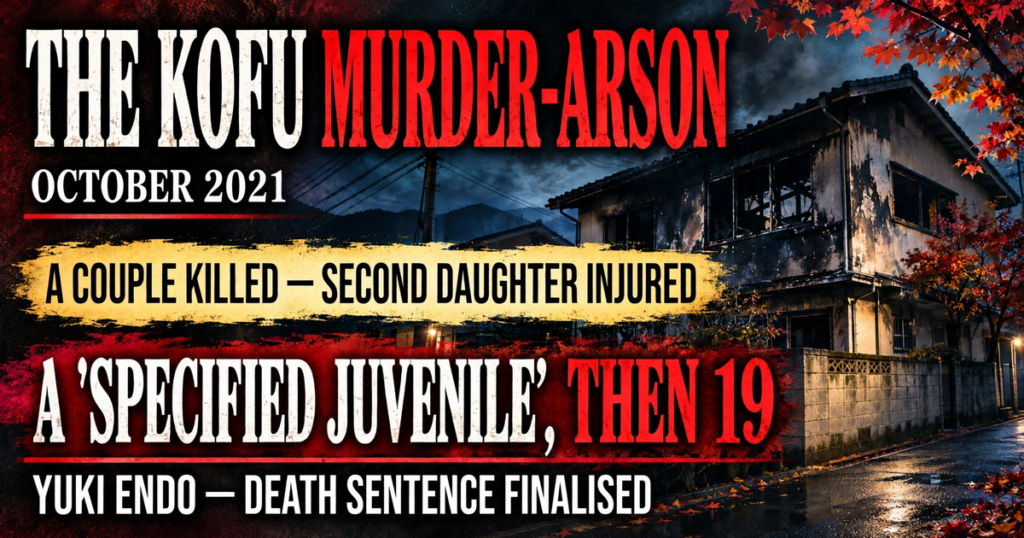
A family was attacked in its home in Kofu on October 12, 2021
In the early hours of October 12, 2021, Yuki Endo, who was nineteen at the time, entered a home in the Hōzawa area of Kofu, Yamanashi Prefecture. He attacked the married couple who lived there, a fifty-five-year-old man and his fifty-year-old wife, and killed both. He also attacked their younger daughter, who was injured. The two daughters escaped from the house and contacted the police. Endo set fire to the residence, which was destroyed. He left the area by car and later went to a police box, where he surrendered that evening. The case involved two completed murders, an attack on the younger daughter and the arson of an occupied residence.
The motive involved an unrequited attachment to the couple's older daughter
Endo and the couple's older daughter had known each other through high school. Endo had developed a one-sided romantic interest in her. Prosecutors later argued that he became resentful after she rejected him and blocked him on a messaging application. The Kofu District Court found that the rejection contributed to feelings of despair and anger, and that Endo then moved toward an attack on the family. The motive was not treated as a simple misunderstanding or a mutual relationship dispute. The court described it as self-centred and irrational. The older daughter was not physically injured in the attack, but she was a central part of the context considered in the prosecution's account of the defendant's motive.
The younger daughter was also attacked, and the home was deliberately set on fire
The indictment alleged that Endo entered the house through a first-floor window at approximately 3:30 a.m. and attacked the couple with a knife before setting fire to the residence using lighter fluid. The younger daughter was struck with a hatchet and suffered injuries. The older daughter and younger daughter were able to escape outside. The charges included murder of the couple, attempted murder of the younger daughter, arson of an occupied building and unlawful entry. The fact that the younger daughter survived does not mean the attack on her was legally treated as a minor injury case; the prosecution charged attempted murder, and the court considered the intent and circumstances of that attack as part of the overall case.
The Family Court sent the case to prosecutors under the revised Juvenile Act
Because Endo was nineteen when the offences occurred, the case initially proceeded through the juvenile justice system. The amended Juvenile Act took effect on April 1, 2022, and created the category of 'specified juveniles' for people aged eighteen or nineteen. On April 4, 2022, the Kofu Family Court decided that the case should be referred to prosecutors for criminal proceedings, a procedure known as reverse referral. On April 8, the Kofu District Public Prosecutors Office indicted Endo and publicly disclosed his name. This was the first case in which prosecutors publicly identified a specified juvenile at the time of indictment under the revised law. Reverse referral was a procedural decision; it was not itself a finding of guilt or a decision that the death penalty should be imposed.
The trial focused on criminal responsibility and sentencing
The lay-judge trial began in October 2023. Endo initially remained silent when asked to respond to the charges, but later answered questions about the events and his reasons for surrendering. The prosecution argued that he had full criminal responsibility and had planned the attack after becoming resentful toward the older daughter. The defense argued that his mental condition amounted to diminished responsibility and that his age and prospects for rehabilitation should prevent a death sentence. The central legal issue was not simply whether Endo had experienced emotional distress. The court had to determine whether his ability to understand the wrongfulness of his actions or control his conduct had been substantially impaired at the time of the offences.
The Kofu District Court found full responsibility and imposed death on January 18, 2024
On January 18, 2024, the Kofu District Court sentenced Endo to death. The court found that he had full criminal responsibility and rejected the argument that his capacity had been substantially diminished. It considered that Endo was nineteen at the time and stated that his age had been given the greatest possible consideration. Nevertheless, the court regarded the killing of two people, the attack on the younger daughter, the arson and the defendant's motive as exceptionally serious. It also assessed his attitude after the crime and the possibility of rehabilitation. The court concluded that his age did not provide a decisive reason to avoid the death penalty. This was the first death sentence imposed on a specified juvenile under the revised framework.
The lawyer filed an appeal, but Endo personally withdrew it
After the death sentence was pronounced, Endo's defense lawyer filed an appeal to the Tokyo High Court on February 1, 2024. Endo himself submitted a withdrawal of the appeal on the same date. The distinction between the lawyer's appeal and the defendant's later withdrawal is essential. The lawyer had initiated the appellate process, but Endo's own withdrawal ended it before the Tokyo High Court could review the evidence, criminal responsibility or sentence. The fact that Endo had earlier expressed an intention not to appeal during the trial did not itself make the sentence final; the legal effect came from the formal withdrawal after the judgment had been delivered.
The first-instance death sentence became final on February 2, 2024 without appellate review
The death sentence became final on February 2, 2024, as a result of Endo's personal withdrawal of the appeal. The Tokyo High Court did not issue a decision dismissing the appeal, and the Supreme Court did not review the case. The final sentence was therefore the Kofu District Court's January 18, 2024 judgment, made final through the defendant's withdrawal of the appeal. It is inaccurate to say that the death sentence was upheld by the Tokyo High Court or the Supreme Court. The case was the first in which a specified juvenile received a death sentence, and the first such sentence to become final. The legal history is unusual because finality resulted from withdrawal rather than a substantive appellate ruling.
Original Japanese record: 甲府殺人放火事件|19歳の特定少年に死刑、本人の控訴取下げで確定
Last updated:
Related articles

Case record
The Kiso and Nagara River Serial Group-Assault Murders: Four Victims in Eleven Days and Three Final Death Sentences
Case record
The Ebetsu University Student Group Assault Death
Case record
The Kaminokawa Robbery-Murder
Case record