
The Fukagawa Random Murder Attack: Four Deaths, a Seven-Hour Hostage Crisis and Diminished Responsibility
On June 17, 1981, Gunji Kawamata attacked passers-by in Tokyo's Fukagawa district, killing four people and injuring two. He then took a woman hostage in a Chinese restaurant. The court found diminished responsibility and imposed life imprisonment.
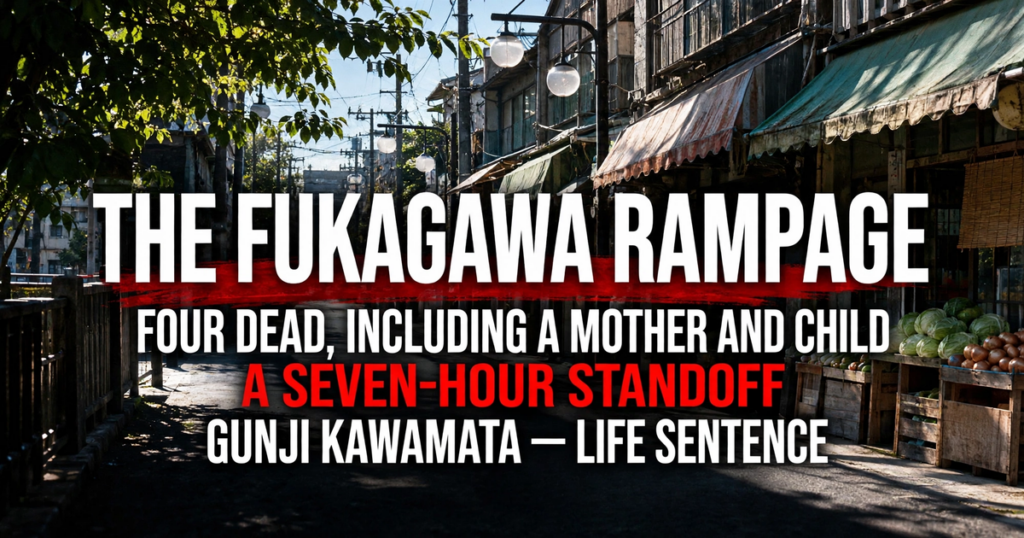
A sudden attack struck a shopping street in Tokyo's Fukagawa district
At about 11:35 a.m. on June 17, 1981, twenty-nine-year-old Gunji Kawamata attacked people walking through the Morishita area of Koto Ward, Tokyo. He carried a long kitchen knife and struck several people in a short period. Four people died: a twenty-seven-year-old mother, her three-year-old daughter, her one-year-old son, and thirty-three-year-old Miyoko Nihonmatsu. Two other women, aged seventy-one and thirty-nine, were injured. The victims were ordinary pedestrians who had no connection to Kawamata. The attack lasted only a few minutes, but the event did not end when the street violence stopped. Kawamata seized another woman and took her into a nearby Chinese restaurant, creating a hostage situation that continued for approximately seven hours.
The street killings and the hostage crisis were two distinct phases
After the attacks, Kawamata did not simply flee. He grabbed a woman who was returning from shopping and brought her into the restaurant. The family members and other people inside were able to leave, but the woman remained as a hostage. Police sealed off the surrounding area and attempted to negotiate while considering how to enter without placing her in greater danger. The hostage's safety changed the nature of the police response. A rapid arrest on the street was no longer possible, and officers had to manage the risk of further violence inside the restaurant. About seven hours after the first attacks, police entered the premises and arrested Kawamata. The hostage was rescued alive.
The defendant's mental condition could not be explained by stimulant use alone
Kawamata had used stimulants, and the attack was often described in simple terms as a drug-fuelled rampage. The court record and later medical discussion presented a more complicated picture. Kawamata had reported unusual experiences involving radio waves before his stimulant use, and these experiences were described as continuing over time. His background also included unstable employment, family difficulties and psychological problems. The existence of stimulant use was an important fact, but it did not by itself explain the condition in which he committed the attacks. Psychiatric assessments were conducted both before indictment and during the trial. The court considered the findings together with his conduct before, during and after the street attacks.
His behaviour during the hostage crisis was relevant but not conclusive
During the standoff, Kawamata communicated with police and took steps to protect himself by using the hostage situation to his advantage. Those actions suggested that he could understand at least some aspects of the immediate circumstances. However, the legal question was not simply whether he could speak, negotiate or react to police movements. The court had to assess whether, at the time of the killings, he retained the ability to understand the wrongfulness of his conduct and to act in accordance with that understanding. A person may be capable of purposeful actions in one situation while having substantially impaired judgment or control in another. The court therefore examined the attacks themselves and the hostage behaviour separately rather than treating the latter as automatic proof of full responsibility.
The court distinguished diminished responsibility from a complete loss of responsibility
The psychiatric evidence led the court to find that Kawamata's ability to judge and control his conduct had been significantly reduced. It did not find that he had completely lost the capacity required for criminal responsibility. Under Japanese criminal law, that distinction is important. A finding of insanity or lack of criminal responsibility would have had a different legal consequence from diminished capacity, which permits conviction while requiring a reduction in punishment. The court accepted diminished responsibility, known in Japanese law as shinshin-jakusho, rather than complete loss of responsibility. The result did not erase the four deaths or the injuries. It determined how the defendant's mental condition at the time of the offence affected the sentence that could lawfully be imposed.
The prosecution sought life imprisonment after psychiatric assessments
Two psychiatric assessments were conducted in the case, and the prosecution considered whether the appropriate sentence should be death or life imprisonment. The case record described by writer Ryuzo Saki indicates that the prosecution ultimately sought life imprisonment in light of the psychiatric findings. The seriousness of the outcome remained central: four people had been killed and two others injured in a public street, followed by a prolonged hostage crisis. At the same time, the prosecution and the court had to take account of the reduced capacity found at the time of the offences. The legal process therefore did not treat the death toll as the only factor in sentencing. It assessed the gravity of the conduct alongside the degree of criminal responsibility.
The Tokyo District Court imposed life imprisonment in December 1982
On December 23, 1982, the Tokyo District Court sentenced Kawamata to life imprisonment. The court did not acquit him and did not find that he was incapable of criminal responsibility. It convicted him while applying the legal consequences of diminished capacity. The sentence became final in 1983. The distinction is sometimes lost when the case is described only as a four-person random killing. The final legal outcome was not a finding that stimulant use excused the attacks. It was a judgment that the defendant's mental condition had substantially impaired his ability to judge or control his actions, while leaving enough responsibility for a criminal conviction and life sentence.
The case remains important in debates about mental illness and serious violence
The Fukagawa attack illustrates why criminal responsibility cannot be assessed from the number of victims alone or from one label such as drug use. The court considered the defendant's long-standing abnormal experiences, psychiatric assessments, actions during the street attack and behaviour during the hostage crisis. It distinguished a complete loss of responsibility from a substantial impairment that reduced punishment. The case is also remembered for the suddenness of the street violence and the long period during which a hostage's safety depended on police negotiations. Its legal significance lies in the way the court addressed a devastating result without treating either the seriousness of the deaths or the psychiatric evidence as irrelevant.
Original Japanese record: 深川通り魔事件|母子ら4人死亡、7時間の立てこもりと心神耗弱による無期懲役
Last updated:
Related articles

Case record
The Shinjuku West Exit Bus Arson: Six Deaths and a Life Sentence After Diminished Capacity Was Found
Case record
The 2008 Akihabara Attack: Seven Deaths and the Supreme Court's Sentencing Decision
Case record
The 1995 Tokyo Subway Sarin Attack: Victims, Criminal Trials and a Continuing Legacy
Case record