
The Saitama Dog Breeder Serial Murders: Four Victims, Disappearing Remains and a Third Retrial Petition
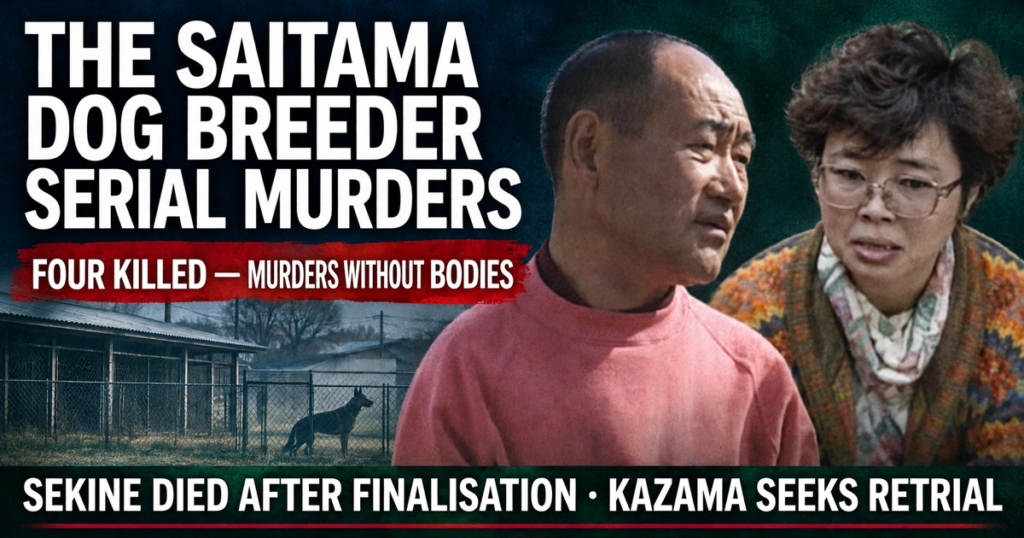
Four people disappeared in Saitama and Gunma in 1993. Dog-breeding business operators Gen Sekine and Hiroko Kazama were convicted of the murders; Sekine died in custody in 2017, while Kazama continues to seek a retrial.
A separate case from the Osaka dog-lover murders
The Saitama Dog Breeder Serial Murders were a different series from the Osaka Dog-Lover Serial Murders. The central figures were Gen Sekine and his former wife, Hiroko Kazama, who operated a dog-breeding and sales business known as Africa Kennel around Kumagaya, Saitama Prefecture. Four people disappeared between April and August 1993. The disappearances were initially difficult to connect because the victims did not leave intact bodies that could immediately establish a series of murders. The later investigation linked the victims to financial dealings with the business and to the couple's activities. The final criminal judgments concerned four murders, not the five victims in the Osaka case.
The first victim was a company executive who disappeared in April
The first victim was a thirty-nine-year-old male company executive from Gyoda. He disappeared on April 20, 1993, after becoming involved in a substantial financial dispute connected with dog breeding and sales. The final judgment found that Sekine and Kazama summoned him and gave him a capsule containing strychnine nitrate, killing him. His remains were taken to Katashina, Gunma Prefecture. The relationship was not simply that of a customer who had bought a dog. It involved a high-value business transaction and a serious financial conflict. The prosecution later relied on this connection, the victim's disappearance and the evidence concerning the disposal of his remains.
Two men were killed on July 21
The second and third victims were a fifty-one-year-old man described as a yakuza executive and his twenty-one-year-old male driver. Both were killed on July 21, 1993. The court found that they had made property-related demands of Sekine's side in connection with the earlier disappearance and financial dispute. They were also poisoned, and their remains were taken to Katashina. The case did not involve only one victim at a time: the two men were killed on the same day. Their relationship to one another and their demands on the dog-breeding business became part of the prosecution's account of why they were targeted. The court examined the actions of Sekine and Kazama separately rather than assuming that every act had been carried out in precisely the same way.
The fourth victim was a woman killed in August
The fourth victim was a fifty-four-year-old woman from Gyoda who had financial dealings with Africa Kennel involving dog purchases and investment. She was killed on August 26, 1993. An important distinction in the final judgment is that this murder was attributed to Sekine acting alone. The courts did not find that Sekine and Kazama had jointly committed every one of the four murders. The finding about the woman's death shows why the scope of each defendant's participation must be described carefully. Kazama was nevertheless convicted in the overall case because the courts found her jointly responsible for the other murders and for the destruction and disposal of the bodies.
The remains were destroyed or dispersed, making the disappearances difficult to investigate
The court found that the bodies were not simply buried intact. They were dismembered at locations including a building in Katashina, parts were disposed of in a river and bones were burned before being discarded in wooded areas. This process meant that investigators did not have four complete bodies to examine. The victims could initially be treated as separate missing-person cases, even though their disappearances were connected to the same business and its operators. The later recovery of bone fragments and personal belongings became important corroborating evidence. The account of the disposal is relevant to the investigation and the judgments, but it should not obscure the central fact that four people were killed.
A former company officer's account brought the investigation forward
The investigation changed significantly at the end of 1994 and the beginning of 1995, when a former company officer who had worked with Sekine and taken part in the disposal of the remains cooperated with police. He described the transportation, destruction and disposal of the bodies. Saitama police searched wooded areas and river surroundings in Gunma Prefecture and found bone fragments and belongings thought to be connected to the missing people. On January 5, 1995, Sekine and Kazama were arrested on suspicion of damaging and abandoning bodies. Murder charges followed. At trial, the former officer's account was contested, and the courts considered it alongside physical discoveries, financial relationships and the conduct of the people involved.
The courts distinguished joint conduct from Sekine's solo murder
The prosecution and defense presented conflicting accounts of what Sekine, Kazama and the former company officer had done. Sekine acknowledged involvement but gave a different account of his own actions. Kazama denied involvement in the murders. The courts examined the evidence victim by victim. On March 21, 2001, the Urawa District Court sentenced both defendants to death. It found joint responsibility for the company executive's murder and the July killings, while treating the August woman's murder as Sekine's sole act. The Tokyo High Court dismissed their appeals on July 11, 2005. On June 5, 2009, the Supreme Court dismissed their appeals, and the death sentences became final.
Sekine died in custody; Kazama's third retrial petition remains distinct
Sekine died at the Tokyo Detention House on March 27, 2017, aged seventy-five, before his death sentence was carried out. His death ended the possibility of executing his sentence, but it did not alter the final judgment in the case. Kazama continues to deny involvement in the murders and has pursued retrial proceedings. Her first and second retrial applications did not lead to a retrial. A third application was filed in 2020 and remained unresolved in the latest located reporting in November 2026. The existence of a retrial petition does not itself suspend or overturn the final conviction. The current legal position must therefore be described as a final death sentence with a third retrial application ongoing, not as an acquittal or a new trial already granted.
Original Japanese record: 埼玉愛犬家連続殺人事件|4人を毒殺し遺体を消した元夫婦と、風間博子の第3次再審
Last updated:
Related articles
Case record
The Greater Tokyo Suspicious Deaths: How Circumstantial Evidence Established Three Murders

Case record
The Osaka Dog-Lover Serial Murders: Five Victims and the Death Sentence of Yoshinori Ueda

Case record
The Gunma Pachinko-Parlor Robbery-Murders: Two Employees Killed for Store Keys and Cash

Case record