
The Soka Jiro Incidents: Bombings, Threats and the Unidentified Signature
A series of explosions, threats and shootings in the Tokyo area between 1962 and 1963 was associated with the signature 'Soka Jiro.' No offender was identified or convicted.
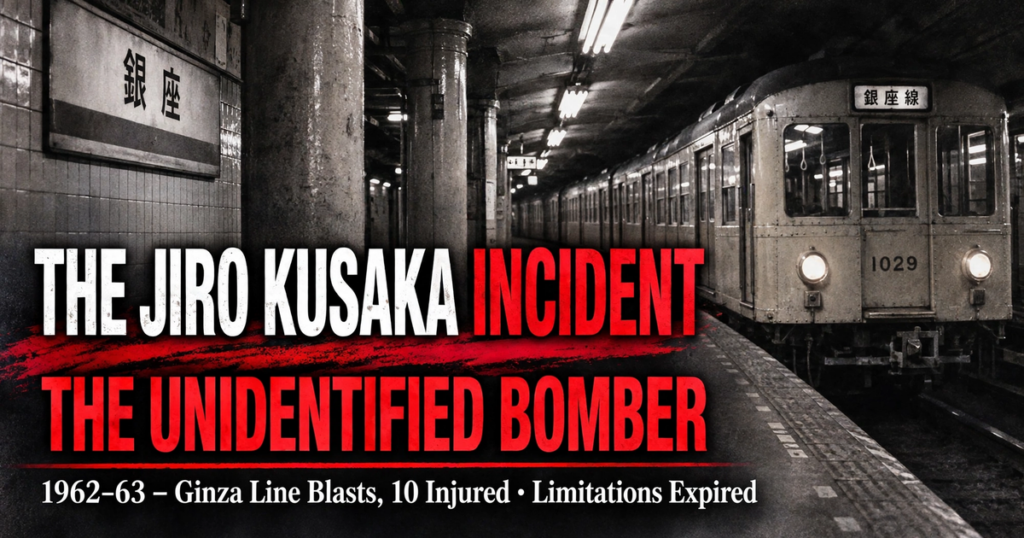
Soka Jiro was a signature, not an identified person's name
The name 'Soka Jiro' became associated with a series of threatening communications, explosive incidents and shootings in the Tokyo metropolitan area between 1962 and 1963. The signature appeared in more than one written form, including characters that could be read as 'Soka Jiro' and 'Sugika Jiro.' Police and later reporting connected incidents through similarities in handwriting, letters and explosive devices. No person was identified in court as the author of the signature. The name should therefore be understood as the label attached to the case series, not as the confirmed identity of an offender.
The first known incident involved singer Chiyoko Shimakura's supporters
On November 4, 1962, an unmarked envelope arrived at the office of singer Chiyoko Shimakura's supporters' association. When a male employee pulled a paper from a tube inside the envelope, a device ignited and caused burns that reportedly required approximately two weeks to heal. The tube carried characters including 'congratulations' and 'curse,' together with the signature 'Soka Jiro.' This incident brought the name into the investigation. It also showed that the threats were not limited to letters containing ordinary demands or insults: a mailed object could cause physical injury to the person who handled it.
Explosive incidents spread beyond the original office
After the Shimakura incident, explosive devices were reported at cinemas and other locations in Tokyo, including theatres associated with the film industry and public venues in areas such as Hibiya, Asakusa and Setagaya. The targets and methods were not identical in every incident. The case series also came to include threats and a shooting-related incident in Ueno Park in 1963, as well as the sending of ammunition or similar material to police. Later summaries have grouped more than a dozen incidents under the Soka Jiro label. Because no offender was tried, the precise number of acts attributable to one person was never established by a court.
Threatening letters were sent to actress Sayuri Yoshinaga
From May 1963 onward, letters bearing the Soka Jiro signature were sent to the home of actress Sayuri Yoshinaga, then eighteen years old. Later accounts describe six threatening letters and a demand for one million yen. The letters specified a method for transferring the money, including an instruction involving a train. Police prepared a controlled response using counterfeit notes and officers positioned to observe the proposed exchange, but the person who sent the letters did not appear to collect the money. The failed exchange did not reveal the writer's identity. The letters were significant because their handwriting and wording provided material for comparison with other communications.
The Ginza Line explosion at Kyobashi injured ten people
The most serious public incident occurred on September 5, 1963, at Kyobashi Station on Tokyo's Ginza subway line. An explosive device placed beneath a seat in a train detonated shortly before departure. Ten passengers suffered injuries ranging from relatively minor to serious. The explosion brought the threat into a crowded public transport setting, where people using the train had no connection to the earlier letters or celebrity-related threats. The ten injured people are the reported casualty figure for this incident. No death was attributed to the Kyobashi explosion in the public record.
The 1964 parliamentary record documents the investigation
On February 4, 1964, the matter was discussed in the House of Councillors Committee on Judicial Affairs. A police official reported that investigators were conducting neighbourhood inquiries focused on the area served by Shitaya Post Office, from which explosive devices and threatening letters were believed to have been mailed. The investigative team had been transferred from the Fourth Investigation Division to the First Investigation Division and had twenty-seven personnel assigned at that stage. The official also said that a youth arrested in connection with a different matter had been questioned in relation to the case, but that the offender had not been arrested. The parliamentary record documents the status of the inquiry; it does not identify the youth as Soka Jiro.
The suspected links did not establish one offender or one motive
The repeated signature, handwriting comparisons, explosive materials and postal patterns gave investigators reasons to examine the incidents together. Those similarities did not establish that one person carried out every act later included in the series. The letters contained financial demands as well as language that some commentators interpreted as political or anti-establishment. Yet no offender was arrested and questioned in a criminal trial, so no motive was tested through evidence and cross-examination. Claims that the offender had a particular occupation, political belief or personal grievance remain hypotheses unless supported by independently verifiable evidence.
The case reached its reported limitation deadline without a trial
The principal series continued through the September 5, 1963 Kyobashi explosion. Published chronologies give September 5, 1978 as the date on which the fifteen-year prosecution limitation period expired for the final major incident. The relevant limitation rules were those in force at the time; later changes to Japanese law did not revive offences whose prosecution periods had already been completed. No person was indicted or convicted as Soka Jiro, and the public record contains no judicial finding that every incident in the series was committed by the same individual. The identity behind the signature remains unknown.
Original Japanese record: 草加次郎事件|島倉千代子・吉永小百合への脅迫と銀座線爆発、正体不明のまま時効
Last updated:
Related articles
Case record
The 1995 Tokyo Subway Sarin Attack: Victims, Criminal Trials and a Continuing Legacy
Case record
The 1977 Cyanide Cola Murders: Two Deaths and an Unproven Link to a Separate Poisoning
Case record
The 1985 Paraquat Poisoning Cases: Poisoned Drinks, Vending Machines and 78 Reported Incidents
Case record