
The Tsuyama Massacre: Thirty Residents Killed in a Rural Japanese Settlement
In the early hours of May 21, 1938, Mutsuo Toi attacked residents of the Kaio district in western Okayama Prefecture. Thirty residents were killed and three were injured. Toi died by suicide before any criminal proceedings could begin.
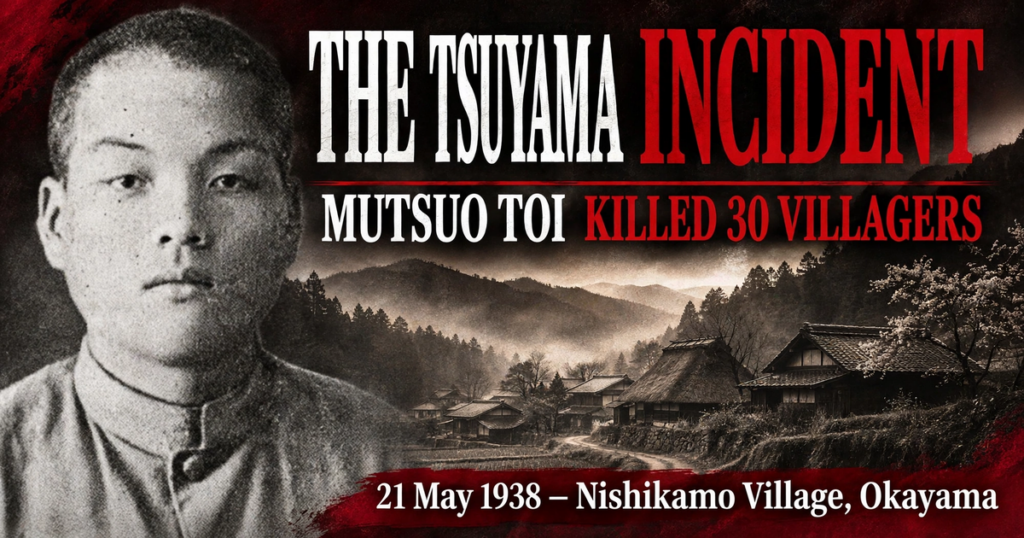
The attack in Kaio on May 21, 1938
In the early hours of May 21, 1938, Mutsuo Toi, aged twenty-one, attacked residents of Kaio, a small settlement in Nishikamo Village, Tomata District, Okayama Prefecture. The area is now part of Tsuyama City. Thirty residents were killed and three were injured. The attack moved from house to house rather than taking place at a single gathering. Toi left the settlement after the killings and later died by suicide. Because he was dead, prosecutors did not bring a case and no criminal trial took place.
The electrical lines had been cut before the attacks
Later investigations based on the Okayama Prefectural Police history describe Toi cutting electrical wires leading into the settlement before the attack. He then moved through the darkness carrying a hunting gun and a Japanese sword. The cutting of the wires, the preparation of weapons and the movement between several homes are evidence of actions taken in advance. They should not, however, be converted into a judicial finding of premeditation: no court examined the evidence in an adversarial trial or issued a judgment on that legal question.
Thirty deaths and three injuries: what the figures mean
The commonly used name, the Tsuyama Massacre or Tsuyama Thirty-Person Killing, refers to the thirty residents who died. Three other residents were injured. In 1939, the Criminal Affairs Bureau of the Ministry of Justice compiled a 496-page report titled, in translation, The Thirty-Three-Person Killing and Injuring Incident in Nishikamo Village, Tomata District, Okayama Prefecture. The figure thirty-three combines the thirty residents killed and the three injured; it does not mean that thirty-three people died. If Toi's later death is included in a count of all deaths connected with the incident, the total becomes thirty-one. Each figure therefore requires a clearly stated counting method.
Why Toi is described as both twenty-one and twenty-two
Toi was born in 1917 and was twenty-one by the age-counting system used today when the attack occurred in May 1938. Some contemporary and later accounts call him twenty-two. The difference reflects the traditional Japanese system of counting age, under which a person was generally considered one year old at birth and gained a year at the New Year. The two figures do not refer to different people or to a disagreement about his date of birth. This record uses his completed age, twenty-one, and explains why older sources may use twenty-two.
The perpetrator died before a trial could examine motive or responsibility
After leaving Kaio, Toi went into the surrounding hills, left a written statement and died by suicide. His death ended the possibility of a criminal prosecution. There was no public trial in which witnesses could be cross-examined, evidence tested by both sides, or a court asked to determine his motive and criminal responsibility. Police and government investigations were conducted, but an investigative report and a court judgment are different kinds of records. To say that a court found Toi legally insane, or that a court established a particular motive, would be inaccurate.
Illness, conscription and personal relationships are background evidence, not a settled explanation
Accounts of Toi's life discuss tuberculosis, his failure to pass the military conscription examination, strained relationships within the settlement and relationships with local women. These matters appear in the Ministry of Justice report and later research, but they do not establish a single, conclusively proven motive. Toi's own written statement is important because it records how he described his actions; it is not independent proof that every explanation in it was objectively correct. The same distinction applies to testimony collected by investigators and to later interpretations by writers.
Contemporary descriptions of his mental state must be treated cautiously
Some immediate reports and administrative communications used categorical language about Toi's mental condition. Such descriptions reflected the vocabulary and assumptions of the period, not a modern psychiatric diagnosis reached through a clinical assessment. The preparations attributed to him, including the cutting of electrical lines and the collection of weapons, also complicate any simple description of the event as an unplanned episode. Because there was no trial and no courtroom examination of psychiatric evidence, no retrospective diagnosis or legal conclusion about his capacity should be presented as established fact.
The 1939 Ministry of Justice report is a major record, but not a substitute for a verdict
The Ministry of Justice report assembled information about the scene, people connected with the event, Toi's life and the investigation. Its title and 496-page length make it an unusually substantial official record for a case in which no trial occurred. The National Diet Library's reference service later reported that it could not confirm a copy in its own collection, while a 1949 catalogue of the Ministry of Justice Library listed the report, including scene photographs. Its status as an official investigative record gives it historical importance, but does not transform its assessments into judicial findings. The distinction between what investigators recorded, what Toi wrote and what later researchers inferred is essential to an accurate account.
Original Japanese record: 津山事件|30人死亡・3人負傷、「三十三人殺傷事件」を司法省が496頁で記録
Last updated:
Related articles
Case record
The Kitashinchi Building Arson: Twenty-Six Victims Killed, No Criminal Trial and the Fire-Safety Reforms That Followed
Case record
The 2008 Akihabara Attack: Seven Deaths and the Supreme Court's Sentencing Decision
Case record
The Takachiho Six Deaths
Case record