
The Sekihotai Attacks: The Murder of an Asahi Shimbun Journalist and Five Unsolved Incidents
A journalist was killed at the Asahi Shimbun's Hanshin bureau in 1987. Police designated five incidents for a joint investigation; none resulted in a conviction.
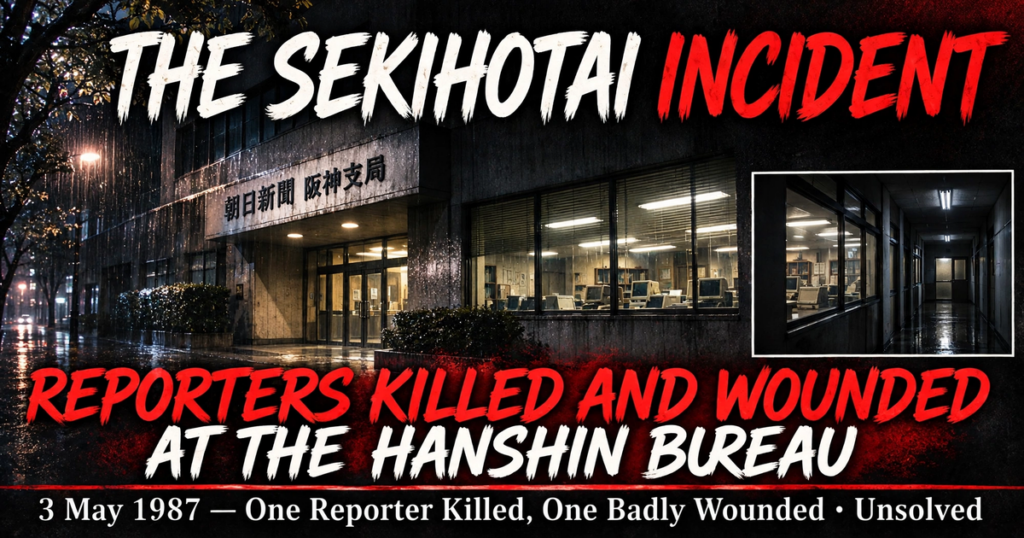
A masked gunman attacked the Asahi Shimbun's Hanshin bureau
At about 8:15 p.m. on May 3, 1987, a man wearing a mask entered the Hanshin bureau of the Asahi Shimbun in Nishinomiya, Hyogo Prefecture. He went to the second-floor newsroom and fired a shotgun at journalists who were working there. Reporter Tomohiro Kojiri, aged 29, was killed. Another reporter, Hyoe Inukai, aged 42, was seriously injured and later died in 2018. The gunman left without being identified. Afterward, communications claiming responsibility under the name Sekihotai were sent to news organisations, turning the investigation toward a wider series of attacks and threats.
The first designated incident had occurred at the Tokyo headquarters
The sequence later grouped by police as the National Police Agency's Designated Incident No. 116 began with a shotgun attack on the Asahi Shimbun's Tokyo headquarters in January 1987. The damage was not fully recognised until October 1, when marks consistent with a shooting were identified. A statement sent after the Hanshin attack referred to the earlier incident, and police added it to the investigation. Investigators compared the weapon, locations, timing and communications to determine whether the events were connected.
The statement threatened the newspaper as an institution
The communications sent after the Hanshin attack used the name Sekihotai and expressed hostility toward the Asahi Shimbun. Their language threatened the organisation and its employees as a whole, rather than identifying only one journalist or one article. This led investigators to examine political and ideological motives. A statement can provide clues about how an offender wants to be perceived, but it does not establish the writer's actual identity, membership or motive. Those questions remained unresolved.
Police designated five incidents between 1987 and 1988
The five incidents formally grouped under Designation No. 116 were the January 1987 shooting at the Tokyo headquarters, the May 3 attack on the Hanshin bureau, the September 24 shooting at the Asahi Shimbun's Nagoya staff residence, the March 12, 1988 attempted bombing at the Shizuoka bureau and the August 10, 1988 shooting at the home of former Recruit chairman Hiromasa Ezoe. The National Police Agency first designated the Hanshin and Nagoya incidents on September 25, 1987, then added the Tokyo headquarters shooting on October 3. The Shizuoka and Ezoe incidents were added in 1988.
The methods and communications were compared across locations
Investigators compared the shotgun attacks, the devices used in the Shizuoka incident and the written communications. For the Shizuoka and Ezoe incidents, the police examined features such as the paper stock, the physical characteristics of the documents, the word-processing equipment thought to have been used and the style and wording of the statements. The police considered the shared characteristics sufficiently strong to investigate the incidents as a connected series. That is an investigative assessment of likely common authorship, not a court judgment identifying the offender.
Several related threats were outside the five-incident designation
The broader history of communications using the Sekihotai name includes threats sent to former prime minister Yasuhiro Nakasone and prime minister Noboru Takeshita in March 1988. In May 1990, a fire at the Aichi Korean Residents' Association hall in Nagoya was also reported with a statement using the same name. These incidents are relevant to the wider history of the threats, but they were not among the five incidents formally designated as No. 116 in the National Police Agency's white papers. Counting every event associated with the name as part of the official five would distort the scope of the police designation.
No individual or organisation was established as the perpetrator
The statements expressed hostility toward the postwar political order and the Asahi Shimbun. Police investigated people and organisations associated with right-wing politics and other possible backgrounds. But ideological similarity is not proof that a particular group carried out a shooting or placed an explosive device. No individual or organisation was identified in a criminal trial as the perpetrator or directing body. The available public record establishes the attacks, the communications and the police decision to group five incidents for investigation. It does not establish who wrote the statements, who fired the shotgun or whether a single person carried out every act.
The prosecution periods expired between 2002 and 2003
At the time of the attacks, the prosecution limitation period for murder was fifteen years. The murder of Kojiri at the Hanshin bureau reached its limitation deadline in May 2002. The other designated incidents reached their respective deadlines by 2003. The police continued investigating the series for many years, and the National Police Agency's 2000 white paper still listed Designation No. 116 as under investigation. However, the perpetrators were not charged before the relevant periods expired. The abolition of the limitation period for murder in 2010 did not revive cases whose periods had already expired. New information may contribute to historical understanding, but it does not reopen prosecution for the completed offences.
The case remains a record of violence against journalism
The Asahi Shimbun has preserved damaged materials and other records at an incident archive room in the Hanshin bureau. The newspaper continues to report on the attack around May 3 each year. They are distinct from proof of who carried out the crime. The case is often discussed in the context of press freedom because the statement threatened the newspaper as an institution, and because one journalist was killed and another seriously wounded. The identity of the gunman, the existence of any directing organisation and the precise motive remain matters that were never resolved in court.
The official scope and the unresolved questions must remain separate
The most reliable way to describe the Sekihotai incidents is to begin with the five events designated by the National Police Agency, then identify other related threats separately. The Hanshin bureau attack killed Kojiri and seriously injured Inukai. The Tokyo, Nagoya, Shizuoka and Ezoe incidents were grouped with it because police considered the methods and communications strongly connected. The perpetrator was never identified, and the prosecution periods expired. The name Sekihotai should not be treated as the proven name of an established organisation, nor should the statements' political content be used to accuse a specific group.
Original Japanese record: 赤報隊事件|朝日新聞阪神支局記者殺傷と警察庁指定116号5事件の全経過
Last updated:
Related articles
Case record
The 1985 Paraquat Poisoning Cases: Poisoned Drinks, Vending Machines and 78 Reported Incidents
Case record
The Nagasakiya Amagasaki Store Fire: Fifteen Deaths from Smoke on the Fifth Floor
Case record
The Murder of a First-Grade Girl in Kobe's Nagata Ward: A Death Sentence Replaced by Life Imprisonment
Case record