
The Matsukawa Railway Incident: Twenty Convictions Overturned and Three Deaths Still Unresolved
A derailment caused by sabotage killed three railway employees in 1949. Twenty defendants were initially convicted; all were ultimately acquitted.
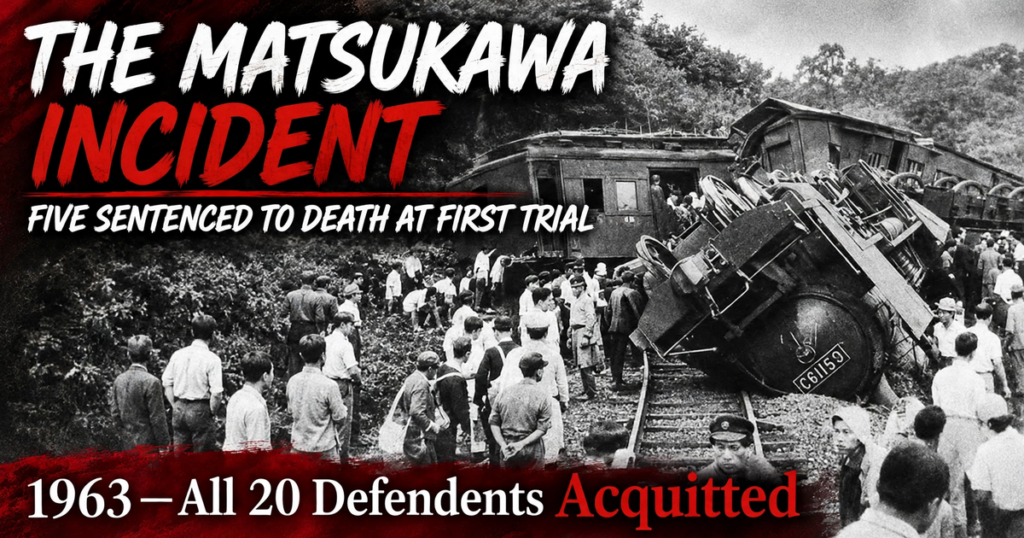
A passenger train derailed after the track was deliberately damaged
At about 3:09 a.m. on August 17, 1949, a passenger train travelling from Aomori toward Ueno derailed between Matsukawa and Kanayagawa stations on the Tohoku Main Line in Fukushima Prefecture. The track had been tampered with. Joint plates, bolts and rail spikes had been removed, and a section of rail approximately 25 metres long had been displaced. The locomotive overturned, followed by other cars. Three railway employees died: engineer Shozo Ishida and assistant engineers Riichi Ito and Masaichi Motegi. Other railway staff and passengers were injured. The physical scene indicated deliberate interference with the railway, but identifying the people responsible became a separate and much more difficult question.
The investigation turned toward labour union members
The incident occurred during a period of major workforce reductions and labour conflict at both Japanese National Railways and Toshiba's Matsukawa factory. Investigators focused on members of the railway and factory unions, suspecting that the derailment had been planned as part of a political or labour-related conspiracy. Statements obtained from arrested individuals widened the investigation, and twenty people were ultimately indicted for offences including causing death through train derailment. The prosecution argued that the defendants had conspired, divided responsibilities and carried out the sabotage together. The political climate made the theory appear plausible to many observers at the time, but the existence of labour disputes did not establish that union members had committed the crime.
The first two courts accepted a case built around multiple confessions
On December 6, 1950, Fukushima District Court convicted all twenty defendants and sentenced five to death. The prosecution's case relied heavily on statements made during the investigation, which were used to describe meetings, roles and actions at the railway line. On December 22, 1953, Sendai High Court acquitted three defendants but upheld convictions against the remaining seventeen, including four death sentences. The defendants challenged the voluntariness and reliability of the statements. They argued that the accounts differed about times, places, participants and movements, and that parts of the alleged conspiracy did not fit objective records. The case was therefore not simply about whether the track had been sabotaged; it was about whether these twenty people had been proved to have done it.
The Suwa memorandum became a turning point
A document later known as the Suwa memorandum recorded labour negotiations at Toshiba's Matsukawa factory. It provided information relevant to the whereabouts of some defendants at times when the prosecution said they had been involved in preparatory meetings. The defence argued that the document supported alibis and undermined the alleged conspiracy. The memorandum had existed within the investigative and corporate records but had not been adequately brought into the earlier proceedings. Its importance became a subject of parliamentary scrutiny, including questions about why potentially favourable material had not been presented sooner. The document did not, by itself, prove who had sabotaged the railway. It gave the courts a concrete basis for re-examining whether the prosecution's timeline and the defendants' alleged roles were credible.
The Supreme Court ordered a new examination of the evidence
On August 10, 1959, the Supreme Court's Grand Bench set aside the Sendai High Court judgment and remanded the case. It examined the Suwa memorandum and the other material relevant to the factual findings. The decision was significant because it showed that the Supreme Court could consider evidence in an appeal when necessary to determine whether the lower court's findings contained a serious error. The remand did not immediately acquit the defendants. It meant that the case had to be reconsidered by the High Court, with the confessions, alibis and objective evidence examined again. The distinction matters: the convictions remained in place until the retrial proceedings produced new judgments.
The remand proceedings tested the statements against objective evidence
During the renewed proceedings, Sendai High Court examined whether the defendants' statements were consistent with each other and with the physical conditions at the railway line. The court considered the times and locations of alleged meetings, the routes the defendants were said to have travelled and the practical details of the sabotage. The Suwa memorandum was one part of a broader evidentiary review. A confession could not reliably corroborate another confession if both were inconsistent with objective records. The defence argued that the original prosecution had built a single conspiracy from statements that did not withstand close comparison. The court reconsidered the case as a whole rather than simply repeating the findings from the first two trials.
All twenty defendants were ultimately acquitted
On August 8, 1961, Sendai High Court acquitted the seventeen defendants whose convictions had survived the first appeal. Three defendants had already been acquitted in 1953. The prosecution appealed the new acquittals, but on September 12, 1963, the Supreme Court dismissed the appeal. The acquittals of all twenty defendants therefore became final. The process had taken fourteen years from the derailment. The result overturned the original convictions, including the death sentences. The judgment meant that the prosecution had not proved that these twenty people were responsible. It did not establish who had actually removed the railway fittings or carried out the sabotage.
Compensation and a separate state-liability case followed
After the acquittals, seventeen of the former defendants received criminal compensation totalling 15,129,600 yen, according to a 1968 parliamentary explanation. The compensation system addressed detention and loss of liberty; it did not by itself resolve every question about how the investigation had been conducted. Former defendants and their families also brought a state-liability action in 1964. That separate civil case examined whether the state had acted unlawfully in the investigation and prosecution. Parliamentary discussion in 1973 referred to a final judgment awarding compensation to the former defendants. The criminal acquittals and the civil damages proceedings were different legal processes and should not be conflated.
The acquittals did not identify the people who derailed the train
The Matsukawa Incident is both a major wrongful-conviction case and an unsolved railway sabotage. The courts ultimately found that the twenty defendants had not been proved guilty, but no other person was subsequently convicted of the derailment. Three railway workers died, and the person or persons who removed the track fittings were never identified in a final criminal judgment. The case remains important for the role of the Suwa memorandum, the treatment of confessions and the disclosure of potentially exculpatory material. It also demonstrates why an acquittal must be described accurately: it removes the conviction of the accused; it does not automatically reveal who committed the underlying offence.
Original Japanese record: 松川事件|5人死刑・20人有罪を覆した自白と諏訪メモ、14年後の全員無罪
Last updated:
Related articles
Case record
The TEPCO Employee Murder: An Acquittal, a Reversed Conviction and DNA Evidence That Led to a Retrial
Case record
The Oita Midoriso Case: An Acquittal After Hair Evidence and DNA Testing Were Reexamined
Case record
The Hirosaki University Professor's Wife Murder: A Fifteen-Year Sentence Overturned by a Retrial Acquittal
Case record