
The Shimoyama Incident: The Unexplained Death of Japan's First National Railways President
Sadanori Shimoyama disappeared on July 5, 1949, and was found dead the next morning. Conflicting forensic assessments left the manner of death unresolved.
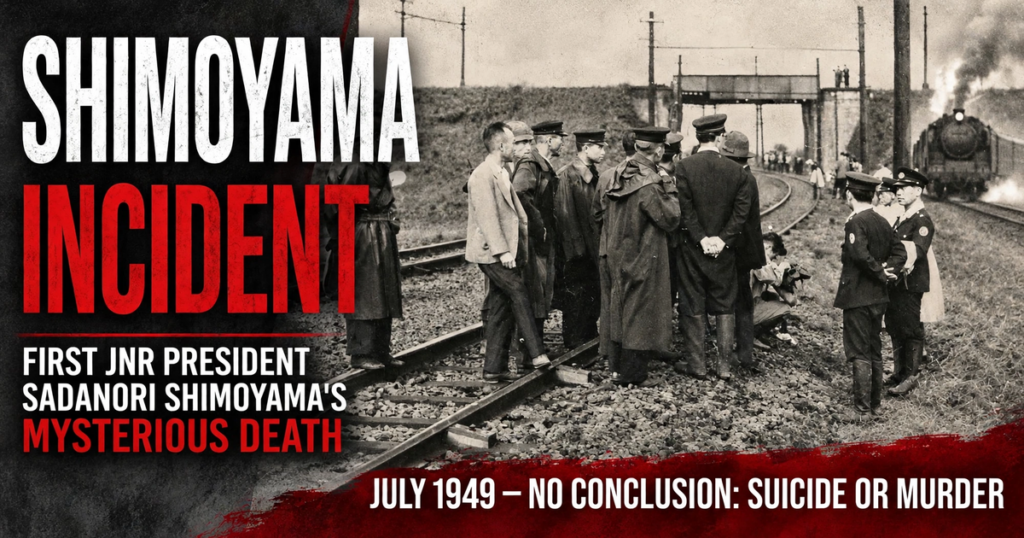
The first president of Japanese National Railways disappeared on his way to work
On the morning of July 5, 1949, Sadanori Shimoyama, the first president of Japanese National Railways, left home in his official car and travelled through Tokyo toward his office. He entered the Mitsukoshi department store in Nihonbashi and then disappeared. In the early hours of July 6, his body was found on the Joban Line in Adachi Ward, near the section between Ayase and Gotanno. He had been struck and mutilated by a train. The timing immediately drew attention to the political and labour tensions surrounding the new national railway, but those circumstances did not by themselves establish why Shimoyama died.
The workforce reduction formed the background, not a proven motive
Japanese National Railways had been established in June 1949 as a public corporation. It was implementing a large restructuring under the postwar personnel-reduction policy. On July 4, the railway notified approximately 30,700 employees that they would be affected by the first round of reductions. Shimoyama was the executive responsible for the organisation at a moment of intense labour conflict. The dispute over jobs and the wider occupation-era political climate became important to later theories about his death. Yet the existence of industrial conflict does not prove that a union, political organisation or occupation authority killed him. Nor does it prove that he took his own life.
The last confirmed movements are incomplete
Shimoyama's movements on July 5 have been reconstructed from official records, witnesses and later reporting, but not every part of the day is certain. He travelled in his official car, entered Mitsukoshi and was subsequently seen in a series of locations described by witnesses. His body was found shortly after midnight on July 6 on the railway line in the Ayase-to-Gotanno area. Because no murder prosecution followed, the witness accounts were never tested through a criminal trial with cross-examination and a final judicial assessment. Later books and television programmes have sometimes presented estimated times or reported sightings as settled facts. They should instead be identified as investigative or historical material of varying reliability.
The government confirmed the body's identity through several forms of evidence
A government reply submitted to the Diet in January 1950 described how the authorities had identified the body as Shimoyama. Investigators considered his clothing and personal belongings, and people who knew him, including a former secretary, a person who had lived with him and family members, were asked to identify him. The reply also referred to fingerprints found on an oil bottle used for a lighter, which were reported to match Shimoyama's fingerprints. Blood-type information was also discussed. Keeping identity and cause of death distinct is essential to understanding the case.
The central forensic dispute was whether he was alive when the train struck him
The principal medical controversy concerned the condition of Shimoyama's body at the moment of impact. Professor Tanemoto Furuhata and other experts associated with the University of Tokyo supported the view that the injuries were postmortem, meaning that Shimoyama had died before the train struck him. Professor Kyuhei Nakadate and experts associated with Keio University considered the injuries consistent with the body being struck while he was still alive. No criminal court ultimately selected one expert position as the established cause of death.
The government did not announce a conclusion of suicide or murder
In January 1950, the government answered parliamentary questions about the case and said that it could not then announce a determination of suicide or homicide. It also rejected the claim that police and prosecutors were officially in conflict over the issue. Questions raised in the Diet addressed blood traces, belongings, forensic examinations and the handling of the investigation, but the government withheld some details because the investigation had not produced a publishable conclusion. The government did not announce that Shimoyama had been murdered, and it did not announce that he had committed suicide.
Political conspiracy theories were never established in court
The timing of Shimoyama's death, the workforce reductions and the occupation-era political climate led to theories involving the General Headquarters, intelligence organisations, political groups or other outside actors. The subsequent Mitaka and Matsukawa railway incidents also encouraged writers to consider whether the events were connected. Such theories have been examined in books and historical research, including well-known works of investigative nonfiction. However, no individual was indicted for murdering Shimoyama, and no court found that GHQ, a political group or another organisation had directed his death. Historical hypotheses can be described as hypotheses, but they should not be presented as proven explanations.
Records survived, but they were not made fully public
A 1969 parliamentary question asked whether the investigation records and forensic reports should be disclosed twenty years after the death. The government's reply said that important materials remained with the Tokyo District Public Prosecutors Office and the police. These included forensic materials, scene-inspection records, investigation reports and statements from people connected with the case. The government nevertheless declined to publish the full files, citing considerations such as the reputation and feelings of the deceased and relatives, as well as possible effects on future investigations. It does not mean that the records have been evaluated in an adversarial criminal trial or that they establish a particular perpetrator.
The prosecution period expired in July 1964
The investigation did not produce a suspect who could be prosecuted for murder. Under the law then in force, the prosecution period for murder expired in July 1964. The limitation period for murder was abolished in 2010, but the reform did not revive cases for which the period had already expired. Shimoyama's death therefore cannot now be prosecuted as a new murder case simply because additional historical material might emerge. It closes the possibility of prosecution; it does not resolve the historical cause of death.
The unresolved cause of death is the case's present legal status
More than seventy years later, the established facts remain limited. Shimoyama disappeared on July 5, 1949, and his body was found on the railway line early the next morning. His identity was confirmed, but the forensic interpretations of whether he was alive at impact remained divided. No one was prosecuted for his death, no criminal judgment established homicide, and no court established suicide. The statute of limitations expired in 1964. The case remains important to postwar history because it sits at the intersection of railway restructuring, labour conflict, occupation policy and forensic controversy.
Original Japanese record: 下山事件|国鉄初代総裁の失踪と轢断死、自殺・他殺の結論が出なかった理由
Last updated:
Related articles
Case record
The Wanted Case of Tsuyoshi Yoshiya: The 1999 Ayase Group Attack
Case record
The 300 Million Yen Robbery: The Unsolved Theft of Japan's Showa Era

Case record
The Setagaya Family Murders: Why a Wealth of Evidence Has Yet to Identify the Killer
Case record