
The Okegawa Stalking Murder: A Woman's Repeated Appeals for Help, Police Failures and a Final Life Sentence
University student Shiori Ino, 21, was stabbed to death near Okegawa Station on October 26, 1999, after repeated threats and harassment. Her former boyfriend died before trial. His brother, Takeshi Komatsu, received a final life sentence as the organizer.
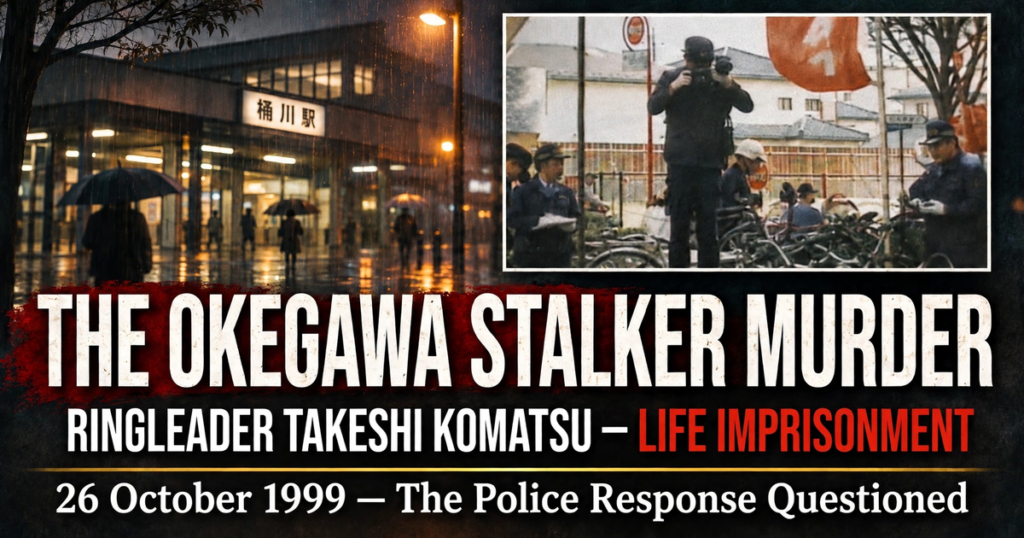
Shiori Ino had reported harassment before she was killed
Shiori Ino, a 21-year-old university student, was stabbed near the west exit of JR Okegawa Station in Saitama Prefecture at about 12:50 p.m. on October 26, 1999. She was taken to hospital but died from her injuries. The attack followed a period of threats, stalking and harassment after she tried to end a relationship with a man. Ino and her family had repeatedly consulted Ageo Police Station. They also filed a formal complaint concerning defamatory material distributed about her. The case therefore did not begin with an apparently random attack at a station: the family had been seeking help before the murder, and the police response became a central subject of public scrutiny.
The harassment extended beyond the former couple
The harassment included threatening communications, unwanted contact, surveillance and defamatory flyers that damaged Ino's reputation. The material was distributed around places connected with her life, making the pressure visible to people beyond the immediate relationship. Her family believed that the situation had moved beyond a private disagreement and repeatedly sought police assistance. At the time, Japan did not yet have the dedicated Anti-Stalking Act that would be enacted the following year. That absence did not mean that all the conduct was lawful or beyond police action: threats, defamation and other offences could be investigated under existing laws. The family's complaint was therefore important because it formally asked police to investigate specific conduct.
The former boyfriend died before he could face a murder trial
The former boyfriend, Kazuto Komatsu, fled after the murder and was later found dead in Hokkaido in January 2000. Because he died before being prosecuted, there was no criminal trial in which a court could determine his personal responsibility for Ino's murder. This point is important because public summaries sometimes identify him as the person who ordered the killing. The surviving criminal proceedings concerned other people, including his older brother, Takeshi Komatsu, whom prosecutors accused of leading the murder and defamation. The former relationship and the harassment were part of the background, but a person's relationship to the victim cannot substitute for a court finding of criminal responsibility.
Takeshi Komatsu was convicted as the organizer
The surviving defendants were prosecuted for the murder and related offences. Takeshi Komatsu, the former boyfriend's older brother, was charged with murder, defamation, trespass, extortion and other offences. The Saitama District Court sentenced him to life imprisonment on December 25, 2003. The courts found that he had acted with three accomplices and had played a leading role in the murder and defamation. His appeal did not change the sentence, and the conviction became final on September 20, 2006. The legal finding against Takeshi must be kept separate from the former boyfriend's death before trial. The court convicted the surviving defendant on the evidence presented in his case.
The family's damages lawsuit exposed another part of the police response
In a separate civil action, Ino's family sued Saitama Prefecture, arguing that police had failed to investigate the defamation complaint properly. In 2003, the Saitama District Court found that the police response to the complaint had been inappropriate and ordered the prefecture to pay 5.5 million yen. The courts did not, however, find a legal causal link between the police's unlawful handling of the complaint and the murder itself. The parties continued to contest the civil judgment, and the result became final at the Supreme Court in August 2006. The finding of police misconduct should not be overstated as a judicial finding that proper police action would certainly have prevented the killing.
The police publicly acknowledged serious failures
The National Police Agency examined the case as an institutional failure, not merely a mistake by one officer. The 2000 Police White Paper expressed exceptionally strong regret over the handling of the case. Later reviews identified problems in accepting and investigating complaints, recognising the danger of escalation and treating stalking as a matter of personal relationships rather than a potential threat to life. The case prompted changes in how police receive complaints, coordinate between departments and consider protective measures. The distinction between criminal and institutional responsibility remains important: the offenders were responsible for the murder, while the police were separately criticised for failing to respond adequately to the warnings that had been brought to them.
The Anti-Stalking Act was enacted in 2000 and later expanded
Japan enacted the Anti-Stalking Act in May 2000, and it came into force in November of that year. It established warnings and prohibition orders for certain stalking conduct, criminal penalties for repeated stalking and assistance for victims. The law was later amended as stalking methods changed. Reforms included responses to GPS-based tracking and, in later amendments, the use of lost-item tracking devices to obtain location information without consent. A 2025 amendment also created a system for police to issue warnings on their own initiative in specified circumstances and expanded the role of workplaces and schools in supporting victims. Further provisions took effect in March 2026 to address third parties who might disclose a victim's information to a stalker. These changes address different stages of risk. GPS restrictions target the means used to locate a victim; proactive warnings allow police to intervene in specified circumstances without waiting for a fresh formal request from the victim; and the third-party information rule addresses the possibility that someone other than the stalker may disclose a victim's personal information. The amendments strengthen prevention and information protection, but they do not alter the criminal findings in the Okegawa case.
Original Japanese record: 桶川ストーカー殺人事件|猪野詩織さん殺害、警察の告訴対応と無期懲役確定まで
Last updated:
Related articles

Case record
The Gunma Family Murders: Three Victims and the Search for Hiroshi Kogure
Case record
The Nagasaki Stalking Murders: Two Family Members Killed, Three Police Forces Criticised and a Final Death Sentence

Case record
The Urawa Game-Center Murder: The Unsolved Killing of a 73-Year-Old Employee Near Kita-Urawa Station
Case record