
The Murder of Junko Furuta: A Case That Tested Japan's Juvenile Justice System
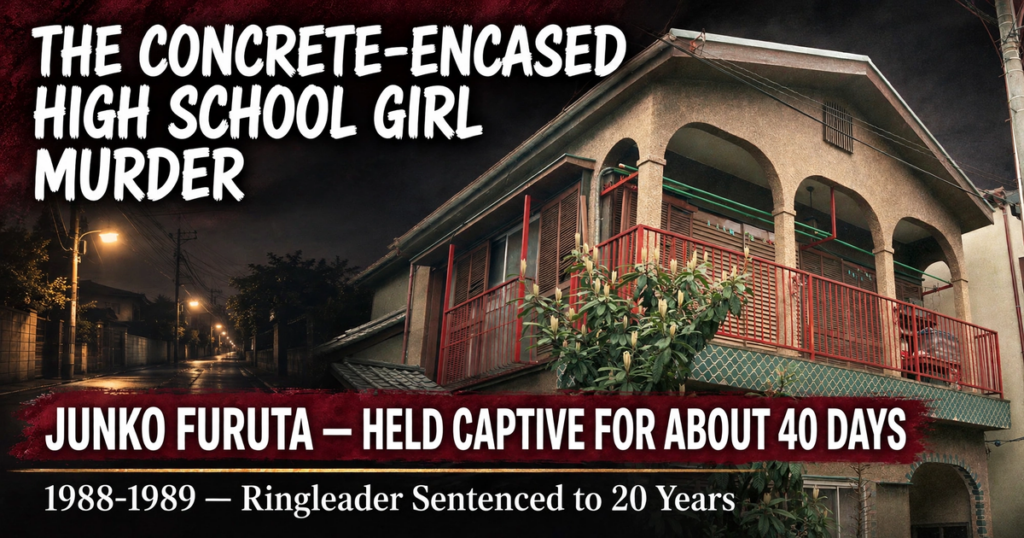
Seventeen-year-old high-school student Junko Furuta was abducted in November 1988, held for about forty days and killed on January 4, 1989. Four juveniles were prosecuted in criminal court. The Tokyo High Court increased several sentences on appeal, ultimately imposing a twenty-year term on the principal offender and indeterminate terms on the other three.
A seventeen-year-old student disappeared on her way home
On the night of November 25, 1988, Junko Furuta, a seventeen-year-old high-school student, was abducted while returning home after finishing a part-time job in Saitama Prefecture. She did not know the young men who took her. She was transported to a residence in Adachi Ward, Tokyo, and held there against her will. The house belonged to one of the juveniles involved in the crime. What began as an abduction became a prolonged period of confinement, sexual violence and repeated physical abuse. Furuta was not free to leave, contact people who could help her or obtain medical treatment. Her family searched for her, but the offenders took steps to make it appear that she had left home voluntarily.
The confinement continued for about forty days
Furuta was kept in a room in the home and was watched by the young men. The four principal juveniles were involved in different ways and at different stages. The Tokyo High Court later examined not only the duration of the confinement but also each defendant’s participation, knowledge and conduct. The offenders used communications from Furuta to create the impression that she was away from home by choice. A message or telephone call from a person who is being held captive cannot automatically be treated as proof that the person is safe or acting freely. The manipulation of contact with her family delayed the discovery of the actual location where she was being held. The confinement lasted roughly forty days, during which her physical condition deteriorated.
The court examined the final assault and the point at which intent to kill arose
Furuta died on January 4, 1989. The High Court did not simply find that all four juveniles had possessed an intent to kill from the beginning of the entire period of confinement. Instead, it examined the final assault on January 4. By that stage, Furuta was severely weakened. The court concluded that, as the defendants continued the assault while recognising that she might die, they accepted the possibility of her death. This was a finding of implied intent to kill. One defendant disputed that he had recognised the risk of death, but the High Court considered his knowledge of her condition and his active participation in the assault. The distinction matters: the judgment separated the prolonged confinement and abuse from the specific point at which the legal requirements for murder were met.
The body was concealed after her death
After Furuta died, the offenders did not call an ambulance or notify the police. They placed her body in a metal drum, filled the drum with concrete and transported it to reclaimed land at Wakasu in Koto Ward, Tokyo, where it was abandoned. The body was discovered on March 29, 1989. Concealing the body was a separate act from the violence that caused her death and formed part of the criminal proceedings as an offence involving disposal of a body. The sequence—from abduction, to prolonged confinement, to death and concealment—was central to understanding the seriousness of the case. The Japanese article avoids reproducing every graphic detail of the abuse; the essential facts are the loss of freedom, the failure to stop the violence and the deliberate effort to hide the death.
The first-instance court imposed a seventeen-year term on the principal offender
On July 19, 1990, the Tokyo District Court sentenced the principal offender, identified in the Japanese article as A, to seventeen years’ imprisonment. B received an indeterminate sentence of five to ten years; C received four to six years; and D received three to four years. The prosecution had sought life imprisonment for A, thirteen years for B and longer indeterminate terms for C and D. The District Court recognised the seriousness of the crime but also considered the defendants’ youth, immaturity and potential for rehabilitation. The first-instance judgment was not the final result. The prosecution appealed in relation to all four defendants, arguing that the sentences were too lenient. The defence for B and C also appealed, challenging aspects of the findings and punishment.
The Tokyo High Court increased three sentences
On July 12, 1991, the Tokyo High Court set aside the first-instance judgment for A, C and D and increased their sentences. A was sentenced to twenty years, the then-maximum fixed-term sentence. C received an indeterminate term of five to nine years, and D received five to seven years. B’s original term of five to ten years was maintained. The High Court considered the defendants’ ages and the juvenile justice system’s emphasis on rehabilitation, but it also weighed the nature of the offences, the duration of the confinement, the harm to the victim and the responsibility of each participant. It concluded that being a juvenile did not automatically justify a substantially reduced sentence in a case of this gravity. The judgment did not treat all four as having played identical roles.
The remaining appeal was rejected in 1992
After the High Court decision, the sentences of A, B and C became final. D filed a further appeal, which was rejected by the Supreme Court in July 1992. The criminal proceedings against all four defendants were then final. The final sentences were twenty years for A, five to ten years for B, five to nine years for C and five to seven years for D. The indeterminate terms must be reported as ranges; they should not be rewritten as if each were a single fixed sentence. The defendants later completed their terms and returned to society. Completion of a sentence does not erase the crime or the responsibility established by the judgments.
The case must be understood through the findings, not sensationalised detail
The case has often been retold through graphic descriptions of the abuse. The Japanese article instead emphasises the facts necessary to understand the legal findings: a seventeen-year-old who did not know the offenders was taken from her route home, held for about forty days, subjected to repeated abuse, and killed after the offenders had multiple opportunities to stop the violence or seek help. The High Court examined when each juvenile became involved and when the risk of death was recognised. Later reports about the defendants’ lives, employment or separate criminal cases are not part of the legal findings concerning Furuta’s murder and must not be conflated with them. The final criminal judgments remain the authoritative account of the offences and sentences in this case.
Original Japanese record: 女子高生コンクリート詰め殺人事件|古田順子さん約40日監禁と、東京高裁が引き上げた少年4人の刑
Last updated:
Related articles

Case record
The Four-Prefecture Four-Murder Case: Twelve Years for the First Killing and Death for Three Later Murders
Case record
The Yuji-chan Kidnapping-Murder: A Six-Year-Old Lured with an Insect and a Ransom Demand of 20 Million Yen

Case record
The Tachikawa Hotel Double Stabbing and Murder

Case record