
The Assassination of Shinzo Abe: The Shooting, the Security Review and the First-Instance Life Sentence
Former prime minister Shinzo Abe was shot while campaigning in Nara on July 8, 2022, and died later that day. Tetsuya Yamagami received a life sentence in January 2026 and appealed. As of November 20, 2026, the first-instance judgment had not become final.
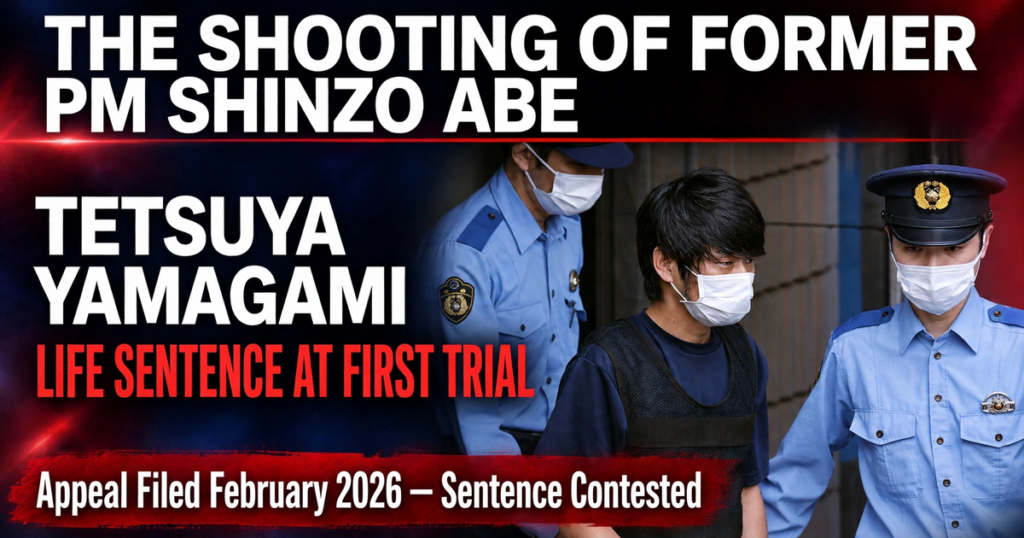
The shooting outside Yamato-Saidaiji Station
On July 8, 2022, former prime minister Shinzo Abe, aged sixty-seven, was speaking in support of a candidate in the House of Councillors election near Kintetsu Yamato-Saidaiji Station in Nara City. At approximately 11:31 a.m., Tetsuya Yamagami approached from behind and fired a homemade firearm twice. Abe was taken to Nara Medical University Hospital, where his death was confirmed at 5:03 p.m. The National Public Safety Commission's initial report stated that the fatal injuries damaged the subclavian arteries and caused fatal blood loss. Yamagami was apprehended at the scene.
The sequence of the two shots
The National Police Agency's review reconstructed the final minutes in detail. Abe began speaking at approximately 11:28:42 a.m. Yamagami approached from the south and took a firearm-like object from a bag at about 11:31:03. At approximately 11:31:06, he fired the first shot from about seven metres away. That shot did not hit Abe. About 2.7 seconds later, from a distance of approximately 5.3 metres, he fired the second shot, which struck Abe. Security personnel then restrained Yamagami. These timings come from the police review and should not be confused with a court's separate assessment of the legal elements of each offense.
A homemade firearm and the legal questions it raised
The weapon was not a commercially manufactured handgun. It was a homemade firing device assembled from metal pipes and other materials. Investigators recovered additional devices, components and materials from locations associated with Yamagami. Evidence presented at trial included preparations and test-firing before the attack. One issue at trial was how the device should be classified under Japan's firearms and weapons legislation. The defense disputed the application of some provisions, while the Nara District Court found that the device had the capacity to fire projectiles capable of killing or injuring a person and applied the relevant weapons offenses.
The defendant's stated grievance and the distinction between motive and responsibility
Yamagami told investigators that he resented a religious organization and believed Abe had a connection to it. His mother had joined the Family Federation for World Peace and Unification, formerly known as the Unification Church, and had made large donations. The family experienced serious financial hardship. Yamagami said that he initially considered targeting people directly associated with the organization but later selected Abe because Abe had sent a video message to an event connected with an affiliated group. These statements describe the defendant's account of his motive. They do not establish that Abe was involved in the mother's donations or legally responsible for them.
The independent police review of the security failure
The National Police Agency conducted a security review separately from the criminal investigation. It identified deficiencies in the security plan, the assessment of risks from behind the speaker, the positioning of officers and on-site command. The review found that the southern approach had not been adequately monitored and that the first shot did not lead to an effective protective response before the second shot was fired. The review was not a ruling on Yamagami's criminal responsibility. It examined why the police operation had failed to protect the person under guard and what changes were needed.
Investigation, indictment and the lay-judge trial
After the arrest, prosecutors arranged a psychiatric examination to assess Yamagami's criminal responsibility at the time of the offense. Following that process, prosecutors indicted him in January 2023, concluding that he had full criminal responsibility. The proceedings also addressed the manufacture and possession of the homemade weapon, ammunition and related offenses. Extensive pretrial preparation was required because the court had to organize evidence about the shooting as well as the legal classification of the device under several statutes. The trial was conducted under Japan's lay-judge system, in which professional judges sit with citizens selected from the public to determine facts and sentence in specified serious criminal cases.
The Nara District Court imposed life imprisonment on January 21, 2026
Yamagami did not dispute that he had shot Abe. The principal issues at trial concerned the legal treatment of the homemade firearm and the appropriate sentence. The defense argued that the mother's involvement with the religious organization and the resulting hardship in the family had deeply affected Yamagami and should justify a fixed-term sentence of no more than twenty years. Prosecutors sought life imprisonment, emphasizing the preparation, test-firing, selection of a public political event and the danger created by firing in front of a crowd. On January 21, 2026, the Nara District Court imposed life imprisonment, the sentence requested by prosecutors. The court acknowledged the defendant's difficult background but found that it did not substantially reduce his responsibility for killing Abe.
The appeal and the legal status as of November 20, 2026
The defense appealed to Osaka High Court on February 4, 2026. The appeal challenged the severity of the sentence and aspects of the legal classification of the homemade firearm; it did not amount to a complete denial of the shooting itself, which Yamagami had admitted. On October 1, 2026, the defense submitted its written grounds of appeal. As of November 20, 2026, no appellate judgment had been identified and the first-instance life sentence was not final. The submission of grounds is a procedural step in the appeal, not a decision by the High Court.
Three separate questions must remain distinct
The case has generated discussion about the former Unification Church, large religious donations, the experiences of children raised in families affected by religious organizations, and the relationship between politicians and affiliated groups. Those social and political questions are distinct from the criminal responsibility for Abe's killing. A third, separate issue is the failure of the security operation, which was examined by the National Police Agency. Keeping the criminal trial, the broader social debate and the administrative security review separate makes it possible to report each accurately without treating one as proof of another.
Original Japanese record: 安倍元首相銃撃事件|山上徹也被告に一審無期懲役、大阪高裁で量刑を争う
Last updated:
Related articles
Case record
The Tsukigase Junior High School Girl Murder: An 18-Year Term Replaced by Life Imprisonment
Case record
The Nara First-Grade Girl Murder: A Child Abducted on Her Way Home and a Death Sentence Final by Appeal Withdrawal
Case record
The Luffy Wide-Area Robbery Cases: Four Separate Leadership Trials and Their Different Legal Stages
Case record