
The Odakyu Line Stabbing: Ten Injured, Three Attempted-Murder Charges and a 19-Year Sentence
On August 6, 2021, a man attacked passengers with a knife on a moving Odakyu Line train, injuring ten people. Three victims were the subjects of attempted-murder charges. Yusuke Tsushima received a 19-year prison sentence from the Tokyo District Court on July 14, 2023; the available record does not establish the sentence's finality.
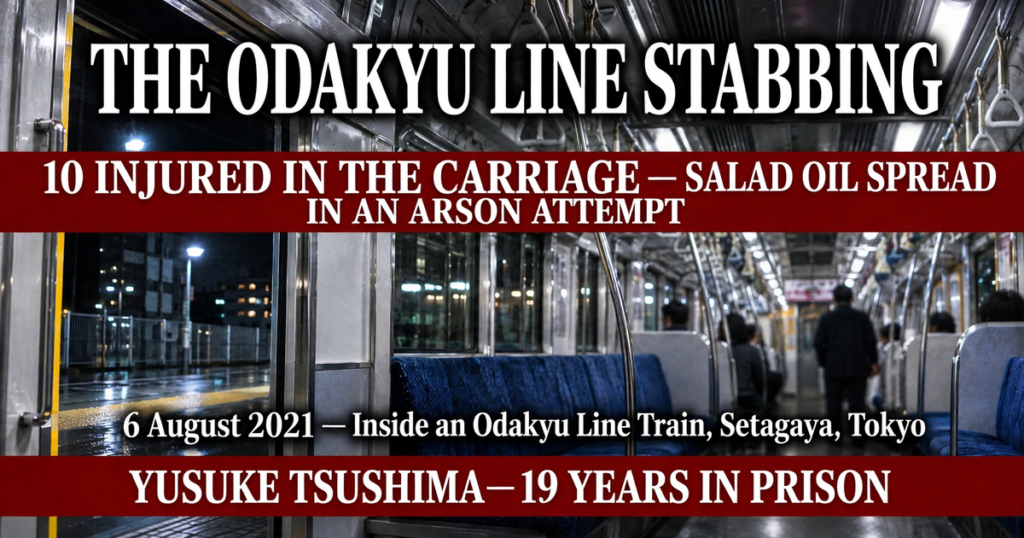
Passengers were attacked inside a moving rapid-express train
At about 8:30 p.m. on August 6, 2021, passengers aboard a rapid-express train on the Odakyu Odawara Line were attacked with a knife as the train travelled between Noborito and Soshigaya-Okura. The attacker used a beef knife to slash and stab people in the carriage. Ten passengers suffered injuries ranging from minor to serious. The attack took place in a confined public space where passengers could not easily move away from the assailant. The train continued to a station, where the immediate response by railway staff, passengers and police began. The event became one of Japan's most widely reported attacks on a commuter train in recent years.
The attacker tried to set a fire but did not ignite the oil
The attacker also poured salad oil inside the train and attempted to set it alight. The attempt did not produce a fire. This detail is important because the case involved more than a knife attack: the defendant also took steps that could have created a fire in a crowded railway carriage. However, no train fire occurred, and the incident should not be described as a completed arson. The Japanese source article distinguishes the attempted ignition from the injuries caused by the knife. The absence of a fire does not lessen the seriousness of the conduct, but it does matter when describing what actually happened.
The suspect fled and then told a convenience-store worker he was involved
After the attack, the man left the train and fled from the immediate area. He later went to a convenience store in Suginami Ward, Tokyo, where he told a worker that he was the person involved in the incident reported in the news. The worker contacted police, and officers took him into custody. On August 7, the Metropolitan Police Department arrested Yusuke Tsushima, aged thirty-six at the time, on suspicion of attempted murder. The initial arrest focused on the attack against a twenty-year-old female passenger who had suffered serious injuries. The other victims and the broader sequence of events were investigated separately.
Ten injured passengers and three attempted-murder victims are different counts
The total number of injured passengers was ten. The prosecution's attempted-murder charges, however, concerned three victims. The distinction is important: the ten-person figure describes the overall injury toll, while the three-person figure identifies the people whose injuries and the defendant's alleged intent were examined under attempted-murder charges. The case also involved allegations of theft, attempted theft, property damage and violations of the Firearms and Swords Control Act. It would be inaccurate to imply that all ten injured passengers were the subjects of identical attempted-murder counts.
The defendant's motive was discussed, but it should not be treated as a justification
During the investigation and trial, Tsushima described resentment toward people he perceived as happy or successful. Reports also described anger arising from his personal circumstances and earlier experiences. Those statements help explain what the defendant said about his actions, but they do not establish that the victims had any connection to him. The passengers were strangers using public transport. The attack was not a response to a dispute with any particular passenger. The Japanese source article presents the conduct as an indiscriminate attack, and the motive must be attributed to the defendant's statements rather than presented as an objective reason that could justify the violence.
Psychiatric assessment preceded the criminal trial
After his arrest, Tsushima was held for psychiatric assessment beginning in September 2021. The assessment was intended to help prosecutors determine whether he could be held criminally responsible. Prosecutors concluded that he could be prosecuted, and he was indicted in January 2022 for attempted murder and related offences. The assessment was not a judicial finding of guilt or a sentence. At trial, the court considered the defendant's mental state as part of the sentencing decision, but the legal question remained whether the prosecution had proved the charged offences and the required intent.
The trial began in June 2023 and the defendant admitted the core conduct
The lay-judge trial began at the Tokyo District Court on June 27, 2023. Tsushima admitted the factual conduct described in the indictment, while the defence contested the degree of murderous intent and argued that his mental condition should be considered in sentencing. The prosecution sought twenty years' imprisonment. The defence sought a shorter term, arguing that the defendant's mental state and the circumstances of the attack should reduce the punishment. The court therefore had to assess the manner of the attack, the number of injured passengers, the danger created by the attempted fire and the defendant's responsibility.
The Tokyo District Court imposed nineteen years on July 14, 2023
On July 14, 2023, the Tokyo District Court sentenced Tsushima to nineteen years in prison, one year below the prosecution's request. The court treated the attack as a serious and indiscriminate assault on passengers who had no reason to expect violence. The use of a knife in a moving train and the attempt to ignite oil were relevant to the danger created for people in the carriage. The sentence was a first-instance judgment. The available Japanese source article does not establish the complete subsequent appeal history or a confirmed date of finality, so this record does not describe the nineteen-year term as final.
The case shows why injury totals and criminal charges must be kept separate
The attack caused ten people to be injured, but the attempted-murder charges were directed at three victims. The defendant's attempted ignition of salad oil did not become a completed train fire. The first-instance sentence was nineteen years, but the available source does not confirm finality. These distinctions are not technical details: they are necessary to describe the event and its legal outcome accurately. The case remains a reminder of the risks created when an attacker brings a weapon into a crowded train, but the record must distinguish the established injury total, the offences charged and the procedural stage of the sentence.
Original Japanese record: 小田急線刺傷事件|無差別襲撃と未遂に終わった車内放火、懲役19年の判断
Last updated:
Related articles

Case record
The Keio Line Stabbing and Train Fire: A Planned Mass Attack and Eleven Attempted-Murder Findings

Case record
The 1995 Tokyo Subway Sarin Attack: Victims, Criminal Trials and a Continuing Legacy

Case record
The Shinjuku West Exit Bus Arson: Six Deaths and a Life Sentence After Diminished Capacity Was Found

Case record