
The Nerima Family Five Murders: A Property Dispute, Five Deaths and the Execution of Kojiro Asakura
On June 27, 1983, real-estate appraiser Kojiro Asakura killed five members of a family living in a house he had bought at auction in Nerima, Tokyo. Their eldest daughter survived because she was away on a school trip. Asakura's death sentence became final in 1996 and was carried out in 2001.
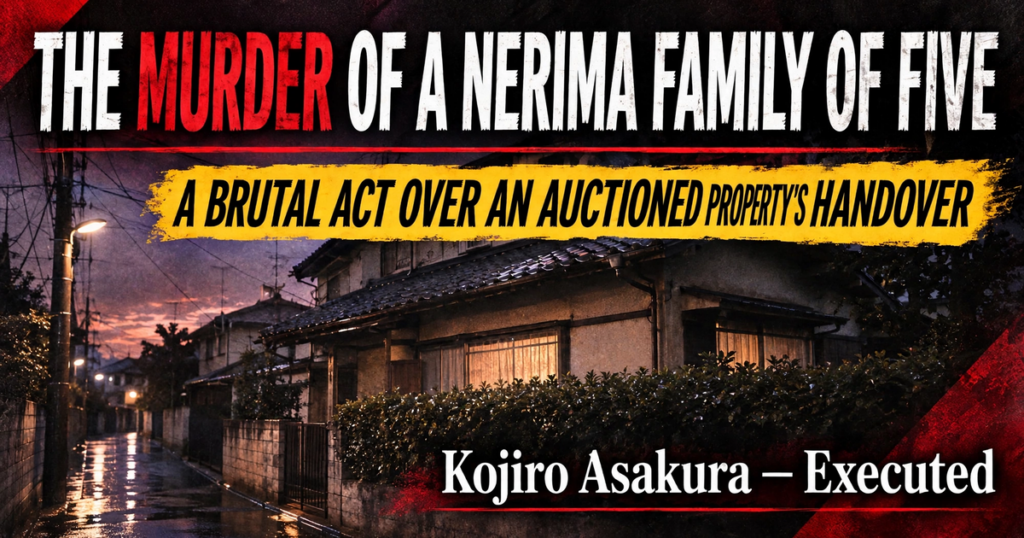
Five members of a family were killed in a Nerima home
On June 27, 1983, five members of a family were killed inside their home in Oizumigakuencho, Nerima Ward, Tokyo. The victims were the father, the mother and three of their children. Their eldest daughter was away on a school trip and was not in the house, so she survived. The person arrested for the killings was Kojiro Asakura, a 48-year-old real-estate appraiser who had acquired the property through a court auction and was seeking to have the family move out. The attack was connected to a property dispute, but the people killed included young children who had no role in the financial transaction.
The house had been purchased at a court auction
The land and house had belonged to a relative of the family but were put up for auction after financial difficulties. Asakura acquired the property in February 1983 for approximately 102.8 million yen. He intended to resell it and entered into a contract with another real-estate business in April, with delivery expected by the end of June. The family continued living in the house, and the negotiations over moving out did not progress. Asakura had already invested a large amount of money and faced a contractual penalty if he could not deliver the property on time. The financial pressure formed part of the background to the crime, but it did not excuse or justify the killings.
The move-out negotiations failed and the deadline approached
Asakura asked the family to leave and pursued civil procedures concerning possession of the property. At one point, the family appeared to agree to move, and Asakura withdrew the legal action. The move did not take place, and the family again refused to vacate the house. The resale contract created a deadline at the end of June. If the property could not be handed over, Asakura faced a penalty of approximately 30 million yen. The Japanese source describes the pressure he experienced as the deadline approached. However, the courts did not treat the dispute as a justification for violence. Legal remedies remained available, and the victims' lives could not lawfully be treated as obstacles to a business transaction.
Asakura attacked the family over the course of the day
On June 27, Asakura entered the home under the pretext of continuing the move-out negotiations. He attacked the mother and the children who were present, using more than one method of violence. Other family members returned later and were also killed. The attack was not a single confrontation in which all five victims were killed at once. Asakura continued acting as the family members arrived at different times. The eldest daughter was away on the school trip and was not exposed to the attack. The fact that she survived did not lessen the loss of her parents and siblings; she was left without five close family members.
The bodies were damaged in an attempt to conceal the crime
After the killings, Asakura damaged some of the bodies in an effort to conceal what had happened and make it possible to dispose of the property. The source describes the use of tools inside the house and the attempt to remove evidence. Neighbours became concerned and contacted police. Officers who went to the area encountered Asakura as he was leaving, and the investigation soon revealed the deaths inside the home. The property records and the negotiations connected Asakura directly to the family. Investigators also examined the tools he had prepared, physical traces at the scene and his conduct after the attack. The concealment effort did not prevent the crime from being discovered.
Asakura admitted the charges, but criminal responsibility was disputed
Asakura was indicted in July 1983 for murder and offences involving the damage to the bodies. At trial, he admitted the basic facts and expressed remorse to the bereaved family. The principal dispute concerned his mental condition at the time of the killings. The defence argued that the prolonged property negotiations and financial pressure had affected his ability to understand or control his actions. The court considered psychiatric evidence and the way Asakura had prepared for and carried out the attack. It found that he had not been in a state of insanity or diminished responsibility. His preparation of tools, the sequence of the attacks and his subsequent conduct showed that he retained the ability to act toward a goal.
The District Court and High Court imposed and maintained death
On December 20, 1985, the Tokyo District Court sentenced Asakura to death. The court considered the five deaths, including those of three young children, the financial motive, the preparation and the attempt to damage the bodies. Asakura's admission and expressions of remorse were considered, but they did not outweigh the seriousness of the crime. On January 23, 1990, the Tokyo High Court dismissed his appeal and maintained the death sentence. It agreed that the financial and psychological pressure had not deprived him of criminal responsibility. The High Court also considered the scale of the harm and the fact that the children were killed despite having no connection to the property dispute.
The Supreme Court upheld the death sentence and it was carried out
On November 14, 1996, the Supreme Court's First Petty Bench dismissed Asakura's final appeal. The Court accepted the conclusion that he had retained full criminal responsibility and that the death sentence was appropriate. A request to correct the judgment was also rejected in December 1996, and the sentence became final. Asakura was executed at Tokyo Detention House on December 27, 2001, aged 66. The case is remembered as a multiple murder arising from a property dispute, but its central fact is not the auction transaction itself. It is that Asakura chose to kill five people, including children, rather than continue to pursue lawful means of resolving a dispute over possession and resale.
Original Japanese record: 練馬一家5人殺害事件|競売物件の明渡しをめぐり一家5人を殺害、朝倉幸治郎に死刑
Last updated:
Related articles
Case record
The Tokyo–Saitama Child Abduction and Murder Case: Four Victims and a Long Trial Over Criminal Responsibility
Case record
The Kodaira Murders: Ten Murder Charges, Seven Convictions and a Postwar Pattern of Predation
Case record
The 1995 Tokyo Subway Sarin Attack: Victims, Criminal Trials and a Continuing Legacy

Case record