
The Hakata Station Stabbing: A Former Partner, a Prohibition Order and a Final 20-Year Sentence
On January 16, 2023, Miki Kawano, 38, was stabbed to death near JR Hakata Station by her former partner, Susumu Terauchi. She had previously sought police help, and a prohibition order under the Stalker Regulation Act had been issued against him. The Fukuoka District Court found that he followed her after work, but did not accept the prosecution's claim that he had waited in ambush outside her workplace. It imposed 20 years in prison on June 28, 2024. Neither side appealed, and the sentence became final in July.
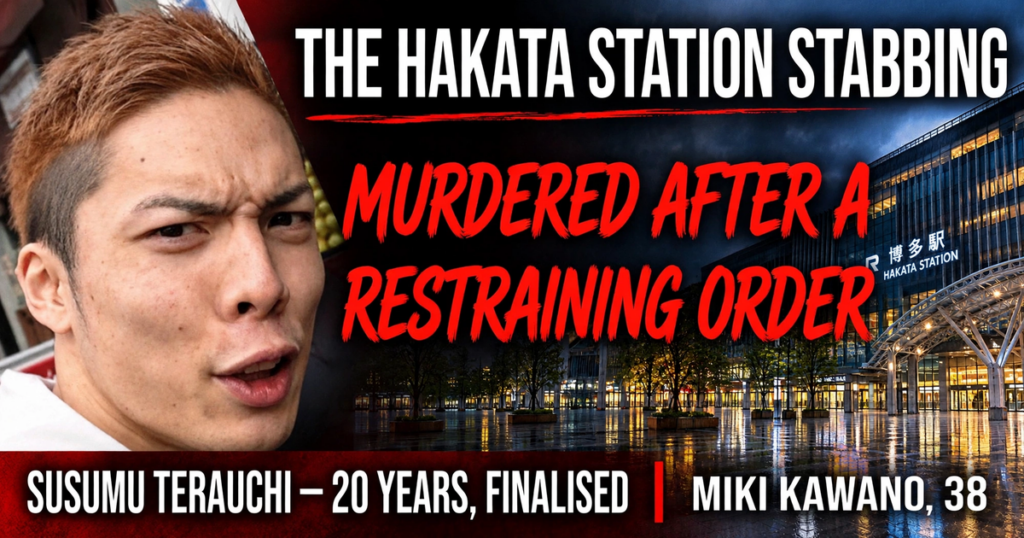
A woman was attacked near JR Hakata Station
On the evening of January 16, 2023, Miki Kawano, a 38-year-old company employee, was attacked on a street near JR Hakata Station in Fukuoka City. Her former partner, Susumu Terauchi, approached her with a knife and stabbed her repeatedly. Kawano was taken for medical treatment but died. The attack took place in a busy urban area near one of Fukuoka's main transport hubs. The case became a major stalking-related murder because Kawano had already sought help from the police and a legal prohibition order had been issued against Terauchi.
The relationship had ended and Kawano had consulted the police
Kawano and Terauchi had previously been in a relationship, but it had deteriorated and ended. Kawano became concerned about his continued contact and consulted the police. Officers took steps under the Stalker Regulation Act, including a warning and a prohibition order intended to stop conduct such as following or unwanted contact. A prohibition order is a formal legal measure; it is not merely advice to stay away. The existence of the order became an important part of the later criminal case.
The prohibition order had not stopped the contact
The Japanese archive records that Terauchi had continued to make contact after police involvement. On the day of the murder, he appeared near Kawano's workplace and later followed her as she left work and moved toward Hakata Station. The prosecution argued that he had waited for her near the workplace and then followed her. The defence disputed the legal character of some of these actions. The trial therefore examined not only the killing but also the precise conduct that could be classified as stalking under the law.
Terauchi was arrested after the attack
After the stabbing, Terauchi left the scene. Police used surveillance-camera footage and interviews with people connected to the area to trace his movements. He was arrested in Fukuoka on January 18, 2023, on suspicion of murder. Prosecutors later charged him with murder, injury, violation of the Swords and Firearms Control Act and violation of the Stalker Regulation Act. The charges covered both the fatal attack and conduct before and around the time of the murder.
The trial separated following from waiting in ambush
The trial opened in June 2024. Terauchi admitted killing Kawano, but disputed parts of the stalking allegation. The prosecution argued that he had remained near her workplace for about three minutes and had waited for her. The Fukuoka District Court did not accept that this short period of standing near the workplace proved a deliberate ambush. It did, however, find that he followed Kawano after she left work and that this conduct constituted stalking under the Stalker Regulation Act. The distinction was based on the evidence about what he did, not on whether the relationship had ended.
The court did not find that the murder had been planned in advance
The court considered the motive and the sequence of events leading to the attack. It found that Terauchi held resentment because Kawano had not accepted his feelings and had sought police assistance. However, it did not find that he had formed a concrete plan to kill her in advance. The court treated the stalking violation and the murder as separate legal questions. A finding that he followed her in violation of a prohibition order did not automatically establish that the killing itself had been planned. This distinction was important to the court's assessment of the case and the sentence.
The Fukuoka District Court imposed 20 years in prison
On June 28, 2024, the Fukuoka District Court sentenced Terauchi to 20 years in prison. Prosecutors had requested 30 years, while the defence argued for a shorter term. The court considered the death of Kawano, the history of police intervention and the stalking conduct that it found proven. It also considered the absence of a finding that the murder had been planned in advance. The sentence covered the offences before the court, including the separate injury case that was handled in the same proceedings.
The first-instance judgment became final because neither side appealed
Neither Terauchi nor the prosecution appealed the 20-year sentence by the deadline. The judgment became final on July 13, 2024. No High Court or Supreme Court decision reviewed the sentence. The final result was the Fukuoka District Court's own judgment, which became binding because neither party sought an appeal. This procedural detail matters: it would be inaccurate to say that the 20-year sentence was upheld by the Supreme Court.
The case prompted renewed attention to monitoring after prohibition orders
The murder raised questions about how police should monitor people who have received prohibition orders and how quickly officers should respond when a victim reports continued contact. After the case, police expanded efforts to contact people subject to prohibition orders and assess whether the risk had changed. Those administrative measures are separate from the criminal judgment. The court determined Terauchi's criminal responsibility; it did not decide every question about police policy or the wider prevention system. The case remains an example of why a prohibition order must be accompanied by meaningful risk assessment and follow-up.
Original Japanese record: 博多駅前女性刺殺事件|禁止命令後に川野美樹さんを殺害、寺内進の懲役20年が確定
Last updated:
Related articles

Case record
The Numazu University Student Stalking Murder

Case record
The Shinjuku Tower-Mansion Stabbing

Case record
The Kitakyushu McDonald's Middle-School Stabbing: A Five-Day Video Investigation and an Eight-Month Psychiatric Assessment
Case record