The Setagaya Family Murders: A Sweatshirt Sold in Just 130 Copies Nationwide — Why Has a Suspect Still Not Been Identified Despite So Many Clues?
The offender left a sweatshirt at the scene. Only 130 matching garments had been sold nationwide by the date of the murders, including ten in Tokyo. Shoe impressions, two black handkerchiefs, a knife and other traces were also left behind. Yet the killer of four members of the Miyazawa family in December 2000 remains unidentified. The case shows the distance between having detailed evidence and being able to connect it to a person.
Introduction: The offender left his sweatshirt behind
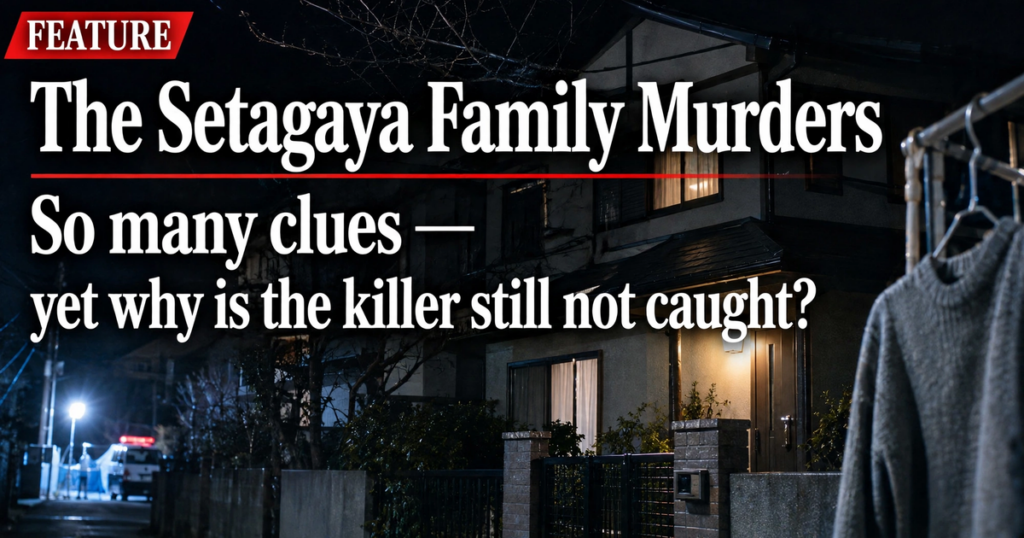
The offender left behind the sweatshirt he had been wearing. Only 130 garments of the same model had been sold nationwide between its release and the day of the crime; just ten had been sold in Tokyo. Shoe impressions and handkerchiefs connected with the weapon were also left at the scene. Even with such concrete clues, the person who killed four members of a family at the end of 2000 has not been identified. There is a surprisingly deep gap between evidence existing and knowing whose evidence it is.
130 sweatshirts: Did the number bring investigators closer?
The Tokyo Metropolitan Police Department's public page about the Setagaya family murders contains an unusual number: 130. That was the number of garments matching the raglan-sleeved sweatshirt left at the scene that had been sold nationwide by the date of the crime. The body of the sweatshirt was pale grey and the sleeves pale purple. Sales in Tokyo were even more limited: ten garments in total at four locations—Hachioji, Seiseki-Sakuragaoka, Ogikubo and Aoto. The purchaser of one is known; police are seeking the purchasers of the remaining nine.
A garment sold in such small numbers might seem likely to lead directly to the offender. In a metropolitan area of tens of millions of people, the number had been narrowed to ten. But the place where a garment was sold and the person wearing it on the night of the crime are not the same piece of information. A purchaser may have given it to someone else; a garment sold outside Tokyo may have been brought into the city; or it may have circulated as second-hand clothing. These are examples of why sales records alone cannot establish the chain of ownership, not confirmed routes in this investigation.
The number 130 is important, but it is not a name. The distance between tracing an object and identifying a person is the starting point for understanding the case.
Four lives that should have welcomed the New Year
Between the night of 30 December and the early hours of 31 December 2000, four members of a family were killed in a house in Kamisoshigaya 3-chome, Setagaya Ward, Tokyo. The victims were Mikio Miyazawa, 44; his wife Yasuko, 41; their daughter Niina, 8; and their son Rei, 6. The New Year they should have welcomed together never came.
The house stood near Soshigaya Park. The Sengawa River ran to the west and a university baseball ground lay to the north. The surrounding area was part of a relocation zone associated with park development. According to the Metropolitan Police Department, only four houses, including the victims' home, stood there at the time.
The location may seem different from the image of a crowded metropolitan neighbourhood. But that does not establish that the offender knew the area. The number of pedestrians or the visibility of the site cannot by themselves prove whether he had conducted prior surveillance. Police continue to seek information about people or vehicles seen nearby during the time of the crime, unusual sounds and people who disappeared from the area afterward. The request shows that the case cannot be solved from objects inside the house alone.
Calling this simply a famous unsolved case pushes the most important fact into the background: four lives were taken and an entire family's ordinary life was cut off. Examining the objects left behind is not an exercise in spectacle. It is a way of asking why clues that can be described in such detail have not led to a resolution.
The offender's clothing is known in unusual detail
The clothing items publicised by police go beyond the sweatshirt. They include a grey knitted hat, a green scarf with red and black checks, a black hip bag, a black Airtech jacket, gloves and details about the shoes established from impressions. Knowing an outfit in such detail may seem to bring investigators close to a concrete picture of the person.
But the items reveal characteristics of objects connected with the crime, not the person's occupation, nationality, home or social relationships. For example, police give the hip-bag belt length as 83 centimetres and the waist circumference as 70–75 centimetres. Those measurements may help identify the product or how it was worn, but they do not determine the wearer's build or age. Belt length and body measurements are not the same, and people wear items differently.
The purpose of publishing detailed measurements is not to encourage readers to imagine a suspicious-looking person. It is to reach people with specific memories: someone who sold or used the same item, someone who knows its owner or a business that handled the product. More objects do not automatically produce a clearer offender profile. Each item has its own distribution history, and investigators must find the point at which those histories can reliably be connected to the same person.
A Korean-made shoe does not establish the offender's nationality
A shoe impression at the scene was identified as matching a Slazenger sports shoe, Japanese size 27.5 centimetres, manufactured in South Korea. Police have published information indicating that this model and size were not sold through ordinary domestic retail channels in Japan.
This detail has long been used as a basis for speculation. But wearing a shoe manufactured or sold in South Korea is not the same as being a South Korean national. It may have been given by someone who bought it overseas, brought into Japan or distributed through another route. The origin of a shoe cannot establish the origin of the person wearing it.
Police have also described features suggesting that the shoes were not newly purchased immediately before the crime but had been used regularly. If so, the relevant history extends beyond the night of the murders: who obtained the shoes, when and where they were worn, and how they came to be at the scene. This does not reduce the value of the clue. It means that even an ordinary object such as a shoe has a history that must be verified.
The danger in discussing an unidentified offender is to jump from a small number of characteristics to a conclusion about what kind of person he must have been. In an unsolved case, that leap can cast suspicion on people who have no connection to the crime.
Two black handkerchiefs with cuts that may have helped grip a knife
Among the items publicised by police, two black handkerchiefs are unusually specific. One had a cut of about three centimetres near its centre. Another part of the cloth could be passed through the cut to form a pouch that fitted over the handle of a kitchen knife. Police said it may have been used to prevent the handle from slipping.
The second handkerchief had been folded into a triangle and appeared to have been drawn tight at both ends. Police said it may have been used as a face covering. Even an ordinary item such as a handkerchief can therefore contain details that go beyond product information. Investigators want to know not only where and when it was bought, but who knew how to use it in this way.
The knife was identified as a Sekimagoroku Ginju yanagiba knife. Information about the composition of the French fragrance Drakkar Noir was also publicised in connection with the handkerchief. The maker and product names are known, but the final link—how each item passed from a shop to the person who brought it to the scene—remains difficult to establish.
These two pieces of cloth may encourage strong images of the offender's actions. But imagining what happened and proving it are different things. They are precisely the kind of evidence that requires that distinction.
The offender was injured, but his identity remains unknown
The Metropolitan Police Department has stated that the offender injured his hand during the crime and had blood type A. This information connects more directly to the body of a person present at the scene than the colour of clothing or the country where a shoe was made. It may be an important memory for someone who noticed a hand injury or heard an explanation for it at the time.
But it does not identify one person. Many people have blood type A. A hand injury is difficult to connect to a particular individual without surrounding information, such as how the person explained it or whether someone saw the wound. Scientific analysis can describe the characteristics of evidence, but that is different from identifying a person who matches them. Without comparison material or information connecting the characteristics to a person, detailed evidence can remain unidentified.
The public police page is not the entire investigative file. Outsiders cannot determine the contents of unpublished evidence or the full results of each examination. It would therefore be wrong to assert that police overlooked a particular clue or that modern technology would necessarily solve the case. What is confirmed is that the hand injury remains part of the information request as of November 2026.
Why are police still looking for the purchasers of nine of the ten Tokyo sweatshirts?
The nine remaining Tokyo purchasers are not being sought merely to complete a numerical list. If investigators can establish each distribution route, they may be able to clarify where the history of the particular garment left at the scene becomes unknown.
Even if all ten purchasers in Tokyo were identified, the investigation would not necessarily be over. There were 130 matching garments sold nationwide, and the original purchaser may not be the person who eventually wore one. Those two facts must not be confused.
The specific question—who bought the remaining nine garments?—is narrower and more verifiable than simply asking who the offender was. The store, the date, the person to whom the garment may have been given and whether it remained at home are all details that someone may still remember. Police have also made clear that a person who comes forward because they own the same sweatshirt will not automatically be treated as the offender. The fact that one garment was left at the scene may help show that other owners of the same product are different people.
What investigators need is not a weak guess about who the offender might be, but verifiable information tied to a particular object, time or place.
The investigation continues beyond the label “unsolved”
More than a quarter-century after the murders, police continue to seek information. As of November 2026, the public reward consists of up to three million yen under the National Police Agency's special investigation reward programme and up to 17 million yen from a private cooperating group, for a combined maximum of 20 million yen. The current period is listed as 16 December 2025 to 15 December 2026. Amounts and deadlines can change, so anyone providing information should check the latest police notice.
Why has the offender not been identified despite so many objects being left behind? The public record does not permit one definitive answer. The full picture known to investigators and the reasoning behind decisions that did not lead to identification have not all been made public.
The objects nevertheless reveal a common problem. The sweatshirt can be narrowed by sales numbers; the shoes by model and size; the handkerchiefs by the way they were cut and folded; and the offender by a reported blood type and hand injury. Each is an important clue, but none has a name written on it. A memory or record held by someone who knows the missing connection may still move the case forward.
What the Miyazawa family needs is not a more sensational theory. It is a reliable account of what happened to the four people and who should be held responsible. The central question is not how many clues exist, but how to connect them to the truth.
At a glance
Incident: about 11 p.m. on 30 December 2000 through the early hours of 31 December. Location: Kamisoshigaya 3-chome, Setagaya Ward, Tokyo. Victims: Mikio Miyazawa, Yasuko Miyazawa, Niina Miyazawa and Rei Miyazawa. Status: unsolved as of 5 November 2026; the Metropolitan Police Department continues to seek information. Public clues include the sweatshirt, shoe impressions, black handkerchiefs, the offender's hand injury and blood type A. Maximum combined reward: ¥20 million, with the current public notice running through 15 December 2026.
Original Japanese feature: 世田谷一家殺害事件【特集】|全国130着のトレーナーを残した犯人――手掛かりが多いのに、なぜ捕まらないのか
Last updated: