The Kishu Don Juan Case: Two Courts Upheld Sudo's Acquittal, and the Prosecution Appealed
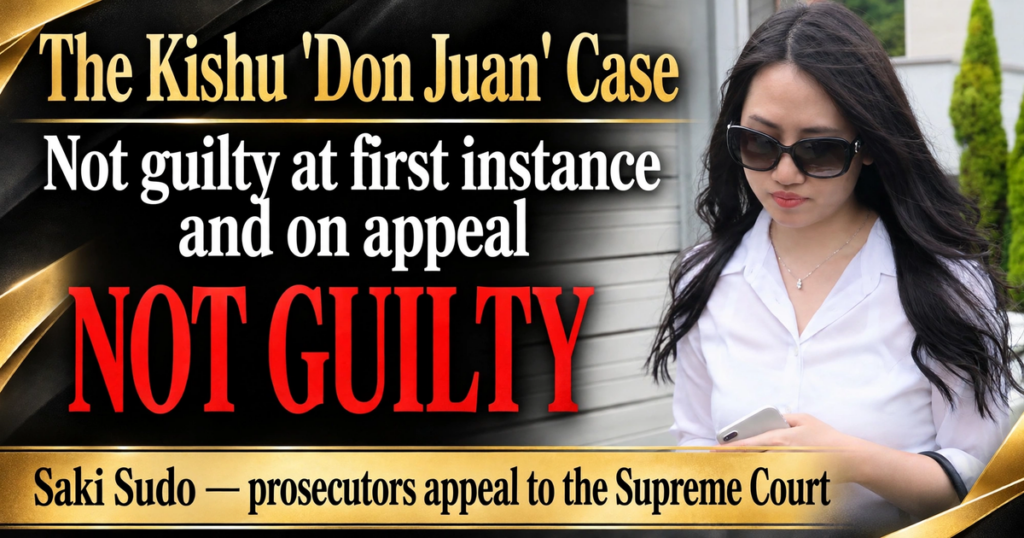
Saki Sudo was acquitted over Kōsuke Nozaki's 2018 methamphetamine-poisoning death. The Osaka High Court upheld the acquittal in March 2026; the prosecution's Supreme Court appeal remained pending in the Japanese source's 14 November update.
The death of a wealthy businessman in Tanabe
Kōsuke Nozaki, a businessman known in the media by the nickname “Kishu Don Juan,” died at his home in Tanabe, Wakayama Prefecture, on 24 May 2018. He was 77. A post-mortem examination identified acute methamphetamine poisoning after a large quantity of the drug had been taken orally. The fact of poisoning was central to the investigation, but it did not by itself establish who had supplied the drug or how it had entered his body. The criminal case that followed was therefore about the identity and actions of the person responsible, not simply whether Nozaki had died from poisoning.
The former wife was arrested and charged
Nozaki's former wife, Saki Sudo, was at the residence when he died. She was arrested in 2021 and prosecuted for murder and related offences. The prosecution alleged that she had caused Nozaki to ingest methamphetamine. Sudo denied the accusation. The indictment placed the allegation before a criminal court; it did not prove guilt. In Japan, as in other criminal justice systems, the prosecution must establish the charged offence to the required standard. The distinction between arrest, indictment and conviction is especially important in a case that attracted intense public attention and was frequently discussed as though suspicion alone settled the question.
The prosecution relied on circumstantial evidence
The prosecution presented a collection of indirect evidence. It referred to online searches, the purchase of a substance said to resemble methamphetamine, records of movement on a smartphone and Sudo's position as a person who might benefit from Nozaki's estate. Prosecutors argued that the separate pieces formed a coherent account of preparation and opportunity. None of those items, considered alone, directly recorded the alleged administration of the drug. The court therefore had to decide whether the evidence, taken together, excluded reasonable alternative explanations. The case became a significant example of the limits of circumstantial evidence in a serious criminal prosecution.
The smartphone stair-count data did not establish what happened upstairs
One disputed item was data showing that Sudo's smartphone recorded repeated stair ascents during the afternoon and evening of Nozaki's death. The prosecution argued that she had repeatedly gone upstairs to check on him after administering the drug. The district court considered that the records showed movement but did not identify what she did during each trip. The High Court also treated the data cautiously. A device can register a physical movement, but it does not record the purpose of that movement or prove that a particular substance was administered. The distinction between evidence of opportunity and proof of an act was central to the courts' reasoning.
The timing of Nozaki's own telephone calls mattered
The appellate court examined the timeline in detail. Nozaki's phone made two calls to his business office between approximately 7:34 and 7:35 p.m. The prosecution did not dispute that Nozaki himself had made those calls. The High Court considered that this evidence left a reasonable doubt about whether symptoms of acute methamphetamine poisoning had already appeared by that time. That doubt affected the prosecution's proposed sequence of events. A timeline may be built from digital records and witness evidence, but the court must still determine whether the pieces fit without leaving a reasonable alternative.
The district court acquitted Sudo in 2024
The Wakayama District Court acquitted Sudo in 2024. Its decision did not mean that the court rejected the medical conclusion that Nozaki died from acute methamphetamine poisoning. The contested issue was whether the prosecution had proved that Sudo administered the drug. The court found that the circumstantial evidence did not establish that allegation beyond reasonable doubt. The result was an acquittal, not a finding that the death was natural or that the poisoning had not occurred. It is also not accurate to say that the court established who else, if anyone, caused the ingestion.
The Osaka High Court dismissed the prosecution's appeal
The prosecution appealed the acquittal. In March 2026, the Osaka High Court dismissed that appeal and upheld the acquittal. The appellate court reviewed the evidence and concluded that the district court's reasoning did not justify reversal. This was a second-instance judgment, not the end of the proceedings. On 6 April 2026, the Osaka High Public Prosecutors Office appealed to the Supreme Court. The existence of that appeal means that, as of the source's November 2026 update, the acquittal was not yet final. It must not be described as a final acquittal or as a conviction.
Why the case remains unresolved in legal terms
The case is sometimes presented as a simple contest between a suspicious death and an accused former spouse. The actual legal question is narrower and more demanding: whether admissible evidence proved that Sudo caused Nozaki to ingest methamphetamine and thereby committed the charged crimes. The prosecution's evidence included digital activity, purchases and possible financial motive, but the courts found gaps in the chain of proof. A motive or an opportunity can support an inference, but neither replaces proof of the act itself. The Supreme Court appeal remains a separate procedural stage; until it is resolved, the case should be described as an acquittal upheld by the High Court with a prosecution appeal pending.
The alleged dose and the disputed timeline
The autopsy attributed Nozaki's death to acute methamphetamine poisoning. The autopsy and expert testimony estimated that he had ingested at least 1.8 grams of methamphetamine. Prosecutors alleged that Sudo administered the drug between about 4:50 p.m. and 8 p.m. on 24 May 2018. The prosecution relied in part on Sudo's smartphone health-app data, which recorded at least eight ascents to the second floor during that window, including seven between 6:45 and 7:53 p.m. This was movement data, not a recording of the alleged administration or proof of what she did upstairs. The source also notes two calls Nozaki made to his office at 7:34 and 7:35 p.m., which formed part of the dispute over the timing of his symptoms.
The substance Sudo obtained was not forensically linked to the fatal dose
The substance Sudo obtained from a dealer was not conclusively identified as methamphetamine. The suppliers gave conflicting accounts: one said the packet contained crushed ice sugar, while another said it was actual methamphetamine. Investigators did not establish a forensic link between the packet and the drug found in Nozaki. The High Court considered the possibility that Nozaki had accidentally ingested the drug himself as a possible alternative, not as a proven explanation. The acquittal therefore did not determine exactly how he died; it held that the prosecution had not proved that Sudo administered the fatal dose beyond reasonable doubt. The Japanese article's 14 November 2026 update continued to list the prosecution's Supreme Court appeal as pending.
Original Japanese record: 紀州のドン・ファン事件|一・二審が退けた間接証拠と検察上告
Last updated: