
The Luffy Wide-Area Robbery Cases: Four Separate Leadership Trials and Their Different Legal Stages
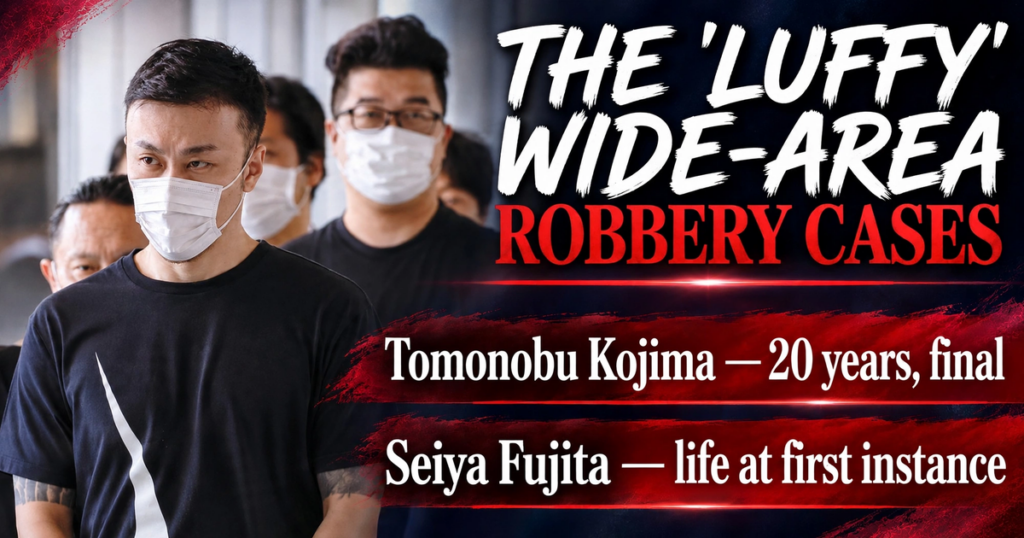
The Luffy label covers robberies prosecuted in separate cases. Kojima's 20-year sentence is final, Fujita's life sentence is under appeal, Watanabe's trial began on 11 November 2026, and Imamura's trial date remains unset.
A label for a series, not a single criminal case
“Luffy” became the public label for a series of robberies carried out across Japan in 2022 and 2023. The label can make the events sound like one centrally organised offence, but the criminal proceedings were divided by incident, defendant and alleged role. Local operatives entered homes and businesses, while people outside Japan were suspected of arranging targets, recruiting participants and sending instructions. The police investigation connected offences through communications, devices, statements and movement records. It is important to keep the overall pattern in view without assuming that every person was involved in every robbery or that one judgment resolved the whole series.
The Philippines became a focus of the investigation
Investigators identified the Philippines as a base from which several alleged organisers communicated with people in Japan. Four men identified as senior figures were Watanabe (渡邉優樹), Kiyoto Imamura, Toshiya Fujita and Kojima (小島智信). They were held in a Philippine immigration facility and returned to Japan in February 2023. Japanese police initially arrested them in connection with special fraud investigations and then examined seized devices and other evidence for links to robberies. The four were not automatically responsible for every offence simply because they were described as leaders. Prosecutors had to connect each person to specific incidents and acts.
The priority investigation covered five prefectures and eight cases
The Japanese source describes eight priority robbery cases across Tokyo, Chiba, Kanagawa, Hiroshima and Yamaguchi. The scope of each alleged leader's involvement differed. Reports at the time stated that Imamura was arrested in relation to all eight priority cases, Watanabe and Fujita in seven, and Kojima in four. These counts are not findings that all four committed the same acts. They describe the cases in which police pursued their alleged involvement at that stage. A careful account must distinguish police arrest or charging decisions from final judicial findings. The four priority cases referred to the number of arrest cases, not four robbery counts prosecuted. The indictment covered three robberies and one fraud.
Kojima (小島智信)'s 20-year sentence became final
Kojima received a 20-year prison sentence in a case concerning three robbery counts and one fraud count. The Tokyo High Court upheld the first-instance judgment. Kojima appealed to the Supreme Court, but the Supreme Court dismissed his appeal by a decision dated 3 August 2026. His 20-year sentence therefore became final. This is a distinct procedural outcome from a sentence that becomes final because an appeal is not filed or is withdrawn. Here, the Supreme Court considered the appeal and rejected it. The result should be attributed to Kojima's case and should not be generalized to the other three alleged senior figures.
Toshiya Fujita received a first-instance life sentence
Fujita was tried in a case involving seven robberies, including the Komae robbery resulting in death. He disputed the prosecution's account of the extent of his instructions and argued that his responsibility was closer to assistance than joint principal liability. On 16 February 2026, the Tokyo District Court found that he had played a central role by recruiting operatives and giving detailed directions while offences were underway. It imposed life imprisonment, matching the prosecution's request. The Japanese source describes this as a first-instance judgment. Unless a later appeal result is confirmed, it must not be described as a final life sentence.
The cases of Watanabe and Imamura remained distinct
The source's earlier update said that the proceedings involving Watanabe and Imamura had not reached trial. That changed on 11 November 2026, when Watanabe's first trial opened at Tokyo District Court. He pleaded not guilty to three robbery cases and said that, in the other four, including the Komae robbery resulting in death, he had only helped co-defendants; he admitted the fraud and theft charges. Closing arguments were scheduled for 2 December and judgment for 14 December 2026. On 20 November, Nagata testified that Watanabe had used the chat alias “Sugar” but had not actively issued instructions in the group chat; Nagata described his presence as low-profile. That was witness testimony, not a court finding. Imamura's trial date remained unset.
How remote instructions can create criminal responsibility
The cases raised a question for readers unfamiliar with Japanese criminal law: a person need not be physically present at a robbery to face serious charges. Prosecutors may argue that a remote organiser who recruits participants, selects targets, supplies information and directs the execution is a joint principal rather than a mere helper. The court must examine the actual degree of control, the defendant's knowledge and the relationship between the instructions and the crimes. The label “instruction role” is descriptive; the legal conclusion depends on the evidence and the judgment in each case.
The current position must be read defendant by defendant
As of 22 November 2026, Kojima's 20-year sentence was final following the Supreme Court's dismissal on 3 August 2026. Toshiya Fujita's life sentence of 16 February 2026 remained under appeal. Watanabe's first trial had opened on 11 November, with judgment scheduled for 14 December; no verdict had yet been delivered. Kiyoto Imamura's trial date had not been set. These are four distinct procedural positions. The accurate summary is not that “the Luffy group” received one sentence, but that a series of offences produced separate prosecutions, with different outcomes and stages.
Original Japanese record: ルフィ広域強盗事件|小島智信の懲役20年確定、藤田聖也に一審無期懲役
Last updated:
Related articles

Case record
The Komae Robbery Resulting in Death: Kinuyo Oshio's Killing and the Separate Trials of Local Operatives and Overseas Organisers
Case record
The King of Comedy Kenichi Takahashi School-Uniform Theft Case: 182 Items, 25 Victims, and a Suspended Sentence

Case record
The Tachikawa Hotel Double Stabbing and Murder

Case record