
The Higashiosaka University Student Murders: Retaliation, Two Burials and a Final Death Sentence
Two 21-year-old men, university student Shoji Fujimoto and his friend Tetsuya Iwagami, were killed after a group retaliation in June 2006. Ryuji Kobayashi's death sentence became final in 2011; he died in custody on 31 January 2026 before it was carried out.
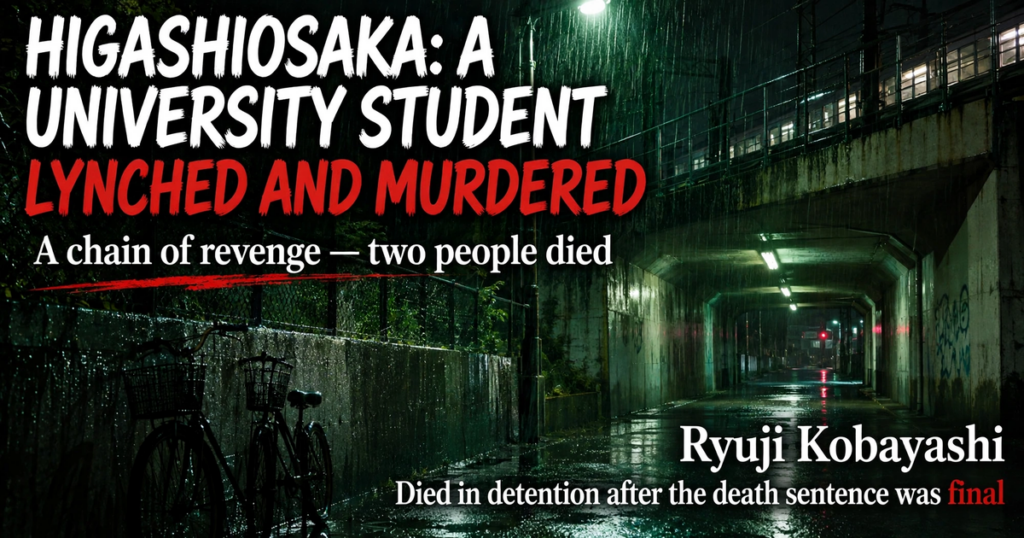
A dispute among young people developed into a group retaliation
The events that became known as the Higashiosaka University Student Lynching Murders took place in June 2006. The background was a dispute among young people involving relationships with women and violence against members of a group that included Ryuji Kobayashi's childhood friend, Yuki Sato. When Kobayashi learned that his associates had been attacked, he intervened and helped organize retaliation. The Supreme Court later found that he did more than accompany others to a confrontation: he persuaded people who were reluctant to participate, brought additional people into the group and took a leading role in moving the plan forward. The initial purpose was retaliation for the earlier dispute, not a carefully prepared plan from the outset to kill two people. But the group violence and the effort to prevent the police from learning what had happened led to two deaths on successive days.
Fujimoto and Iwagami were summoned to Okayama on 19 June
On 19 June 2006, Kobayashi and others called 21-year-old Shoji Fujimoto and 21-year-old Tetsuya Iwagami to Okayama Prefecture. Fujimoto was a fourth-year student at Higashiosaka University; Iwagami was his friend. The men were subjected to repeated violence involving golf clubs, batons and other objects. The Supreme Court described the attacks as one-sided and persistent. The victims were not free to leave. The proceedings also established a robbery offence arising from property taken from one of the men while he was confined. The group had initially been assembled in response to a dispute, but the violence continued after the victims were under the defendants' control. The fact that several people participated did not make their criminal responsibility identical. The courts examined each defendant's role, the extent of participation in the assaults and whether the required agreement to the later killings had been proved.
Fujimoto was buried alive at an industrial waste site
After the assault, Fujimoto was taken to an industrial waste collection site in Okayama City. A hole was dug with an excavator, and he was buried alive. The Supreme Court treated the method as extremely cruel and found that Kobayashi had taken a leading part in the assault and killing. The murder was not described as an impulsive blow delivered during a sudden argument. The victim was moved to another location, machinery was used to dig a hole, and the group covered him with earth. The court found that the first killing was intended to prevent the earlier violence from being reported to police. The decision to kill Fujimoto created another problem for the group: Iwagami remained alive and could disclose what had happened. Instead of ending the violence, the first murder became part of the reason the group chose to kill a second victim the following day.
Iwagami was killed the next day in a second act of concealment
On 20 June, the group decided to kill Iwagami as well. The Supreme Court found that the defendants feared not only police investigation but also possible retaliation by a person associated with Iwagami. He was assaulted and confined, taken to the same industrial waste site with his face covered, and buried alive in another hole dug by an excavator. The two murders were connected and used the same general method, but they were not one simultaneous event. Fujimoto was killed first; the group then had an opportunity to stop, disband or report what had happened. Instead, it chose to kill Iwagami the next day. The courts treated that second decision as an important part of the seriousness of the case. The two deaths were not merely the unintended result of a single episode of group violence. They followed separate decisions to silence people who could expose the earlier offences.
Eight people were prosecuted, but their sentences differed
Eight people, including Kobayashi, were indicted in connection with the series of offences. They did not all receive the same punishment. The proceedings examined who had proposed and advanced the retaliation, who had gathered the participants, how each person took part in the assaults, whether each had shared an intent to kill, and whether anyone had withdrawn from the group before the murders. Some co-defendants received fixed prison terms, while others received sentences ranging from 11 years to life imprisonment. The differences reflect the individual findings made in each case. Kobayashi was treated as the central organizer who persuaded reluctant participants, involved younger people and personally took an active part in the violence and killings. The fact that a group committed the offences did not remove the need to establish each defendant's conduct and mental state separately.
The courts considered Kobayashi's youth but upheld the death sentence
Kobayashi was 21 at the time of the offences and 22 when the Osaka District Court sentenced him to death on 22 May 2007. The defence argued that the murders had not been planned from the beginning and that the violence had escalated unexpectedly. It also relied on his youth, limited prior record, admissions and expressions of remorse. On 20 May 2008, the Osaka High Court dismissed his appeal. It accepted that the original purpose had been retaliation rather than a fully developed murder plan, but held that the killings could not be described as accidental once the group chose to bury the victims to prevent discovery. On 25 March 2011, the Supreme Court's Second Petty Bench rejected his final appeal. The Court acknowledged the mitigating circumstances but concluded that Kobayashi's leading role, the brutality of the killings and the decision to kill two people to silence them made his criminal responsibility exceptionally serious. His death sentence became final.
The sentence was never carried out; Kobayashi died in custody in 2026
The finality of a death sentence is not the same as execution. Kobayashi remained under sentence of death after the Supreme Court decision. On 31 January 2026, he was found unresponsive in his single-person cell at Osaka Detention House and was taken to hospital, where his death was confirmed. The public record reports that he died in custody; it does not describe an execution. The legal sequence is therefore a 2007 death sentence, dismissal of the appeal in 2008, Supreme Court rejection in 2011, and death in detention in 2026 before the sentence was carried out. The case is also a reminder that group homicide cases require careful attention to each participant's role. Kobayashi's death sentence was based on findings about his leadership and participation, while the other defendants' outcomes differed according to their individual conduct and proven intent.
Original Japanese record: 東大阪大生リンチ殺人事件|報復の連鎖で2人を生き埋め、小林竜司に死刑が確定するまで
Last updated:
Related articles
Case record
The Ochi Kiyoshi Wanted Case: The Killing of Eiko Ochi and the Disappearance on Kuchinoerabu Island
Case record
The Yao Child Death and Concealment Case: Eighteen Years Before Discovery and Two Separate Judgments
Case record
The Suspicious Death of Physician Shoko Yajima

Case record