
The Mitsubishi Bank Hostage Siege: Forty-Two Hours in Kitabatake
Armed robber Akimi Umekawa killed four people at a bank in Osaka in January 1979 and held customers and employees hostage for about 42 hours. Police records differ on the number of hostages, and the suspect died after the police assault, so no criminal trial took place.
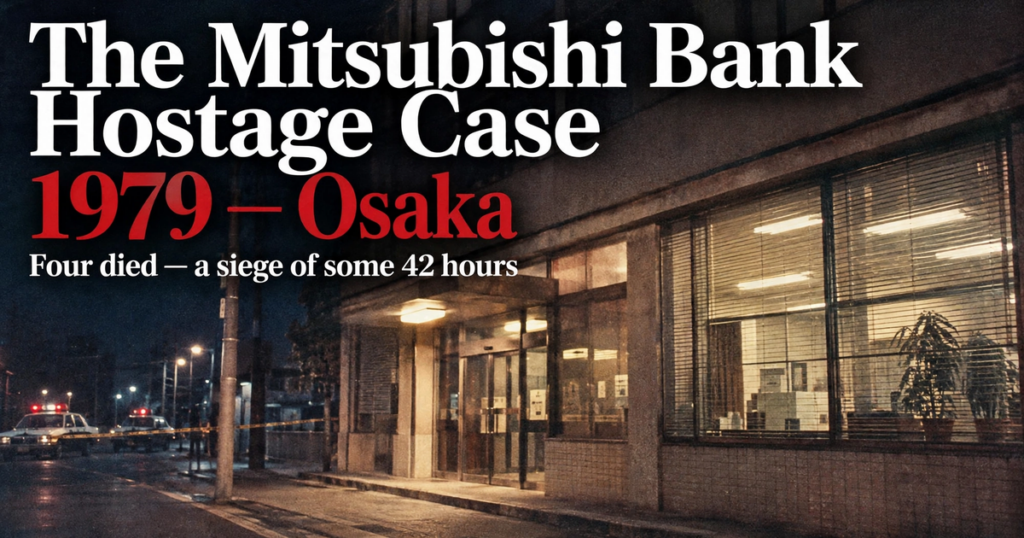
A gunman entered the Kitabatake branch on 26 January 1979
At about midday on 26 January 1979, 30-year-old Akimi Umekawa entered the Kitabatake Branch of the Mitsubishi Bank in Sumiyoshi Ward, Osaka, carrying a shotgun. He demanded 50 million yen. The incident quickly became far more than an attempted bank robbery. When employees tried to contact the police, Umekawa opened fire inside the branch. He also shot officers who entered after receiving the report. Two bank employees and two police officers were killed, bringing the death toll to four. Other employees were injured. The branch was surrounded, and the prospect of a safe escape disappeared. Umekawa then forced employees to lower the shutters and remained inside with customers and staff. The attack took place during a period when firearms-related robberies and hostage incidents were a serious concern for Japanese police. The use of a shotgun that Umekawa had been licensed to possess later became a central issue in the review of firearms administration.
The siege continued for about 42 hours
The hostage situation lasted until the morning of 28 January, approximately 42 hours after the gunman entered the bank. Police surrounded the building, gathered information and attempted to manage the situation without exposing the hostages to additional danger. Umekawa positioned employees near the entrance and used them as human shields, making it difficult for officers to obtain a clear shot. Police records also describe him forcing one employee to use a knife against an injured colleague. The number of hostages is not consistent across official police publications. The 1980 White Paper on Police refers to 43 employees and customers, while a later 2000 police white paper gives the figure as 37. Both are official records, and the published material does not explain the discrepancy. A careful account should preserve both figures rather than choose one without evidence. What is consistent is that a large number of people were held inside, four people had been killed, and police faced a high-risk rescue problem.
The police waited for a moment when the hostages were away from Umekawa
The police had to balance the need to end the siege against the danger that an assault could lead to further deaths. The hostage-takers' use of people as shields limited the available options. On the morning of 28 January, officers observed an opportunity when the hostages were separated from Umekawa. A special police unit entered the bank and shot him. He was taken into custody but died after being transported for medical treatment. The hostages were rescued, and the two-night, three-day standoff ended. Because Umekawa died, there was no criminal trial in which he could enter a plea, contest the evidence or have his criminal responsibility assessed by a court. Police records describe the case as having been referred to prosecutors with the suspect deceased. It is therefore inaccurate to describe the outcome as a conviction or a judicial sentence. The four deaths and the actions inside the bank are recorded through police and official historical materials rather than a final criminal judgment against Umekawa.
The licensed shotgun raised questions about firearms screening
The shotgun used in the attack was one Umekawa had been authorized to possess. The 1980 White Paper on Police described the incident as raising questions about the administration of firearms permits. After the siege, police stated that they would conduct more thorough inquiries into applicants with serious criminal records or prior histories that could indicate unsuitability. The response also went beyond the initial decision to grant a licence. Police emphasized continued monitoring after a permit had been issued and the need to revoke it when later conduct or other circumstances showed that the holder was no longer suitable. The significance of the case was therefore not simply that a firearm had been used in a bank robbery. It showed how a legally licensed firearm could become part of an exceptionally serious crime and prompted attention to both initial screening and ongoing supervision. The article's discussion of firearms administration is based on the official police white paper's description of the changes considered after the incident.
The siege was part of the development of Japanese police tactical units
Special police units had already been established in the Metropolitan Police Department and Osaka Prefectural Police after the 1977 Dhaka hijacking. The 1997 police white paper records that the Osaka unit contributed to resolving the Mitsubishi Bank incident. The unit's presence was therefore not created from nothing by the 1979 siege. The experience at Kitabatake became one of the major cases in which the special unit's role in a hostage situation was demonstrated. The police later organized the special units as the Special Assault Teams, commonly known as SAT, in April 1996. It would be misleading to say that the Mitsubishi Bank incident alone directly created the SAT system. The official record instead places the case within a longer development that began after the Dhaka hijacking and continued through later hostage and hijacking incidents. The siege became part of the institutional history of police tactical response because it showed the importance of specialized training, intelligence and timing in a hostage rescue.
The record preserves uncertainty rather than forcing every number into one version
Several aspects of the case are firmly established: the date, the bank branch, the gunman's identity, the demand for 50 million yen, the four deaths, the approximately 42-hour siege and the police assault on 28 January. Other figures require qualification. The hostage count appears as 37 in one police publication and 43 in another. The official record also refers to three people as seriously or otherwise severely injured, but the exact injury descriptions vary between sources. A responsible account should not turn these differences into false precision. The central human consequences remain clear regardless of which hostage count is used: bank employees and customers were held in a place where they worked or conducted ordinary business, four people were killed and three people were recorded as seriously injured. Police had to consider the safety of those still inside when choosing how to end the siege. The case remains an important record in discussions of firearms licensing, hostage rescue and police tactical capability.
Original Japanese record: 三菱銀行人質事件|4人射殺・42時間の立てこもりと、猟銃行政・特殊部隊に残した影響
Last updated:
Related articles
Case record
The Osaka Electrolysis Murders: Two Executives Killed in a Staged Embezzlement Disappearance
Case record
The Osaka Private Video Booth Fire: Sixteen Deaths, a Final Death Sentence and a Second Retrial Denial
Case record
The Kitashinchi Building Arson: Twenty-Six Victims Killed, No Criminal Trial and the Fire-Safety Reforms That Followed
Case record