The Kochi Serial Insurance Murders
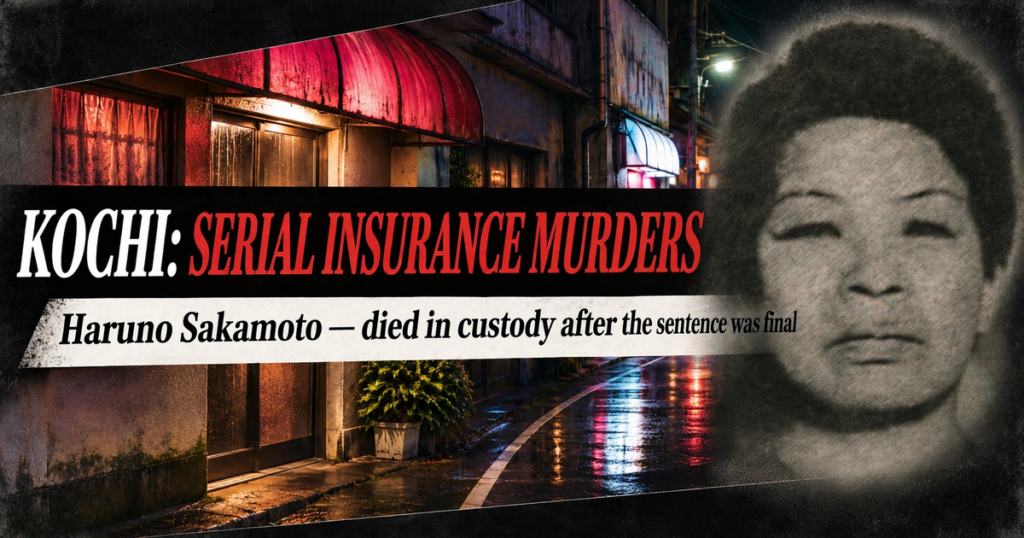
Haruno Sakamoto was convicted of two insurance-motivated murders committed about five years apart. More than ¥50.14 million was obtained after the first killing; the second insurance fraud was unsuccessful. Her death sentence became final in 2004, but she died in custody in 2011 without being executed.
Two murders were separated by about five years
The Kochi serial insurance murders involved two victims and two separate conspiracies. The first victim was a 54-year-old man known to Haruno Sakamoto. The second was a 60-year-old woman who had formerly lived with that man as his common-law wife. The crimes occurred between 17 January 1987 and 19 August 1992. Sakamoto was convicted of murder, disposal of bodies, fraud and attempted fraud. The two killings were linked by the use of insurance contracts and by the court's finding that Sakamoto planned and led both offences.
The first victim was brought into the household and made a legal spouse
Sakamoto conspired with her sister and brother-in-law in the first case. She persuaded the man to live at her home and arranged for him to become her husband in the family register. Two insurance policies were then taken out on his life. The sequence mattered to the Supreme Court: the victim was not simply someone who happened to have insurance before a sudden killing. The relationship and the legal status were created as part of the preparation for obtaining insurance proceeds. The court treated this as evidence of deliberate planning.
The first killing produced insurance proceeds of more than ¥50.14 million
The man was made intoxicated before the attack. The Supreme Court's findings, as summarized in the Japanese article, state that Sakamoto struck his head with a large stone as the first attack. He was then suffocated, with the co-conspirator also involved in the fatal acts. After his death, the circumstances were misrepresented to the insurers and claims were made. The total death benefits received exceeded ¥50.14 million. The proceeds were not merely expected: the first case resulted in the actual payment of the insurance money.
The second victim had been the first man's former common-law wife
About five years later, the woman who had formerly lived with the first victim became the target of a second insurance scheme. She was then 60 years old and living at Sakamoto's home. This time Sakamoto conspired with a person who operated an insurance agency and arranged two policies on the woman's life. The co-conspirator in this second case was not the same group as in the first. The two cases should therefore not be described as one continuous operation by an unchanged group of offenders.
The second woman was killed, but the insurance fraud was not completed
The woman was asleep and therefore vulnerable when the attack took place. The Supreme Court found that Sakamoto delivered the initial blow to her head with a large stone, after which she was suffocated with the involvement of the co-conspirator. After the killing, the body was placed on a road near Sakamoto's home to make the death appear to have resulted from a traffic accident. The attempt to obtain insurance proceeds failed because the murder was discovered. Murder and disposal of the body were completed offences, while the insurance fraud concerning this woman remained an attempt.
A separate false accident claim involved Sakamoto herself
The case also included a separate fraud in which Sakamoto falsely presented herself as having been involved in a traffic accident. She obtained more than ¥4.17 million through that claim. This offence was distinct from the two murders, although it formed part of the wider pattern of insurance-related conduct examined by the courts. The Supreme Court case title included murder, disposal of bodies, fraud and attempted fraud because the prosecution covered both the completed insurance fraud in the first murder and the unsuccessful scheme in the second, as well as the separate false claim.
Sakamoto was found to be the planner and principal actor in both killings
The co-conspirators differed between the two murders, but the Supreme Court found that Sakamoto was the principal planner in both. She devised the schemes and played a leading role in carrying them out. The judgment also treated her as an active participant at the scenes: she delivered the first attack against each victim rather than merely arranging insurance and leaving the violence to others. The court considered planning and execution together. The presence of other participants did not reduce her role to that of a passive organiser or make the killings the independent acts of someone else.
The victims' vulnerability was a central feature of the court's assessment
The judgment described both victims as people whose limited intellectual abilities made them susceptible to Sakamoto's influence. The court's concern was not that their personal characteristics made them responsible for what happened; it was that the offenders exploited their vulnerability to create relationships, obtain insurance and carry out the killings. The first man was intoxicated when attacked, while the second victim was asleep. The use of these circumstances, together with the insurance arrangements and concealment, supported the court's finding that the crimes were planned and especially grave.
Sakamoto disputed parts of the prosecution case
Sakamoto did not consistently admit both murders throughout the proceedings. In the first case, she argued that her confession to the killing of the man who had become her husband was coerced and maintained that she was not guilty. She had admitted the woman's murder at the first trial, but later changed her position on appeal and argued in substance that the co-defendant had acted alone. These changes must be distinguished from the final judicial findings. The convictions were based on the evidence accepted by the courts, not on a claim that Sakamoto consistently confessed to both killings.
The district and High Courts imposed and upheld the death sentence
The Kochi District Court sentenced Sakamoto to death on 29 July 1998. The Takamatsu High Court dismissed her appeal on 28 September 2000, leaving the first-instance sentence in place. The case then proceeded to the Supreme Court under case number Heisei 12 (A) No. 1634. The appeal raised issues including factual error and the severity of the sentence. In Japan, the Supreme Court reviews an appeal on legal grounds and does not ordinarily conduct a new trial of the evidence as a first-instance court.
The Supreme Court dismissed the appeal, but Sakamoto was never executed
On 19 November 2004, the Supreme Court's Second Petty Bench dismissed Sakamoto's appeal. Her death sentence therefore became final. She was not executed. On 27 January 2011, aged 83, she died of illness at Osaka Medical Prison. The distinction is essential: she was a person whose death sentence had become final, but she died while in custody before the sentence was carried out. It would be inaccurate to describe her as having been executed or to imply that the death sentence was overturned.
Original Japanese record: 高知連続保険金殺人事件|2人への保険契約、5014万円詐取と坂本春野の死刑確定
Last updated: