
The Aizu-Misato Couple Robbery-Murders
On 26 July 2012, Akihiko Takahashi entered the home of Nobuhiro and Sachiyo Endo in Aizu-Misato, Fukushima Prefecture, to steal money. Both were killed. The Supreme Court found that Takahashi entered with a conditional willingness to kill if discovered, but that his intent to kill Nobuhiro became definite during the struggle. The death sentence was upheld in 2016. A separate civil case brought by a juror who developed acute stress disorder did not alter the criminal judgment.
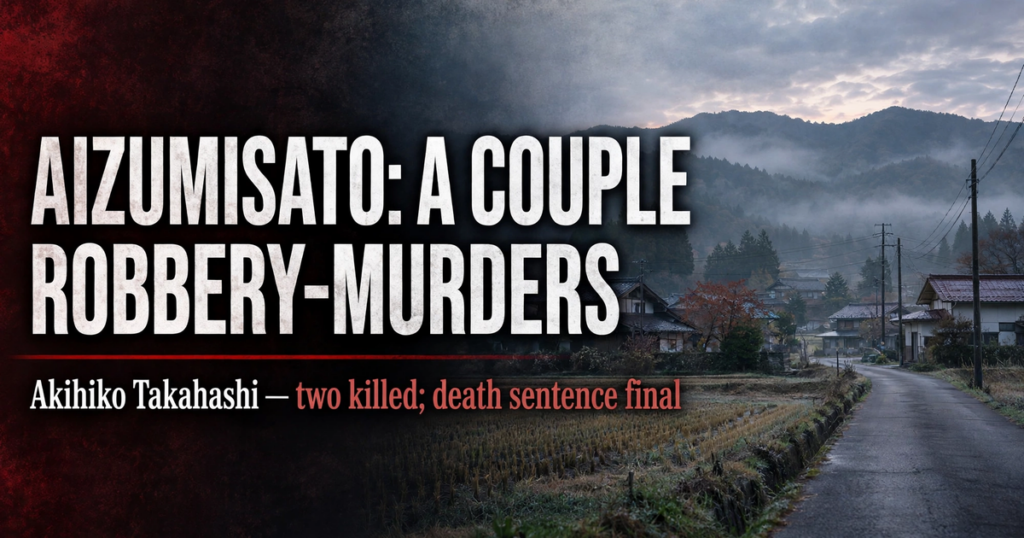
A couple were killed during a robbery in Aizu-Misato
Early on 26 July 2012, a man entered the home of Nobuhiro Endo, aged 55, and his wife Sachiyo, aged 56, in Aizu-Misato, Fukushima Prefecture. He intended to steal money and valuables. Both residents were killed. The defendant was Akihiko Takahashi, who used his wife's family name, Yokokura, at the time of the offence. The Supreme Court judgment referred to the victims anonymously as A and B, while contemporary reporting identified them by name.
Takahashi had built a false account of his employment and finances
The Supreme Court found that Takahashi was unemployed and had left a rented home because he could not pay the rent. He and his wife were living in a car. Despite this, he told his wife that he had found employment and that his employer would provide money toward the purchase of a home. He needed to obtain a substantial sum to maintain these false claims. He decided to enter a private home and steal property as a way of obtaining the money.
He prepared a knife and entered the house to steal
Before the offence, Takahashi obtained a small knife and other items. He entered the Endo residence early in the morning and first took a wallet. The Supreme Court did not find that he had a personal financial relationship with the couple or that he had visited to borrow money. The purpose was to obtain property through a robbery. The distinction is important because the article's account should not suggest that the victims knew him or that a debt dispute between the couple and Takahashi led to the attack.
The Supreme Court distinguished conditional intent from a definite decision to kill
Takahashi entered with the conditional willingness to kill if the occupants raised an alarm. The Supreme Court did not find that he had already made a detailed, definite decision to kill Nobuhiro before entering. When Nobuhiro resisted and the situation developed, Takahashi formed a definite intent to kill. He then stabbed Nobuhiro repeatedly in the neck and head. The Court considered the robbery plan and the later formation of definite intent together, rather than treating them as contradictory accounts.
Sachiyo was forced to disclose her card PIN before being killed
Takahashi then attacked Sachiyo. He obtained the PIN for her cash card. The Supreme Court found that she repeatedly asked him to call an ambulance, but he did not do so. Instead, he stabbed her repeatedly in the neck and head, causing her death. The court treated the refusal to seek help and the continuation of the attack as significant features of the offence. Both victims had no fault in the events that led Takahashi to enter their home.
The robbery purpose and the violence were considered together
The case was prosecuted as robbery-murder, not simply as two murders followed by a theft. The prosecution had to establish the relationship between the taking of property and the violence. The Supreme Court considered the preparation for the robbery, the conditional willingness to use lethal force, the confrontation with Nobuhiro and the continued attack on Sachiyo. It found that the property-taking purpose and the killings were legally connected. The fact that the definite intent to kill Nobuhiro developed during the confrontation did not remove the robbery-murder classification.
The Fukushima District Court's Koriyama Branch imposed death in March 2013
On 14 March 2013, the Koriyama Branch of the Fukushima District Court sentenced Takahashi to death. It considered the two deaths, the financial motive, the attack on the victims and the way the offence unfolded. The defence argued that the killings had not been planned in the most deliberate manner and that Takahashi had no prior convictions. The court nevertheless concluded that the gravity of the crime justified death. It was reported as the first death sentence imposed in a lay-judge trial in Fukushima Prefecture.
The Sendai High Court upheld the sentence
Takahashi appealed. On 3 June 2014, the Sendai High Court dismissed the appeal and upheld the district court judgment. The High Court considered the degree of planning, the way Takahashi had formed the intent to kill and his attitude after the offences. It found no basis to change the sentence. Takahashi then appealed to the Supreme Court, challenging the findings and the proportionality of the death sentence.
The Supreme Court upheld death on 8 March 2016
On 8 March 2016, the Supreme Court's Third Petty Bench dismissed Takahashi's appeal. It accepted that the killings had not been planned in every detail from the outset and that the definite intent to kill Nobuhiro developed during resistance. It nevertheless considered the robbery motive, the preparation of a weapon, the repeated attacks on both victims and the refusal to respond to Sachiyo's requests for an ambulance. The Court found the criminal responsibility extremely serious and upheld the death sentence.
The sentence became final after the correction procedure
After the Supreme Court dismissed the appeal, a judgment-correction application was also rejected. The death sentence became final in March 2016. The legal record should distinguish the district court's sentence, the High Court's dismissal, the Supreme Court's dismissal and the later finality after the correction procedure. The Japanese article's 2026 update lists Takahashi as a death-sentenced prisoner and does not report an execution.
A juror's mental-health claim was a separate civil proceeding
The case also drew attention to the psychological burden placed on lay judges. A woman who served as a lay judge reportedly became unwell after seeing colour photographs of the victims and hearing the recording of Sachiyo's emergency call. She was later diagnosed with acute stress disorder and sought damages from the government. Her claim was ultimately rejected. That outcome did not mean that she had experienced no psychological harm; the legal question was whether the government had committed an act that gave rise to liability for damages.
The civil claim did not change the criminal judgment
The juror's lawsuit concerned the conditions under which citizens participate in criminal trials and the psychological impact of confronting distressing evidence. It was separate from Takahashi's criminal case. The dismissal of the damages claim did not reopen the murder trial, alter the findings about the two victims or affect the final death sentence. The Japanese article also notes that courts may limit the evidence shown to lay judges and, where appropriate, use illustrations instead of especially distressing photographs. This is an explanation of current practice, not a claim that one case alone created the policy.
The final record includes both the murders and the separate institutional issue
The central criminal finding is that Takahashi entered the Endo home to steal, killed Nobuhiro and Sachiyo, and received a death sentence that became final in March 2016. The Supreme Court's analysis distinguished his conditional willingness to kill from the later formation of definite intent toward Nobuhiro, while still upholding robbery-murder. The juror's acute stress disorder and unsuccessful damages claim are a separate issue concerning the operation of the lay-judge system. Both are part of the article's history, but they do not alter the criminal outcome.
Original Japanese record: 会津美里夫婦強盗殺人事件|死刑を維持した最高裁判断と、裁判員の精神的負担が残した制度課題
Last updated:
Related articles

Case record
The Sendai Yakuza Executives Serial Murders: Two Deaths in One Month and One Death Sentence

Case record
The Ito Dried-Fish Shop Robbery-Murders

Case record
The Ginza Wealthy Couple Robbery-Murders
Case record