
The Himeji Murders of Two Women and Disposal of Their Remains
In January 2005, Kazuya Takayanagi killed two 23-year-old women, Mika Hatafuji and Etsumi Tanigawa, in Aioi, Hyogo Prefecture. The victims were friends. After the killings, Takayanagi dismembered their remains and disposed of them at multiple locations. The victims' family members pursued inconsistencies in his explanations. The Supreme Court upheld Takayanagi's death sentence in November 2013.
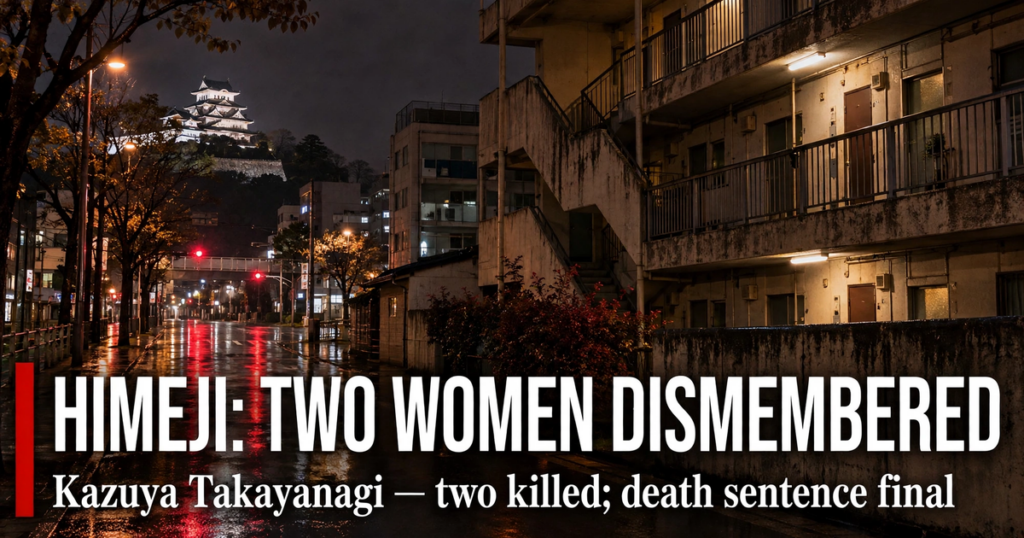
Two young women disappeared in January 2005
In January 2005, Mika Hatafuji and her friend Etsumi Tanigawa, both aged 23, stopped communicating with people close to them. Hatafuji's family became concerned and sought information from Kazuya Takayanagi, who had presented himself as her boyfriend. They found his explanations unsatisfactory and began tracing her movements and relationships themselves. The later court findings established that Takayanagi killed both women at his home in Aioi, Hyogo Prefecture, on 9 January 2005. Their remains were later divided and abandoned at several locations.
Takayanagi had misrepresented his background to Hatafuji
According to the Supreme Court findings summarized in the Japanese article, Takayanagi had presented himself to Hatafuji as the son of a wealthy family. He sometimes gave her money, reinforcing the image he had created. On the day of the killings, Hatafuji demanded more money and pulled his hair during an argument. Takayanagi became enraged and killed her. The court acknowledged that her words and actions had contributed to the confrontation, but emphasized that the dispute arose from Takayanagi's own deception. It did not regard that circumstance as a substantial justification or mitigating explanation.
Tanigawa was killed immediately afterward to prevent disclosure
Tanigawa was staying at Takayanagi's home with Hatafuji. After killing Hatafuji, Takayanagi killed Tanigawa as well. The Supreme Court expressly described the second killing as an attempt to silence a witness and prevent the crime from being exposed. It found no apparent fault on Tanigawa's part that could explain or mitigate the attack. The two women were friends from high school. Tanigawa was not involved in the financial dispute between Takayanagi and Hatafuji, and her presence at the home did not make her responsible for what happened.
The remains were damaged and abandoned at several locations
The court found that both women had been struck repeatedly around the head with a hammer and died. After the killings, Takayanagi damaged their remains around 11 January. Between approximately 13 and 16 January, he disposed of portions at locations including waters in Hyogo Prefecture. The purpose and effect of the disposal were to make identification and discovery more difficult. The Japanese article records the sequence without treating the disposal as a separate spectacle. The legal significance was that the acts formed part of the concealment following two murders.
The victims' family members pursued the inconsistencies
When Hatafuji did not return home and could not be reached, her family asked Takayanagi where she was. His explanations contained inconsistencies. Her relatives began checking her contacts and last known movements. A television Asahi programme, The Scoop, reported in December 2005 on the family's efforts and on assistance from a police officer with extensive investigative experience. The family publicly criticized the initial police response and continued to question the handling of the case after the criminal proceedings. These criticisms form part of the history of the investigation, but they should be distinguished from the facts ultimately established by the courts.
Physical evidence connected the women to the investigation
The investigation eventually recovered portions of the remains, and DNA testing and other identification work connected them to the two missing women. Takayanagi was also prosecuted for violations of the Stimulants Control Act, alongside murder and offences involving the remains. The family's efforts helped bring attention to the inconsistencies in his account, while the criminal case relied on evidence tested in court. The Japanese article treats the family's role as important to the path by which the case came to light, without suggesting that family members themselves made the judicial findings.
The defence disputed intent and the circumstances of the killings
At trial, Takayanagi described the sequence of events but disputed aspects of the manner of the killings and the presence of intent, particularly regarding Hatafuji. The defence argued that a life sentence, rather than death, was appropriate. The prosecution emphasized that two women had been killed, that Tanigawa had been killed to prevent disclosure and that the remains had been damaged and disposed of in an effort to conceal the crimes. The court had to assess the evidence for each victim and the defendant's responsibility for the separate acts.
The Himeji branch of the Kobe District Court imposed death in March 2009
On 17 March 2009, the Himeji Branch of the Kobe District Court sentenced Takayanagi to death, as requested by the prosecution. The judgment placed particular weight on the killing of Tanigawa to silence her after Hatafuji's death, the two deaths and the efforts to prevent identification by disposing of the remains. The defence appealed immediately. The sentence at this stage was a district court judgment, not yet a final sentence.
The Osaka High Court upheld the sentence
On 15 October 2010, the Osaka High Court dismissed Takayanagi's appeal. Issues concerning his mental condition and ability to make decisions at the time of the offences were also considered. The High Court found no basis to alter the first-instance death sentence. Takayanagi then appealed to the Supreme Court, arguing factual error and excessive punishment. The appeal required the Supreme Court to determine whether the lower courts' findings or sentence warranted intervention under the Criminal Procedure Code.
The Supreme Court upheld death while acknowledging the absence of advance planning
On 25 November 2013, the Supreme Court's First Petty Bench dismissed Takayanagi's appeal. The judgment recognized that the two killings had not been planned in advance in a detailed way. It nevertheless found the criminal responsibility extremely serious because Takayanagi killed Hatafuji and then killed Tanigawa to prevent the crime from being exposed. The court also considered the two deaths, the disposal of the remains and Takayanagi's continued unreasonable explanations about the manner of the offences. The death sentence became final.
The two victims' relationship and the final legal findings should remain clear
Hatafuji and Tanigawa were both 23 and had been friends since high school. Hatafuji was the person with whom Takayanagi had a relationship and a financial dispute; Tanigawa was killed after witnessing the first crime. The court's findings treated the second killing as a silencing act, not as an extension of the original argument. Criticism of the police response by Hatafuji's family and the final criminal findings are separate parts of the history. Takayanagi's death sentence was final by 2013; the Japanese article's 2026 update did not report an execution.
Original Japanese record: 姫路2女性バラバラ殺人事件|遺族が追った足取りと高柳和也の死刑確定
Last updated:
Related articles

Case record
The Sendai Yakuza Executives Serial Murders: Two Deaths in One Month and One Death Sentence

Case record
The Gunma Pachinko-Parlor Robbery-Murders: Two Employees Killed for Store Keys and Cash
Case record
The Saitama Dog Breeder Serial Murders: Four Victims, Disappearing Remains and a Third Retrial Petition

Case record