
The Death of Hideaki Noguchi in Naha
Hideaki Noguchi, a 38-year-old executive of HS Securities, died after being found bleeding in a Naha hotel on 18 January 2006, two days after prosecutors searched Livedoor-related offices. Okinawa police concluded that the death was not crime-related; questions were later raised in the Diet.
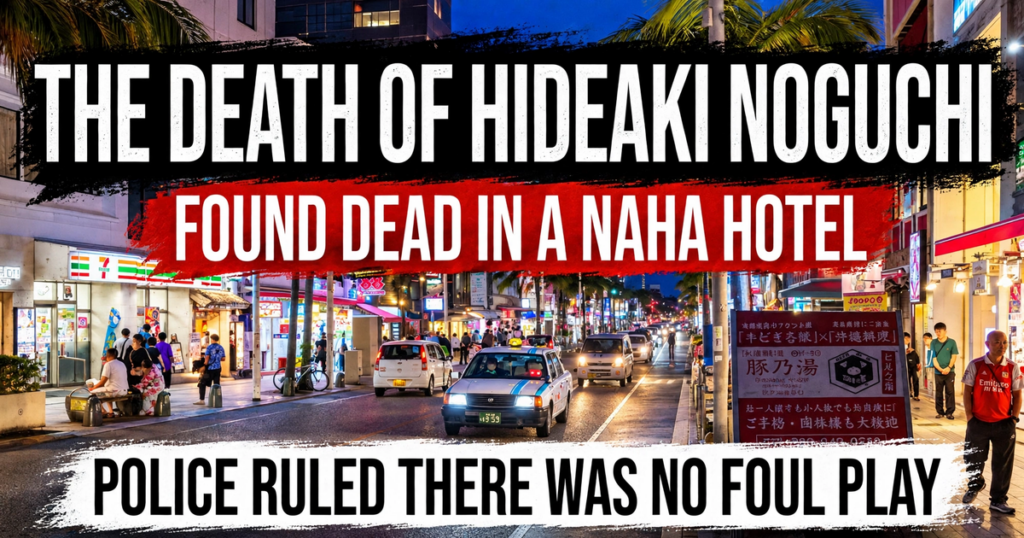
A securities executive was found bleeding in a Naha hotel
Hideaki Noguchi, aged 38, was a senior executive at HS Securities. On 18 January 2006, he was found in a hotel room in Naha, Okinawa Prefecture, bleeding from injuries to his abdomen and other areas. He was transported to hospital, where he died. The date was significant because Tokyo prosecutors had begun searches of Livedoor-related offices on 16 January, two days earlier. Noguchi had been connected through an investment partnership to business transactions involving Livedoor-related companies. The timing drew intense media attention, but temporal proximity alone does not establish that the corporate investigation caused his death or that another person was involved.
The police examined the scene, the body and people connected to the matter
Okinawa Prefectural Police stated that they considered the condition of the body and hotel room, interviewed people concerned and reviewed the findings of an administrative autopsy. Their official conclusion was that the death was not attributable to a crime. A judicial autopsy was not conducted. The police explanation was later repeated in Diet proceedings. It is important to distinguish an administrative autopsy, conducted with the family’s consent in the circumstances described by officials, from a judicial autopsy ordered as part of a criminal investigation. The fact that an autopsy was performed does not itself mean police had concluded that a homicide had occurred.
The Livedoor investigation created a powerful public context
The Tokyo District Public Prosecutors Office searched Livedoor-related locations on 16 January 2006. The following day, media coverage focused on the investigation into the company, and Noguchi’s death on 18 January was widely reported in that context. HS Securities issued a statement on 19 January saying that it was confirming reports about the investment partnership formed and operated by a subsidiary and about Noguchi’s death. The company also said it was checking reports that he had died by suicide. That statement was not a corporate finding about the cause of death. The public discussion combined a major financial investigation with a sudden death, making careful separation of confirmed facts especially important.
The National Public Safety Commission chair explained the police conclusion to the Diet
On 7 February 2006, the House of Representatives Budget Committee discussed the death. National Public Safety Commission Chairman Tetsuo Kutsukake explained that Okinawa police had examined the body, the scene and statements from relevant people, and had concluded that the death was not crime-related. The National Police Agency’s Criminal Affairs Bureau also stated that police had examined the matter from various angles because of the high-profile Livedoor investigation. Officials said they did not consider the circumstances to require a judicial autopsy as a criminal case. These are the official explanations recorded in the Diet, rather than a judicial determination following a criminal trial.
The administrative autopsy was undertaken with the family’s consent
Officials said that, after examining the scene and interviewing people, police proceeded with an administrative autopsy with the family’s consent to confirm the cause of death carefully. They maintained that the findings did not change the assessment that the death was not crime-related. The absence of a judicial autopsy became a central subject of public questioning. However, it would be inaccurate to say that no autopsy took place. The distinction between the two procedures is material: the police said an administrative autopsy was performed, while a judicial autopsy was not. The official account also says that the autopsy findings were considered together with other investigative material.
Further Diet questions addressed his movements and the handling of belongings
At later Diet questioning, including proceedings on 1 March, members asked about Noguchi’s movements before travelling to Okinawa and about clothing and belongings reportedly left in the hotel room. Police officials said that necessary inquiries into his prior movements had been made, but did not disclose details, citing the deceased person’s reputation and the family’s privacy. There was also a difference between the family-side understanding and the police-side report concerning the return of clothing. Officials said they had been told that valuables and clothing were shown to the family and returned on 19 January, and that the police would confirm the matter if the family made a request. The exchange records questions and differing accounts; it does not prove homicide.
Public suspicion and the official police finding are different kinds of information
The timing of the death, the Livedoor investigation and the questions raised in the Diet led to continuing public suspicion. Some commentators questioned why a judicial autopsy had not been performed and whether the investigation had been sufficiently transparent. Those questions are part of the public history of the case. They do not alter the fact that Okinawa police publicly concluded that the death was not crime-related. Nor does that conclusion erase the existence of questions raised by family members or legislators. A balanced account must preserve both: the official assessment and the existence of public scrutiny of the process.
No murder charge or criminal trial has been publicly announced
As of the source article’s August 2026 update, no person had been publicly arrested or indicted on suspicion of murdering Noguchi, and no criminal judgment had found that he was killed by another person. The case should therefore not be categorised as a proven murder or described as a “silencing killing.” The official public conclusion remains that the death was not crime-related. The questions raised in the Diet concerned the basis and transparency of that conclusion; they did not constitute a finding of criminal responsibility. The distinction between suspicion, investigative classification and judicial determination is essential to an accurate record.
The case remains a death that drew scrutiny, not a judicially established homicide
The public record contains several separate strands: Noguchi’s death in a hotel on 18 January 2006; the searches of Livedoor-related offices two days earlier; the police investigation and administrative autopsy; the official conclusion that the death was not crime-related; and the subsequent Diet questions about the autopsy and the handling of belongings. These facts can be reported without deciding beyond the evidence what happened inside the hotel room. As of the latest source update, no criminal prosecution had transformed the public questions into a court finding. The case is best described as a controversial death investigated by police and examined in Diet proceedings.
The Diet debate addressed the autopsy choice and other unanswered questions
During the 7 February 2006 Budget Committee session, legislator Ritsuo Hosokawa questioned whether a judicial autopsy should have been performed from the outset. The National Public Safety Commission chair responded that some points raised did not correspond to the facts and declined to disclose details on grounds of the deceased’s reputation. On 1 March, legislators also asked about airport footage and a separate fatal assault case involving an organised-crime member. Officials acknowledged that the other case was under investigation but did not confirm a connection to Noguchi’s death. At the end of the session, Chairman Kutsukake stated that he could not think of an explanation other than suicide. This was a parliamentary statement, not a criminal court judgment.
Original Japanese record: 野口英昭氏死亡事案|那覇のホテルで死亡、警察の非犯罪死判断と国会質疑
Last updated:
Related articles
Case record
The Matayoshi Takeo Wanted Case: The 1990 Killing of Two Okinawa Police Officers and an Unresolved Search
Case record
The Ochi Kiyoshi Wanted Case: The Killing of Eiko Ochi and the Disappearance on Kuchinoerabu Island
Case record
The Higashi-Ueno 2-chome Condominium Murder
Case record