
The Okayama Underground-Lake Disappearance: A University Explorer Lost Deep Inside Himezaka Limestone Cave
On January 5, 2008, 21-year-old Hiroki Nagura, a third-year student at Kochi University, disappeared while swimming in an underground lake deep inside Himezaka Limestone Cave in Niimi, Okayama Prefecture. Thirteen people had joined the caving activity, and five, including Nagura, entered the cave. The underground lake lies at the end of a cave system approximately 1.6 kilometres long and is about 32 metres deep. After Nagura disappeared, the other participants returned to the surface and called police at around 6:15 p.m. Police, firefighters and experienced cavers searched until January 10 but did not find him. As of August 26, 2026, he remained missing and the city continued to prohibit entry into the cave.
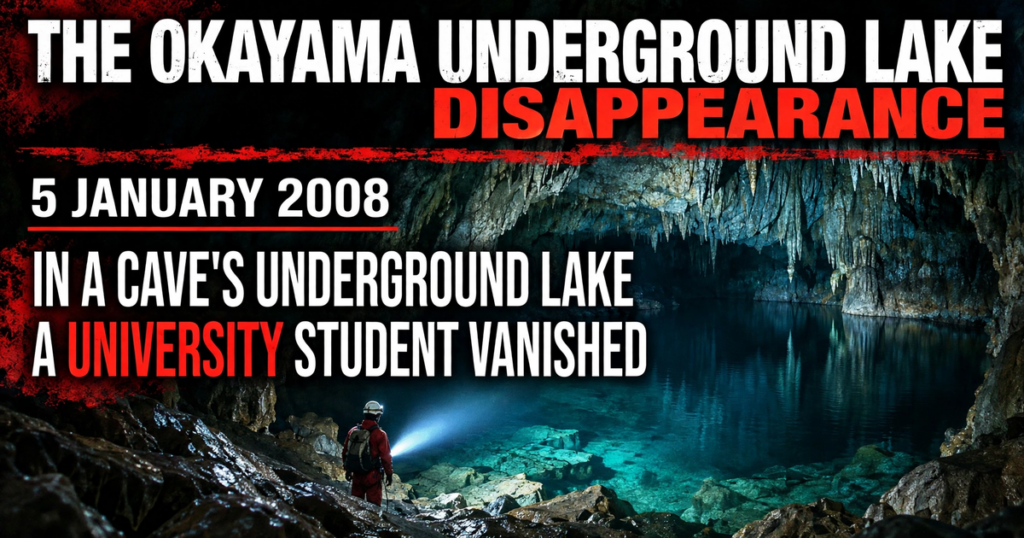
A university student disappeared in an underground lake
On January 5, 2008, Hiroki Nagura, a 21-year-old third-year student at Kochi University, entered an underground lake inside Himezaka Limestone Cave in Toyonaga Akama, Niimi City, Okayama Prefecture. He was taking part in a caving activity connected with a university exploration club. He entered the water and disappeared while swimming. The other participants could not locate him and eventually returned to the surface to report the incident. His body has never been found, and the public record continues to describe him as missing rather than as a person whose remains were recovered.
Thirteen people joined the activity, but only five entered the cave
Accounts based on reporting at the time state that thirteen students and other participants joined the caving activity. Five of them, including Nagura, entered Himezaka Limestone Cave. Nagura was enrolled in the Faculty of Science at Kochi University and participated in its academic exploration club. The distinction between the full group and the five people who went into the cave matters when describing the activity. The article does not identify every participant or establish misconduct by any of them, and the translation does not speculate about individual decisions made inside the cave.
Himezaka is a difficult cave system, not a tourist cave with a lit walkway
Himezaka Limestone Cave extends approximately 1.6 kilometres from its entrance to the underground lake at its deepest point. The lake is about 32 metres deep. Niimi City's cultural-property information describes a steep descent of nearly 100 metres from the area near a shrine to a large cave opening approximately 15 metres high and seven metres wide. From there, underground passages continue toward the lake. This is very different from a commercial tourist cave with a prepared path and lighting. Equipment and rescue supplies must be carried through a long, confined route.
The group reached the lake at the far end of the cave
The five participants moved through the cave and reached the underground lake during the afternoon of January 5. Nagura entered the water and disappeared while swimming. The Japanese Cave Association's accident record classifies the event as a drowning incident during swimming in an underground lake, with the participant's status recorded as missing. That description is not the same as a judicial determination of death or recovery of a body. The translation therefore describes what happened in the water and the subsequent disappearance without claiming that remains were found.
The other participants returned to the surface to call for help
After Nagura could no longer be seen, the remaining participants made their way back out of the cave. Reports place the emergency call at around 6:15 p.m. on January 5. The lake was roughly 1.6 kilometres from the entrance, and a person inside the cave could not simply use a mobile phone to contact emergency services from the water's edge. The return journey itself took time. This created a delay between the disappearance and the arrival of outside rescuers, a condition specific to an accident deep inside a cave.
Police, firefighters and experienced cavers searched the underground lake
After the report, Okayama Prefectural Police, Niimi Police Station, firefighters and people with caving experience began search operations. The Japanese Cave Association's record states that police and fire services searched for several days after the participants' call. Specialists familiar with cave conditions also took part. The lake's depth, the long route for carrying diving equipment and rescue supplies, and the confined passages all made the operation difficult. Searchers had to consider not only the possibility of reaching the missing person but also the risk to the people entering the cave.
The search continued until 10 January without finding Nagura
The search did not end on the day of the accident. It continued until January 10, 2008, but Nagura was not found. An underground lake presents different conditions from an open river or surface reservoir. Visibility, the shape of the rock walls and lakebed, the distance from the entrance and the transport of equipment all constrain the search. The Japanese article does not claim that the body was recovered or that the exact location of Nagura was established. The result of the operation was that he remained missing.
The cave accident became part of the Japanese Cave Association's rescue record
The Japanese Cave Association's rescue committee lists the incident among its past accident cases. It records the date as January 5, 2008, the location as a horizontal cave in Niimi City, the activity as university exploration-club caving and the circumstances as drowning while swimming in an underground lake. The outcome is recorded as missing, and the record notes that rescue assistance was requested and police and fire services searched. This is a factual accident record, not a finding of criminal wrongdoing.
Niimi City introduced controls for cave entry and emergency information
For caves where entry is permitted for research, exploration or similar purposes, Niimi City requires an entry notification. The form includes the cave name, entry date, planned entry and exit times, the representative's name and contact details, a list of participants and emergency contacts for each person. The information is shared with the fire department and police so that authorities can know who entered a cave and when they were expected to return. In a remote cave, the time before an incident is reported can affect the conditions under which rescue is possible.
Himezaka remains closed to entry
Himezaka Limestone Cave is treated differently from other caves in Niimi City. The city states that accidents have occurred repeatedly and prohibits entry for the time being. Three other caves that had been restricted from July 2011 were later reopened for limited research and study purposes, but Himezaka remained closed because of the serious accident history. As of August 26, 2026, the city continued the prohibition, and no official announcement had reported that Nagura had been found. The current status is therefore an unresolved disappearance and a continuing entry restriction, not a recovered-body case.
Original Japanese record: 岡山地底湖行方不明事故|日咩坂鐘乳穴の最奥部で消えた名倉裕樹さんと現在も続く入洞禁止
Last updated:
Related articles

Case record
The Goka High School Girl Murder: The Disappearance of Mai Sato After a Summer Festival

Case record
The Muroran High School Girl Disappearance

Case record
The JR Uetsu Main Line Derailment: Inaho No. 14 and the Sudden Gust

Case record