
The Keio Line Stabbing and Train Fire: A Planned Mass Attack and Eleven Attempted-Murder Findings
On October 31, 2021, a man stabbed a 72-year-old passenger aboard a moving Keio Line express train and then set fire to a carriage. Passengers escaped through windows after the train stopped at Kokuryo Station. The court found attempted murder against the stabbed passenger and ten people exposed to the fire, but not against two other passengers named in the indictment. The Tokyo District Court's Tachikawa Branch sentenced the defendant to 23 years in prison in July 2023; neither side appealed.
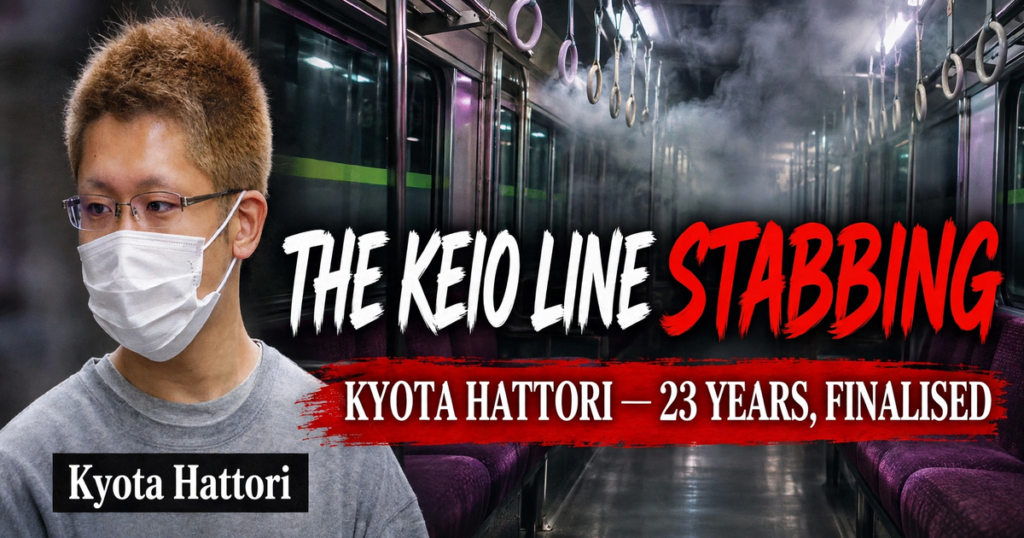
An attack began aboard a moving express train on Halloween night
At about 7:55 p.m. on October 31, 2021, a Keio Line express train was travelling between Chofu and Kokuryo in Tokyo. The date was Halloween, and the train was carrying ordinary passengers returning home. Kyota Hattori attacked a 72-year-old male passenger in the third carriage with a large knife. The victim suffered serious injuries, including a traumatic chest injury, and required about three months of medical treatment. The attack then moved beyond the initial stabbing and developed into a planned attempt to kill more people on the train.
The defendant had prepared weapons and flammable materials
The court found that Hattori had planned to kill multiple passengers aboard a moving express train. He brought a knife, lighters, lighter fluid and an insecticide spray. The judgment linked his decision to kill with personal setbacks, including the end of a relationship and difficulties at work. Those circumstances were part of the court's account of his thinking; they did not excuse the attack. The preparation of several items and the decision to carry out the plan in a crowded train were central to the seriousness of the conduct.
Lighter fluid was spread near the connection between two carriages
After stabbing the passenger, Hattori moved through the train. He saw a group of passengers gathered near the connection between the fifth and sixth carriages. He poured lighter fluid toward them and ignited it with a lighter. The flames and thick smoke created an immediate danger in an enclosed space where passengers had limited routes of escape. Although the fire did not spread widely, the court examined the danger at the time the lighter was ignited, not simply the eventual size of the burned area.
Passengers escaped as the train stopped at Kokuryo Station
The train made an emergency stop at Kokuryo Station. Because the train did not stop in a position that allowed passengers to use the normal doors in the expected way, some people opened windows and climbed out onto the platform. Video of passengers escaping through windows became one of the most widely seen images of the incident. The fire caused no deaths, and the archive does not report additional injuries from the flames. The fact that passengers escaped does not mean that the act was harmless: the court considered the risk created by fire and smoke in a crowded carriage.
The court examined attempted murder passenger by passenger
The prosecution argued that the fire amounted to attempted murder against twelve passengers in the area. The defence did not deny that the defendant had committed arson, but disputed whether the act constituted attempted murder against each person. The legal questions included whether the act had reached the stage of an attempt and whether Hattori had the intent to kill the individual passengers. The court did not treat every person named in the indictment as automatically covered by the same conclusion. It examined the positions of the passengers and what the defendant could be found to have known about them.
Ten passengers were included in the attempted-murder findings
The court found attempted murder against ten passengers near the connection between the fifth and sixth carriages. It did not find beyond reasonable doubt that Hattori had recognised the positions and presence of the other two passengers or accepted the risk of killing them. The attempted murder of the 72-year-old man who had been stabbed was a separate count. The judgment therefore identified eleven victims of attempted murder in total: the stabbed passenger and the ten passengers targeted by the fire. The distinction between the twelve people named in the arson-related allegation and the eleven included in the final findings is important.
The Tokyo District Court's Tachikawa Branch imposed 23 years
On July 31, 2023, the Tokyo District Court's Tachikawa Branch sentenced Hattori to 23 years in prison. The prosecution had requested 25 years. The court assessed the knife attack and the deliberate use of fire in a moving train as extremely dangerous, while also applying the specific limits of the attempted-murder findings. The sentence was not a decision by the Tokyo High Court or the Supreme Court. It was the first-instance judgment of the Tachikawa Branch.
Neither side appealed, so the first-instance sentence became final
The prosecution and the defence both had the opportunity to appeal, but neither filed an appeal by the deadline of August 14, 2023. The 23-year sentence therefore became final in August 2023. It would be inaccurate to say that a higher court reviewed and upheld the sentence. The legal result became final because both sides accepted the first-instance judgment by not appealing. The procedural detail matters when describing the final status of the case.
The case exposed the risks of an attack in an enclosed public space
The incident showed how quickly an attack on a train can place many people at risk. Passengers were trapped in a confined space with smoke and fire, and the position of the train relative to the platform doors affected how they could escape. Railway operators reviewed emergency stopping procedures, passenger guidance and coordination with platform-door systems. These operational questions are separate from the criminal court's findings, but both are part of the case's wider significance. The criminal judgment established the defendant's responsibility for the stabbing, arson and eleven attempted murders; it did not find attempted murder against all twelve passengers originally named in the fire-related allegation.
Original Japanese record: 京王線刺傷事件|刺傷と車内放火、殺人未遂の成立人数を分けた懲役23年判決
Last updated:
Related articles
Case record
The Toyokawa Family Five-Person Attack
Case record
The Hino City Two-Child Arson Murders: Yukie Kitamura, Intent and the Life Sentence

Case record
The Shinjuku West Exit Bus Arson: Six Deaths and a Life Sentence After Diminished Capacity Was Found
Case record