
The Murder of a First-Grade Girl in Kobe's Nagata Ward: A Death Sentence Replaced by Life Imprisonment
Six-year-old Mirei Ikuta disappeared in Kobe's Nagata Ward on September 11, 2014. Yasuhiro Kimino was convicted after evidence linked him to the disposal of her remains. A district court imposed death, but the Osaka High Court replaced it with life imprisonment. The Supreme Court rejected the prosecution's appeal on July 1, 2019, leaving the life sentence final.
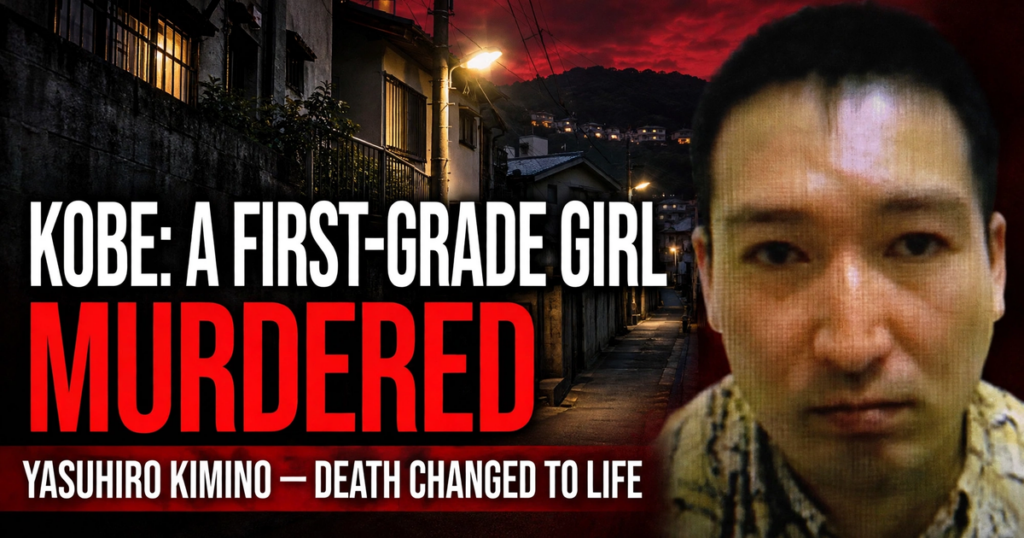
A six-year-old girl disappeared in Nagata Ward
On September 11, 2014, six-year-old Mirei Ikuta disappeared in a residential neighbourhood of Nagata Ward, Kobe, after leaving school. The case began as a search for a missing first-grade pupil. Her family and investigators looked for information about where she had gone, but the inquiry soon shifted toward a nearby residence. The court later found that Yasuhiro Kimino had approached the child near his home and persuaded her to enter his room. Mirei had no prior relationship with him. The fact that a young child was taken from an ordinary neighbourhood setting became central to the case.
The discovery of her remains led investigators to Kimino
Mirei's remains were found in wooded areas after she had been killed. A medical card bearing Kimino's name was discovered in one of the bags used to conceal the remains. Investigators also examined cigarette butts found in the bag; DNA testing linked them to Kimino. These items provided a material connection between the disposal site and the suspect. The evidence did not, by itself, answer every question about the motive or the degree of planning, but it helped identify the person who had been involved. The distinction between evidence connecting a suspect to the disposal and the legal findings about the killing remained important at trial.
Kimino was arrested and the investigation moved into court
Kimino was arrested in September 2014. He initially remained silent, then reportedly began making statements in October acknowledging involvement in the killing and disposal of the remains. His statements during the investigation were not a substitute for judicial findings. The prosecution charged him with sexual-purpose kidnapping, murder, destruction of a corpse and abandonment of a corpse. The proceedings examined both the physical acts and the circumstances in which the child had been lured into the defendant's home. The prosecution also had to establish the elements of the kidnapping offence and the facts relevant to sentencing.
The Kobe District Court imposed the death penalty in 2016
On March 18, 2016, the Kobe District Court, sitting as a lay-judge court, sentenced Kimino to death. The first-instance court assessed the seriousness of the kidnapping and killing, the way the remains were treated and the defendant's responsibility as a whole. It concluded that the death penalty was warranted. This was a first-instance judgment, not the final result. The sentence immediately raised the question of how the case should be compared with other murders involving a single victim, particularly where the killing itself had not been planned in advance.
The Osaka High Court replaced death with life imprisonment
On March 10, 2017, the Osaka High Court quashed the death sentence and imposed life imprisonment. It considered that the killing had not been planned in advance and that the district court had placed excessive weight on some aspects of the defendant's motive and the manner of the offence. The High Court did not deny the kidnapping, murder or the grave harm inflicted on the child and her family. It reconsidered the appropriate punishment by examining the totality of the circumstances and comparing the case with other serious offences. The change was a sentencing decision, not an acquittal.
The Supreme Court left the life sentence in place
The prosecution appealed, arguing that the seriousness of the offence justified the death penalty even without advance planning. On July 1, 2019, the Supreme Court's First Petty Bench rejected that appeal. It accepted that Kimino's conduct was extremely serious and that his criminal responsibility was grave. At the same time, it concluded that the lack of advance planning and the need for consistency with sentencing in comparable cases meant that death could not be said to be unavoidable. The Supreme Court therefore left the Osaka High Court's life sentence intact. The ruling made life imprisonment final.
The Supreme Court did not treat the absence of planning as the only factor
The decision is sometimes reduced to the proposition that a single-victim murder without planning cannot attract the death penalty. That is too broad. The Supreme Court considered the offence as a whole, including the kidnapping, the killing, the treatment of the remains, the defendant's record and the comparison with similar cases. It found the defendant's disregard for life evident, but not so exceptionally pronounced that the ultimate penalty was unavoidable. The ruling therefore addressed the balance among several sentencing factors rather than creating an automatic rule based on the number of victims alone.
The family's response remained distinct from the court's legal reasoning
After the death sentence was overturned, the victim's family expressed profound dissatisfaction with the life sentence. The Supreme Court's task was to apply criminal sentencing principles and maintain consistency across comparable cases. The family's response reflected the permanent loss of a child and the consequences that continued long after the trial. Those perspectives should not be collapsed into one another. Explaining why the courts selected a particular sentence does not diminish the harm suffered by Mirei or her family, and the family's grief does not change the legal sequence of the judgments.
The final legal outcome is a conviction and life imprisonment
The established sequence is clear: Mirei Ikuta disappeared on September 11, 2014; Kimino was arrested and prosecuted; the Kobe District Court imposed death on March 18, 2016; the Osaka High Court replaced that sentence with life imprisonment on March 10, 2017; and the Supreme Court rejected the prosecution's appeal on July 1, 2019. The final sentence is life imprisonment. The Supreme Court did not acquit Kimino and did not restore the death sentence. The case remains an important example of how Japanese courts assess the death penalty in a serious offence involving one victim.
Original Japanese record: 神戸市長田区小1女児殺害事件|君野康弘の一審死刑が無期懲役に変わった理由
Last updated:
Related articles
Case record
The Murder of Le Thi Nhat Linh: A Nine-Year-Old Student, a Community Volunteer and a Life Sentence
Case record
The Hiroshima First-Grader Murder: A Life Sentence After a Complex Appeal and Remand

Case record
The Kobe Nagata Ward Shooting: The Killing of a Security Escort and Hishikawa's Arrest After Nearly Nine Years
Case record