
The Yao Child Death and Concealment Case: Eighteen Years Before Discovery and Two Separate Judgments
Reina Iwamoto, aged six, died after being assaulted by her uncle in late 2006 or early 2007. Her remains were concealed in a concrete-filled case for about eighteen years. Her uncle received a final eight-year sentence for injury resulting in death and corpse abandonment; his partner received a suspended sentence for the separate 2024 corpse-abandonment offence in November 2026.
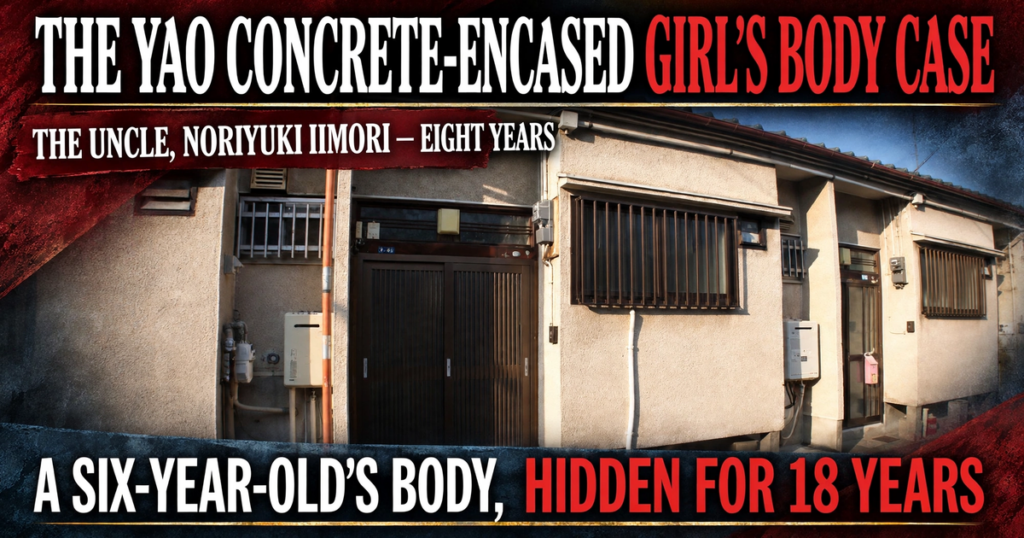
Reina Iwamoto died when she was six, but her death remained hidden for about eighteen years
Reina Iwamoto was born in 2000 and spent part of her childhood living with relatives. By the time she was six, she was living with her maternal uncle in Hirano Ward, Osaka City. The court later found that she died between late December 2006 and early January 2007 after being assaulted by him. Her death was not reported, and her remains were kept in a metal storage case that was covered with concrete. The case was not discovered until February 2025, when it was found in a residential building in Yao, Osaka Prefecture. By then, approximately eighteen years had passed since the child died. The delay made the case not only a criminal investigation but also a question about how a child's disappearance could remain unnoticed for so long.
The child had moved between relatives before living with her uncle
Iwamoto's mother had entrusted her to relatives when the child was young. Her living arrangements changed as adults in the family moved or took on work, and her uncle eventually took her into his home. The 2026 trial examined the circumstances under which he became responsible for her daily care and the financial arrangements between family members. The defense described the burden of caring for a child without sufficient support. The court acknowledged that the uncle had faced difficulties, but it found that he could have sought assistance and that the circumstances did not make violence unavoidable. The existence of family-care pressures did not excuse the assault that caused the child's death.
The removal of the child's residence registration did not itself establish criminal responsibility
In June 2004, the child's grandfather asked Yao City to remove the residence registrations of the mother and Reina, explaining that they were missing. The city removed the registrations in September 2004. The later investigation found that Reina's last known public medical attendance was in March 2005. She had no ordinary school attendance record, and the absence of routine administrative records made it harder for authorities to track her welfare. The city later said that records had passed their retention period, making it difficult to reconstruct the extent of the residence investigation at the time. The removal of the registration is relevant to the background, but no court found that the municipal procedure directly caused the assault or established municipal criminal liability.
The court found that an assault during a reprimand caused the child's death
According to the Osaka District Court judgment, the uncle became angry while reprimanding Reina because she did not follow his instructions. He struck and kicked her, including a forceful kick to her side that damaged internal organs. She died from traumatic shock. The judgment found that the violence continued even though the child was small and unable to protect herself. The prosecution initially investigated the case as murder, and the uncle was rearrested on suspicion of murder on March 21, 2025. However, the final indictment was for injury resulting in death and corpse abandonment, not murder. The court convicted him of those offences. The distinction between a murder suspicion and the offence ultimately proved in court is essential.
Her remains were sealed inside a concrete-covered storage case
After Reina died, her remains were placed in a metal storage case and covered with concrete. The container was kept out of sight, preventing relatives, neighbours and public agencies from knowing that the child had died. The body was not buried through an ordinary funeral process, and the family did not have the opportunity to confirm her death or mourn her. The concealment continued for years as the uncle retained the case and moved it when necessary. The court treated the long-term concealment as a serious part of the corpse-abandonment offence. The passage of time also meant that evidence that might have been available soon after the death was no longer recoverable when the case came to light.
The remains were moved to Yao in November 2024 and discovered in February 2025
On or about November 12, 2024, the uncle moved the concrete-filled case to a residential unit in Yao City, where it was placed in a closet. The case was transported using a trolley. In February 2025, the container was found during work at the residence, and the remains were discovered inside. DNA testing and family information identified the child as Reina Iwamoto. The discovery led police to investigate the long-concealed death and the circumstances in which the remains had been moved. The uncle was first arrested in March 2025 on suspicion of corpse abandonment and was rearrested on March 21 on suspicion of murder. The final charges, however, were injury resulting in death and corpse abandonment.
The uncle received eight years for injury resulting in death and corpse abandonment
The uncle admitted the charges when his trial began on February 26, 2026. Prosecutors sought twelve years' imprisonment, while the defense argued that the family-care circumstances warranted a shorter term. On March 13, 2026, the Osaka District Court sentenced him to eight years. The court found that his assault caused the child's death and that he concealed her remains for years before moving them in 2024. The sentence became final. It is inaccurate to say that he was convicted of murder: although police had rearrested him on suspicion of murder, the prosecution proceeded on injury resulting in death and corpse abandonment, and those were the offences for which he was convicted.
The partner's November 5, 2026 judgment concerned a separate act of corpse abandonment
The uncle's partner, Akari Shibata, was prosecuted only for the separate corpse-abandonment conduct in November 2024. The case did not charge her with the assault that caused Reina's death. Shibata denied knowing that the storage case contained a body and sought acquittal. On November 5, 2026, the Osaka District Court rejected that defense and found that she knew the contents of the case and participated in moving and abandoning it. The court sentenced her to one year in prison, suspended for three years. The court also considered that the uncle had led the operation and that Shibata had been in a subordinate position. As of November 19, 2026, no appeal by Shibata had been confirmed. Her first-instance judgment must therefore not be described as final without further verification.
Original Japanese record: 八尾市コンクリート詰め女児遺体事件|岩本玲奈さん6歳で死亡、18年後発覚と懲役8年
Last updated:
Related articles
Case record
The Higashiosaka University Student Murders: Retaliation, Two Burials and a Final Death Sentence
Case record
The Osaka Sisters Murder: A Planned Robbery, Two Deaths and a Death Sentence Final by Appeal Withdrawal

Case record
The Pepper Lunch Case: A Customer Abducted from a Restaurant and the Twelve-Year Sentence for Its Manager
Case record