
The Inokashira Park Murder Case: 27 Recovered Remains, an Unknown Cause of Death and an Expired Limitation Period
On April 23, 1994, 27 pieces of human remains were found in refuse bins at Inokashira Park. They were identified as belonging to 35-year-old Seiichi Kawamura (川村誠一). The cause and place of death were never established, and the murder limitation period expired in 2009.
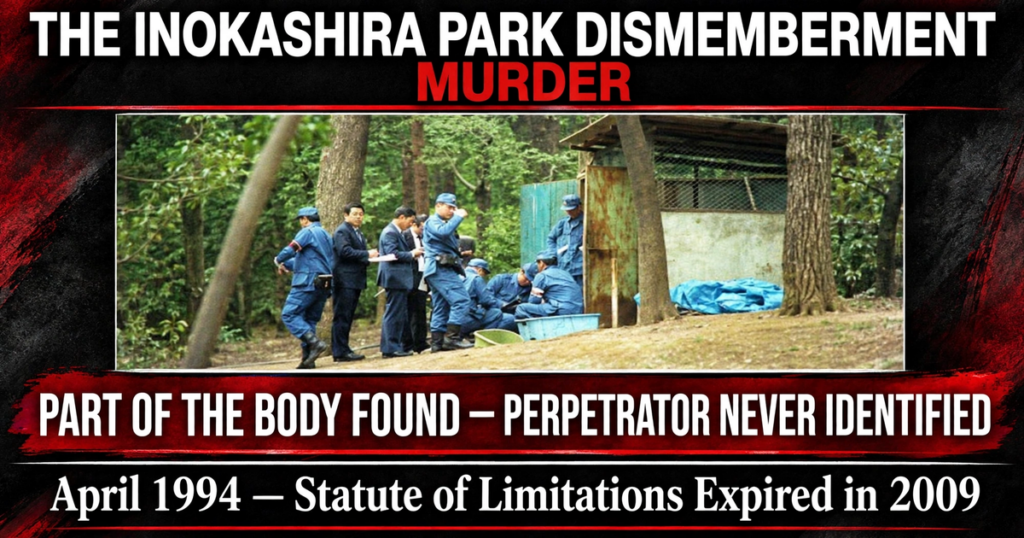
Human remains were found in refuse bins at Inokashira Park
On the morning of April 23, 1994, a cleaner found part of a human foot in a rubbish bag at Inokashira Park, which lies across Mitaka and Musashino in western Tokyo. Police searched the park and found additional remains in several refuse bins around the grounds. Twenty-seven pieces were ultimately identified. The victim was Seiichi Kawamura (川村誠一), aged 35, who lived near the park and worked in the construction industry. The remains had been distributed among more than one bin. Investigators examined the timing of the disposal and possible routes through the park, but they could not identify the place where Kawamura had been killed or where the body had been dismembered.
The number 27 refers only to the pieces recovered
The figure of 27 is sometimes misunderstood as meaning that the whole body had been divided into exactly 27 pieces. The Japanese source makes clear that it is the number of pieces recovered by police, not a count of every part of the body. The head and important internal organs were not found. The missing parts meant that the remains could not provide all the information normally available in a complete forensic examination. Police were able to identify Kawamura, but the discovery did not establish how he had died. The distinction between the number of recovered pieces and the total number of pieces is important when describing the case accurately.
Kawamura's last confirmed movements ended near Shinjuku Station
Two days before the remains were discovered, on the evening of April 21, Kawamura had dinner with an acquaintance. Reports published when the limitation period expired stated that he separated from the acquaintance near JR Shinjuku Station at about 11:30 p.m. His movements after that point could not be reliably reconstructed. His family reported him missing on April 22 because he had not returned as expected. The next morning, his remains were found at the park. Although he lived near Inokashira Park, that fact does not establish that he was killed there. The last confirmed sighting and the approximately day-and-a-half gap before the discovery remained major unanswered questions.
Many pieces were cut to lengths of about 22 centimetres
Forensic pathologist Yoshinobu Sato, who was involved in the examination, later explained that many recovered pieces had been cut to lengths of approximately 22 centimetres. That measurement corresponded to the depth of the circular openings in the refuse bins that were installed in the park at the time. Larger parts appeared to have been adjusted so they could fit through the openings. Sato suggested that the person responsible may have known the design of the bins in advance. This is an expert inference about the disposal method, not proof of the offender's occupation or training. The evidence does not establish that the person was a medical worker, butcher or member of an organised group.
Blood had been removed and areas bearing fingerprints were damaged
The recovered remains were described as having been drained of blood. Areas of the hands that could retain fingerprints had also been damaged. These circumstances suggested an effort to make identification more difficult. Even so, investigators were able to identify Kawamura. The treatment of the remains has led to theories that the offender possessed specialist knowledge, had access to particular equipment or worked with several accomplices. None of those theories was established by a criminal trial. The observed facts are the condition of the remains and the way they were placed in the bins. The offender's identity, occupation, number of participants and motive were never determined.
The cause and location of death could not be established
The head and major internal organs were missing, leaving forensic examiners without parts needed to determine the medical cause of death. Police investigated the case as a murder, but the exact fatal act was never identified. The park was the disposal site where the remains were found; it was not established as the place of killing or dismemberment. Investigators considered that the body might have been processed elsewhere and then transported to the park. No location containing decisive blood evidence or tools directly connected with the killing was identified. The case therefore retained several separate unknowns: how Kawamura died, where he was killed, where the body was cut, who carried out the acts and why he was targeted.
A large investigation did not produce an identified suspect
The Metropolitan Police Department investigated Kawamura's relationships and movements and reportedly deployed a cumulative total of approximately 37,000 investigators over the fifteen-year period. About 250 pieces of information had been received by the time the limitation period expired. The 37,000 figure is a cumulative deployment total, not the number of officers assigned simultaneously. The tips did not lead to an identified offender. The 1995 Tokyo subway sarin attack occurred during the investigation period, and forensic pathologist Sato later described being contacted again by police after that event. The existence of other major investigations does not establish that any one of them caused this case to remain unsolved.
The murder limitation period expired in April 2009
At midnight on April 23, 2009, fifteen years after the discovery of the remains, the prosecution limitation period for murder under the law then in force expired. The offender had not been identified. The expiration did not mean that police had established that a suspect was innocent or that the crime had not occurred. It meant that a prosecution for the murder could no longer be commenced. In 2010, Japan abolished the limitation period for murder and certain other offences resulting in death. The reform applied to cases whose limitation periods had not yet expired, but it did not revive cases where the period had already been completed. Inokashira Park therefore remains an unsolved case in which the legal time limit expired before the reform.
Original Japanese record: 井の頭公園バラバラ殺人事件|22センチに切られた遺体と、死因不明のまま迎えた公訴時効
Last updated:
Related articles
Case record
The Disappearance of Mayumi Arashi: What Is Known, and What the “Do Not Believe Yoko” Note Does Not Prove
Case record
The Wanted Case of Tsuyoshi Yoshiya: The 1999 Ayase Group Attack

Case record
The Hijacking of All Nippon Airways Flight 61: A Captain Killed, 517 People Aboard and a Final Life Sentence

Case record